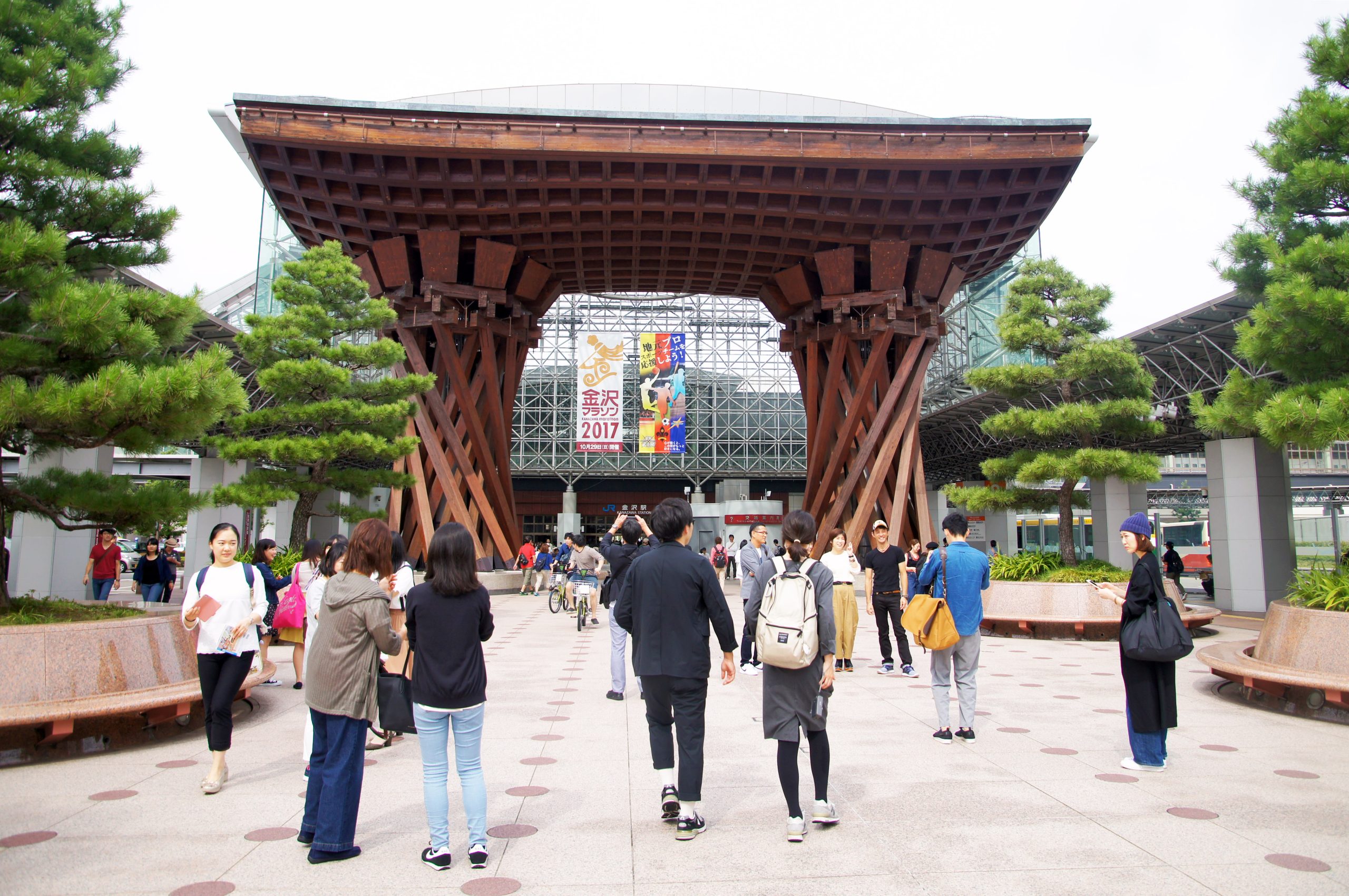
Gary and I stayed in Kanazawa for three nights in September 2017, but only one of those days was spent properly exploring the city. We arrived at the end of a long travel day after detouring to Matsumoto Castle, used another day for a very long trip to Jigokudani and then continued to Osaka.
That left us with one fairly ambitious Kanazawa day: breakfast beneath the huge wooden gate outside the station, Kanazawa Castle, gold-leaf ice cream, Kenroku-en, tea at Shigure-tei, Omicho Market, the old samurai district and Higashi Chaya after most of its shops had closed.
It was busy in places and we reached the final district later than we should have. But Kanazawa still fitted a castle, a famous garden, old neighbourhoods and tea into a city we could explore mainly on foot.
We took this trip in September 2017. Current admission prices, opening hours and transport information were rechecked against official sources in September 2026.
Is Kanazawa worth visiting, and is one day enough?
Yes. If you enjoy gardens, traditional buildings, crafts and historic neighbourhoods, Kanazawa is worth visiting. It also felt very different from Tokyo and Osaka. And although it has its share of temples and traditional buildings, it did not feel like a smaller version of Kyoto.
You can see Kanazawa Castle, Kenroku-en, Omicho Market and at least one of the historic districts in a day. But you cannot see everything without rushing. Two sightseeing days give you time for the 21st Century Museum of Contemporary Art, another chaya district or a craft experience as well.
Our three-night stay sounds longer than it really was. The first day was partly taken up by the journey from Matsumoto and we spent the second full day outside Kanazawa. If I planned the city again, I would still stay for at least two nights, but I would protect one whole day for Kanazawa itself.
Can you visit Kanazawa as a day trip from Kyoto or Osaka?
You can reach Kanazawa and return on the same day, but I would not recommend treating it as a conventional day trip. One sightseeing day is enough for the central sights if you sleep in Kanazawa before or afterwards. It is much less appealing when several hours of that day are spent travelling.
Our one-day Kanazawa route at a glance
- Start at Kanazawa Station and see Tsuzumi-mon Gate.
- Walk to Kanazawa Castle Park.
- Try gold-leaf ice cream near the castle and garden area.
- Explore Kenroku-en and stop for tea at Shigure-tei.
- Walk through Omicho Market.
- Visit Nagamachi and the Nomura Samurai Residence.
- Finish in Higashi Chaya District, preferably before its shops close.
This is the broad order I can reconstruct from our 2017 trip. I no longer have every turn or exact time, so I have not invented a minute-by-minute schedule.
This is the route we followed. If I did it again, I would make it more efficient: go straight to Kenroku-en early, before the paths became so busy, and make sure we reached Higashi Chaya while its shops were still open.
If you choose matcha at Shigure-tei, the named paid stops on this route currently come to 2,050 yen per adult when you use the 500-yen Kenroku-en+1 ticket for Kenroku-en and the paid castle buildings. That total also includes the Nomura Samurai Residence, but not food, gold-leaf ice cream or transport.
What makes Kanazawa different from Japan’s Golden Route?
Kanazawa is a historic castle city on the Sea of Japan side of Honshu. The Maeda family ruled the Kaga Domain from here during the Edo period and supported crafts, tea and other cultural arts. That history still shows in the castle, garden, samurai district and old chaya neighbourhoods.
If you only have a day, you can still walk between most of the main sights. The official tourism guide places them within about two kilometres of Kanazawa Castle. We walked for most of our day, although the distance from the station to the historic centre was longer than it first appeared.
I would not describe Kanazawa as undiscovered. My memory of it now is calm and fond, but it was busy when we were there. At the time it felt like probably the most touristy place we had visited on that trip. It was still worth it.
How Kanazawa fitted into our Japan itinerary
Kanazawa formed part of the central section of our 2017 route. We travelled there after stopping in Matsumoto to see its castle, stayed close to Kanazawa Station and continued to Osaka afterwards. You can see how it connects with the rest of the journey in our two-week Japan itinerary by train.
We also used Kanazawa as a base for Jigokudani Snow Monkey Park. It was possible, but it was a long day and involved travelling back towards Nagano. I would not sacrifice your only Kanazawa sightseeing day for it.
Our one-day Kanazawa itinerary
This is the route we actually followed as far as I can reconstruct it. I know we visited each of these places. But I am less certain exactly where Omicho Market fitted into the afternoon, so treat this as a sensible walking order and not a timestamped record.
Breakfast beneath Tsuzumi-mon Gate
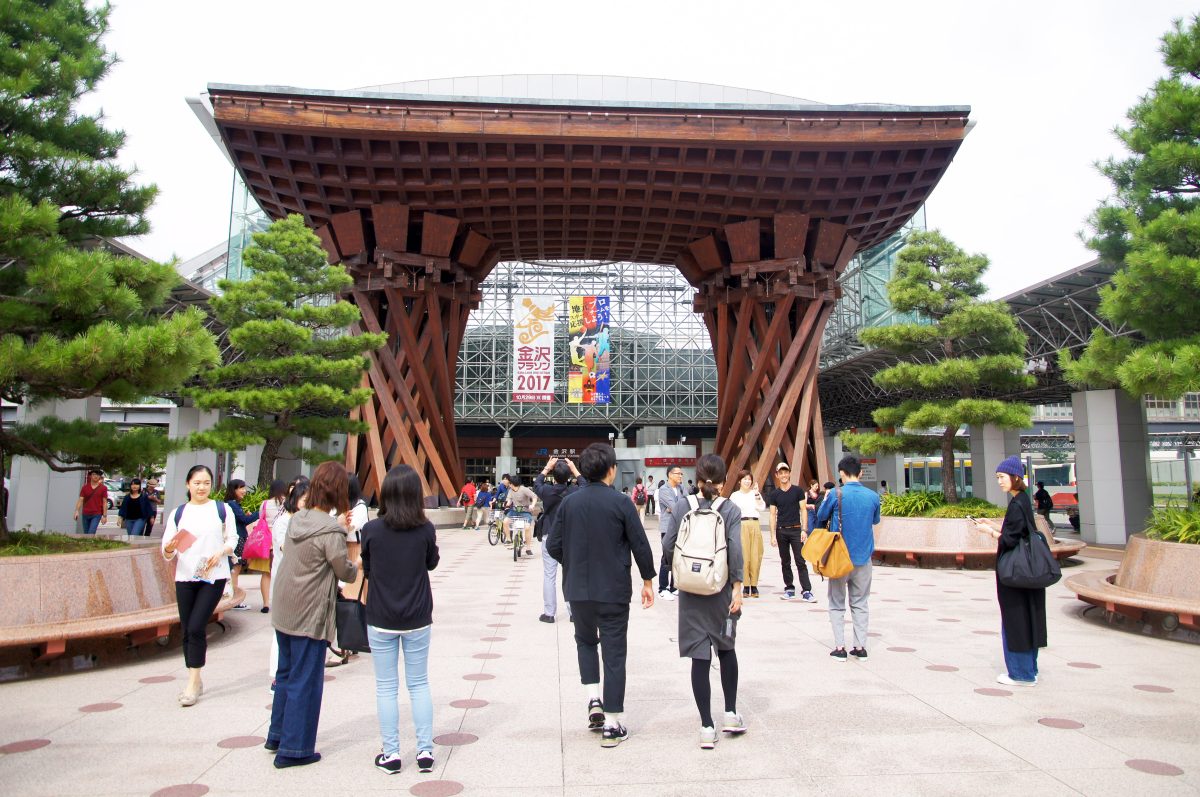
We began outside Kanazawa Station, beneath Tsuzumi-mon Gate. It is difficult to miss: two enormous timber columns curve outwards to support a roof that looks part traditional gateway and part sculpture.
The gate was very grand. Our breakfast was less so. We picked up our usual convenience-store pastries and one of the bottled coffees with cream, then ate in the station plaza. This became one of our standard Japan breakfasts.
Staying near the station made arrivals, departures and our day trip much easier. The compromise was the walk into the castle area, which takes around 25 minutes if you go via Omicho Market.
Kanazawa Castle Park
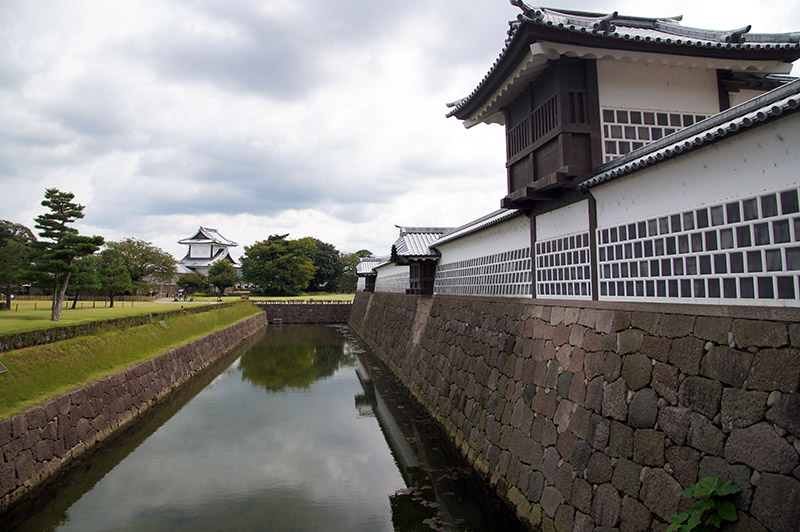
Kanazawa Castle was our first substantial stop. I had remembered it as an entirely rebuilt castle, but that is too blunt. Much of the present complex has been reconstructed or restored, while several historic gates and structures survived. Restoration work is also continuing, so what you can enter may change.
As an architect, I found the displays explaining the building techniques more interesting than I expected. A reconstructed building can sometimes feel a little empty once the exterior photograph has been taken. But I became much more interested once I could see how the buildings had actually been put together.
The site is large. It was also fairly crowded when we visited, so allow more time than a quick look at the map suggests. The castle park itself is currently free. The reconstructed Hishi Yagura, Gojikken Nagaya and connected buildings have a separate admission charge, listed as 320 yen for adults when checked in September 2026.
There was scaffolding in places too. At the time, we assumed some of the work we kept seeing around Japan was preparation for 2020, although it did not cover the entire castle complex. Even with the crowds and building work, it still felt relaxing. I remember telling my mum that it was relaxing, but not so relaxing that I became bored. That is probably still the best description of it.
Gold-leaf ice cream
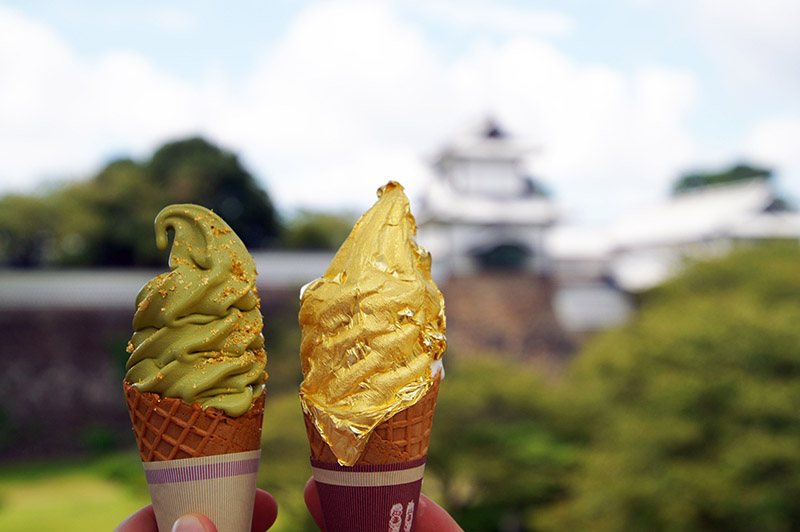
Somewhere around the castle and garden area, we stopped for gold-leaf ice cream. I think we bought it from a stand or small café near the park, but I cannot now identify the exact one.
The gold did not taste of anything. It did not feel like anything either. It was simply a very pretty way to turn a soft-serve ice cream into a photograph, which was reason enough for us to buy it.
Kenroku-en Garden
Kenroku-en sits beside the castle and is regarded as one of Japan’s three most celebrated landscape gardens. If you only choose one place to slow down, make it this one. The garden is large enough that racing through it to tick off a few famous views rather defeats the point.
We visited in September. The garden was green rather than covered in blossom, autumn colour or snow, and it was super busy. Even so, the water, bridges, carefully shaped trees and changing views gave it a calmness that the number of visitors did not entirely remove.
Kenroku-en currently costs 320 yen for adults and is open every day. The official hours are 7am–6pm from 1 March to 15 October, and 8am–5pm from 16 October to the end of February.
Tea at Shigure-tei
Inside Kenroku-en we stopped at Shigure-tei for tea. We were the only two guests with the woman who prepared the matcha and seasonal Japanese sweet for us, which made the room feel wonderfully quiet after the busier paths outside.
Gary loves green tea and was much more at home with the matcha than I was. I enjoyed the experience, but I remember the tea being very bitter. The sweet was quite different from the sort of sweet thing we were used to in Britain. I think ours was pink and green and shaped like a flower, although that small detail has become less certain with time.
We have always called this our first tea ceremony. But it was really a formal tea service. The current official information says Shigure-tei does not offer a hands-on tea-making experience. Matcha with an original seasonal sweet now costs 1,000 yen, while sencha with a Japanese sweet costs 500 yen. Tea is normally served from 9am–4.30pm, with last reception at 4pm and a cleaning closure from noon until 1pm.
Do not leave Shigure-tei until the very end of the afternoon. Its tea service finishes before Kenroku-en closes, and it may also be unavailable during private bookings.
Omicho Market
We also walked through Omicho Market. I do not remember buying a specific dish there or exactly what we stopped to look at, so I am not going to manufacture a food crawl from a walk-through.
Omicho has been part of Kanazawa’s food culture for more than 300 years and now contains fishmongers, produce stalls, grocery shops and restaurants. The official visitor information gives typical hours of 9am–4pm, although individual businesses vary. Go earlier if eating there matters to you.
Nagamachi and the Nomura Samurai Residence
Nagamachi was one of the places where Kanazawa felt most obviously different from the modern cities elsewhere on our route. We walked between old walls, narrow lanes and former samurai residences, then went inside the Nomura family house.
The area was picturesque and busy. Inside Nomura-ke, we saw the rooms, painted sliding panels and a small garden. I found it easier to imagine people actually living here than I had in the much larger castle buildings.
The Nomura Samurai Residence currently costs 550 yen for adults. It is listed as open 8.30am–5.30pm, closing at 4.30pm from October to March, with a small number of holiday closures. Check its official page before relying on those hours.
Higashi Chaya District after the shops closed
We finished in Higashi Chaya, the best-known of Kanazawa’s old teahouse districts. The wooden buildings were lovely, but we had arrived late and most of the shops had already shut. This was not exactly our finest bit of itinerary planning. It was still worth walking through. But we would have seen much more earlier in the day.
I also became slightly obsessed with photographing women in the beautiful kimono we saw around the district. I have no idea whether they were working geisha or visitors who had hired kimono. I did not ask. But they looked wonderful against the old wooden streets.
If Higashi Chaya is a priority, move it earlier and put Omicho or the castle grounds later. Many individual shops and cafés keep their own hours, so an evening walk gives you the atmosphere but fewer open doors.
What would I add with a second day in Kanazawa?
Our day covered the sights that mattered most to us, but it did not cover every major Kanazawa attraction. With another city day, I would slow down. I would not try to fit in another tightly packed circuit.
- Return to Higashi Chaya while its shops and teahouses are open.
- Spend longer eating instead of only walking through Omicho Market.
- Visit the 21st Century Museum of Contemporary Art.
- Walk through Kazue-machi, another historic chaya district beside the Asano River.
- Visit Myōryūji, usually called the Ninja Temple. We did not visit it. Advance telephone reservations are currently required.
- Book a proper craft workshop or a more detailed tea experience.
We did not manage any of these. And I would still resist adding all of them to the one-day route. We already reached Higashi Chaya too late by trying to cover a lot.
Where we stayed in Kanazawa
We stayed at HOTEL MYSTAYS PREMIER Kanazawa from 22 to 25 September 2017 in a non-smoking Superior Double room. We paid 38,600 yen in total for three nights, including the 8% VAT charged at the time. No meals were included, which partly explains the convenience-store pastries and bottled coffee the following morning.
It was not a luxury hotel, but the room was spacious and supplied the useful small things we had already begun to expect from Japanese hotels, including toothbrushes and toiletries. The location was especially useful because Kanazawa was not only a sightseeing stop. We arrived by train at the end of a long day, left by train and used the city as a base for a day trip. If your priority is stepping straight into the historic districts each morning, accommodation nearer Omicho Market or the castle would reduce the walking.
How do you get to Kanazawa?
We reached Kanazawa from Matsumoto and later travelled on to Osaka. Current routes are different from some older Japan guides because the Hokuriku Shinkansen now reaches Tsuruga.
The official Kanazawa tourism guide currently estimates about 2 hours 30 minutes from Tokyo by direct Hokuriku Shinkansen. From Osaka, take the Limited Express Thunderbird to Tsuruga and change to the Hokuriku Shinkansen. The two train legs are listed as about 1 hour 20 minutes and 40 minutes. From Kyoto, the listed journey is about 45 minutes to Tsuruga and then one hour to Kanazawa.
From Matsumoto, the current rail route goes via Nagano and takes roughly 1 hour 50 minutes across its two main train legs. Check live timetables for the connection. Those headline times are not door-to-door guarantees.
Our first-time Japan planning guide covers the broader decisions, while our Japan budget guide explains why transport needs to be planned as part of the route rather than added at the end.
How do you get around Kanazawa?
We mainly walked. That worked because the central sights are close together, but it also made the day longer and probably contributed to our late arrival in Higashi Chaya.
The current official walking estimates put Kanazawa Station about 15 minutes from Omicho Market, Omicho around nine minutes from the castle’s Otemon Gate, Kenroku-en about 15 minutes from Nagamachi and about 20 minutes from Higashi Chaya. Those short sections add up.
The Kanazawa Loop Bus links the station with Omicho, Higashi Chaya, the castle and garden area, the contemporary art museum and Nagamachi. A single adult ride is currently 220 yen. The current one-day pass costs 800 yen and is recommended if you expect to ride four or more times. Tickets are not sold on board, so buy it in advance.
If you want to copy our route without finishing quite so late, walk through the compact central area but use the Loop Bus for the station and the final jump to Higashi Chaya.
Can you use Kanazawa as a base for day trips?
Yes. The station location and regional connections make Kanazawa a useful base, which is one reason our hotel choice worked. But not every possible day trip is equally sensible.
We travelled from Kanazawa to Jigokudani Snow Monkey Park. It gave us plenty of monkeys but no snow. The separate guide covers the journey, what September was really like and whether the park is worth visiting outside winter.
Shirakawa-go is a more natural excursion from Kanazawa, with direct highway buses taking roughly 1 hour 15 minutes according to the current tourism guide. We visited it on a different trip. OurShirakawa-go day-trip guide explains what we saw. You can also connect onwards through the mountains to Takayama rather than returning to Kanazawa.
When is the best time to visit Kanazawa?
We visited in late September. It was a practical time for walking and the gardens were still green, but we did not have autumn colour or Kanazawa’s famous winter snow scenes.
Spring brings blossom, autumn brings colour and winter brings the yukitsuri ropes used to support Kenroku-en’s trees against heavy snow. Those seasons also attract visitors. I would choose according to the landscape you most want to see, then expect the castle and garden to be busy at popular times.
Current Kanazawa prices and opening hours
These details were checked in September 2026. Opening hours can change for restoration work, private bookings, holidays and weather, so use the linked official sources before travelling.
| Place | Adult price | Typical opening hours |
|---|---|---|
| Kanazawa Castle Park | Park free; reconstructed buildings 320 yen | Park hours vary by season; paid buildings normally 9am–4.30pm |
| Kenroku-en | 320 yen | 7am–6pm, or 8am–5pm in winter |
| Shigure-tei tea service | Matcha 1,000 yen; sencha 500 yen | 9am–4.30pm; closed noon–1pm |
| Nomura Samurai Residence | 550 yen | 8.30am–5.30pm; closes at 4.30pm October–March |
| Omicho Market | Free to enter | Usually 9am–4pm; varies by business |
Our honest verdict on Kanazawa
I remember Kanazawa fondly. It was not the single most memorable stop on that Japan trip, and it was certainly not the crowd-free alternative some descriptions promise. But it gave us one grand garden, a castle whose construction details I genuinely enjoyed, smaller historic streets, a quiet tea service and a completely unnecessary sheet of gold on an ice cream.
Give Kanazawa one full day if that is all your itinerary allows. Stay for two sightseeing days if you want time for museums, crafts and proper meals as well. And please reach Higashi Chaya before the shops close. We did not.