
Africa’s wildlife goes far beyond the Big Five. Some animals are genuinely threatened, while others are widespread but difficult to find because they are nocturnal, shy or confined to habitats that most visitors rarely explore.
This guide covers ten rare and elusive African animals, how to recognise them and the regions where travellers may have a realistic chance of seeing them. Here, “rare” often means rarely seen on an ordinary safari; it does not mean every species below is globally endangered.
Wildlife sightings are never guaranteed. Choose responsible guides, keep a respectful distance and never pressure an animal for a photograph.
Quick guide to these elusive African animals
- Usually active by day: tsessebe, nyala, Narina trogon and blue crane.
- Usually easiest to seek after dark: aardwolf, aardvark, Cape porcupine and pangolin.
- Threatened species in this guide: blue crane, black rhinoceros, African wild dog and all four African pangolin species have recognised conservation concerns.
- Best broad regions: southern and eastern Africa, particularly well-managed protected areas with specialist guides.
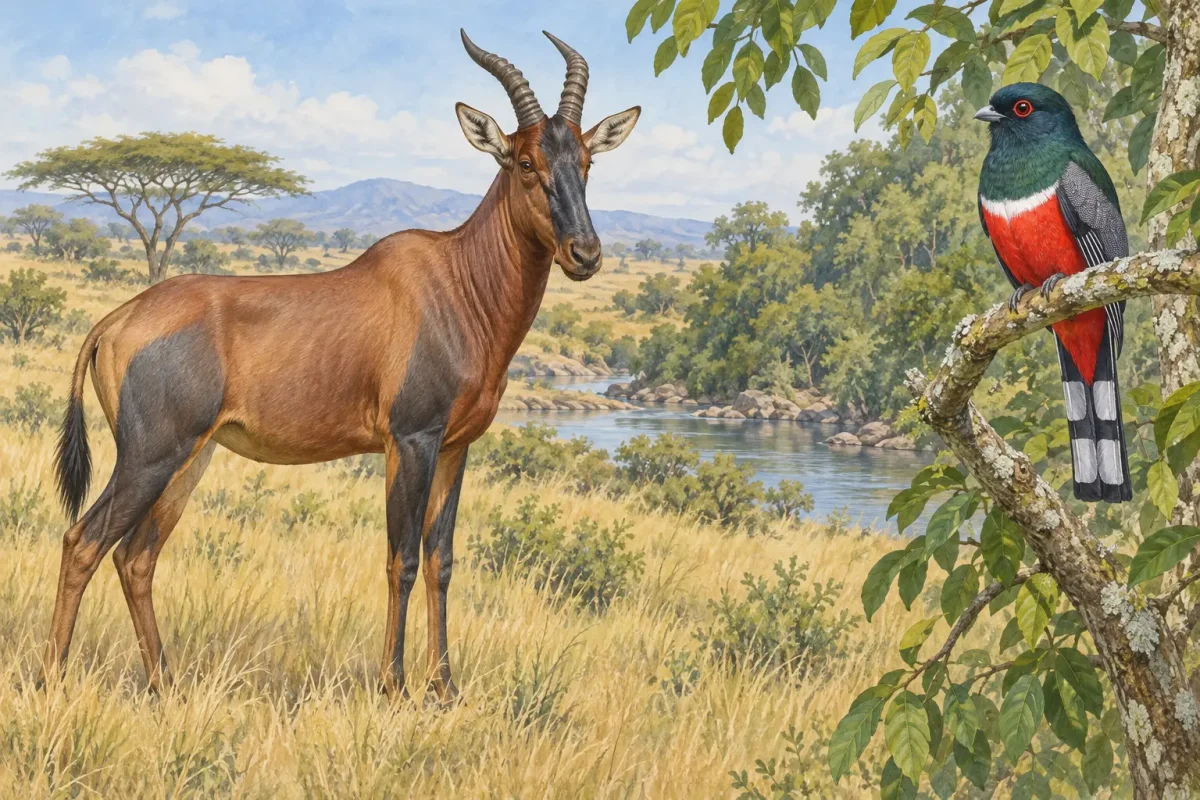
1. Tsessebe: a remarkably fast African antelope
The tsessebe is a large antelope closely related to the topi. Its long face, high shoulders and sloping back give it a slightly unusual outline, while the dark patches on its face and legs make it easier to distinguish from other antelope. Both males and females carry ridged, curved horns.
Tsessebe favour open grasslands and lightly wooded savannah, often remaining close to reliable water. They usually live in small herds, although larger groups may gather where grazing conditions are good. They are frequently described as one of Africa’s fastest antelopes, but published speed figures vary and are best treated as estimates.
Where to look: Northern Botswana—including the wider Okavango and Chobe regions—is particularly associated with tsessebe. They also occur in protected landscapes in Zambia, Zimbabwe, Namibia and northeastern South Africa.
2. Narina trogon: colourful but easily overlooked
The Narina trogon is not globally rare, yet it can be extraordinarily difficult to spot. It spends long periods sitting still inside leafy forest, where the male’s metallic green upperparts disappear into the canopy. The flash of its red breast or movement between branches may reveal it before its shape does.
This is an excellent example of why “rarely seen” and “rare” are not the same thing. A bird may be present throughout suitable habitat but remain unnoticed unless somebody recognises its call and knows which part of the canopy to watch.
Where to look: Forests, wooded valleys and river corridors across much of sub-Saharan Africa. Southeastern Africa, including parts of South Africa and Eswatini, can be rewarding. A local bird guide considerably improves the chances of finding one.
3. Nyala: one species with two very different appearances
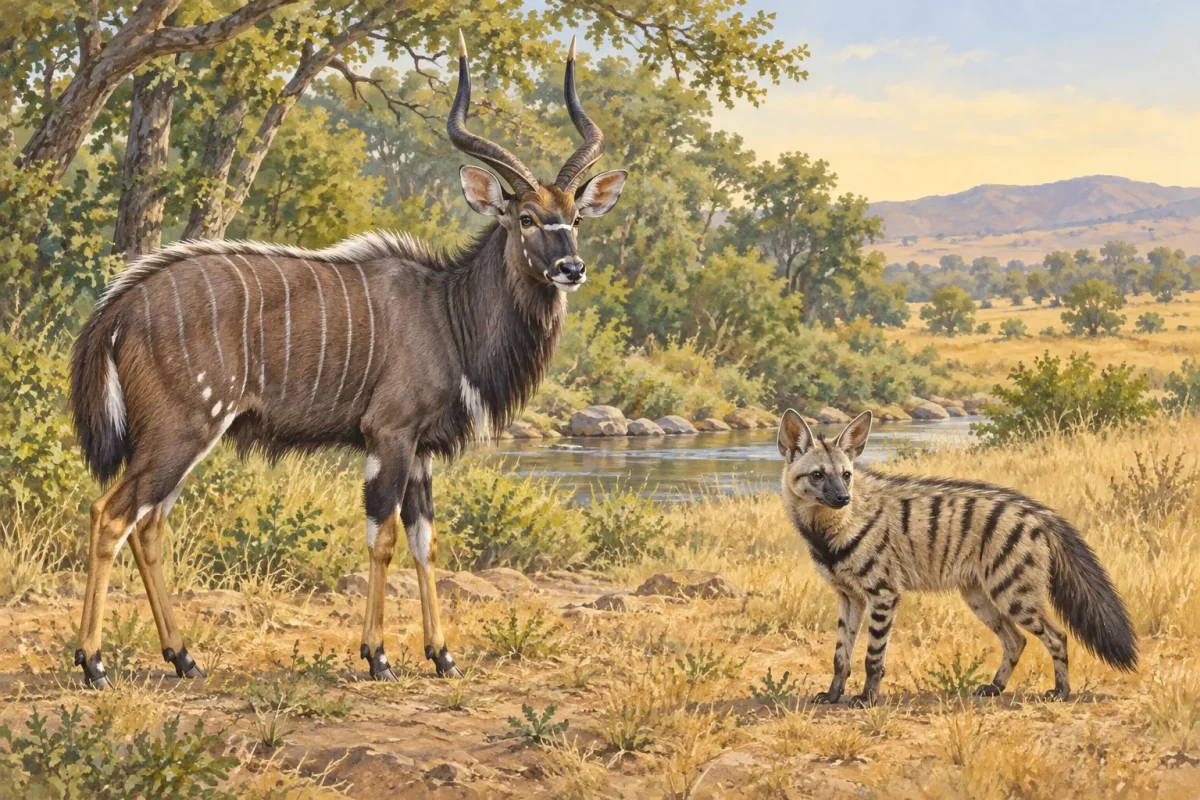
Nyala are shy woodland antelope, normally found close to dense cover. Adult males are dark and shaggy, with pale vertical stripes and long spiral horns. Females are smaller, hornless and chestnut coloured. The sexes look so different that an inexperienced observer could easily mistake them for separate species.
They browse leaves, fruit and shoots and commonly emerge from thickets during quieter parts of the day. In reserves where they are accustomed to vehicles or lodge activity, nyala may appear surprisingly relaxed; elsewhere they can vanish into vegetation almost immediately.
Where to look: Riverine woodland and thickets in southeastern Africa, particularly protected areas in South Africa, Mozambique and Eswatini. Dawn and late afternoon are generally the most productive times.
4. Aardwolf: the termite-eating relative of the hyena
Despite its dog-like name and striped hyena appearance, the aardwolf belongs to the hyena family. It is much smaller and more lightly built than its better-known relatives. Instead of hunting large animals, it feeds mainly on termites, gathering them with a broad, sticky tongue.
Aardwolves are usually nocturnal and spend daylight hours inside burrows. Their dark stripes, upright mane and sloping back are distinctive, but a brief night-time view can still be confused with a jackal or small hyena.
Where to look: Open, dry landscapes in eastern and southern Africa. Specialist night drives in suitable areas of South Africa, Botswana and Namibia provide the most realistic opportunity. Tswalu in the Kalahari and Samara in the Karoo have long been associated with searches for elusive nocturnal wildlife, although no operator can guarantee a sighting.
5. Aardvark: Africa’s extraordinary “earth pig”
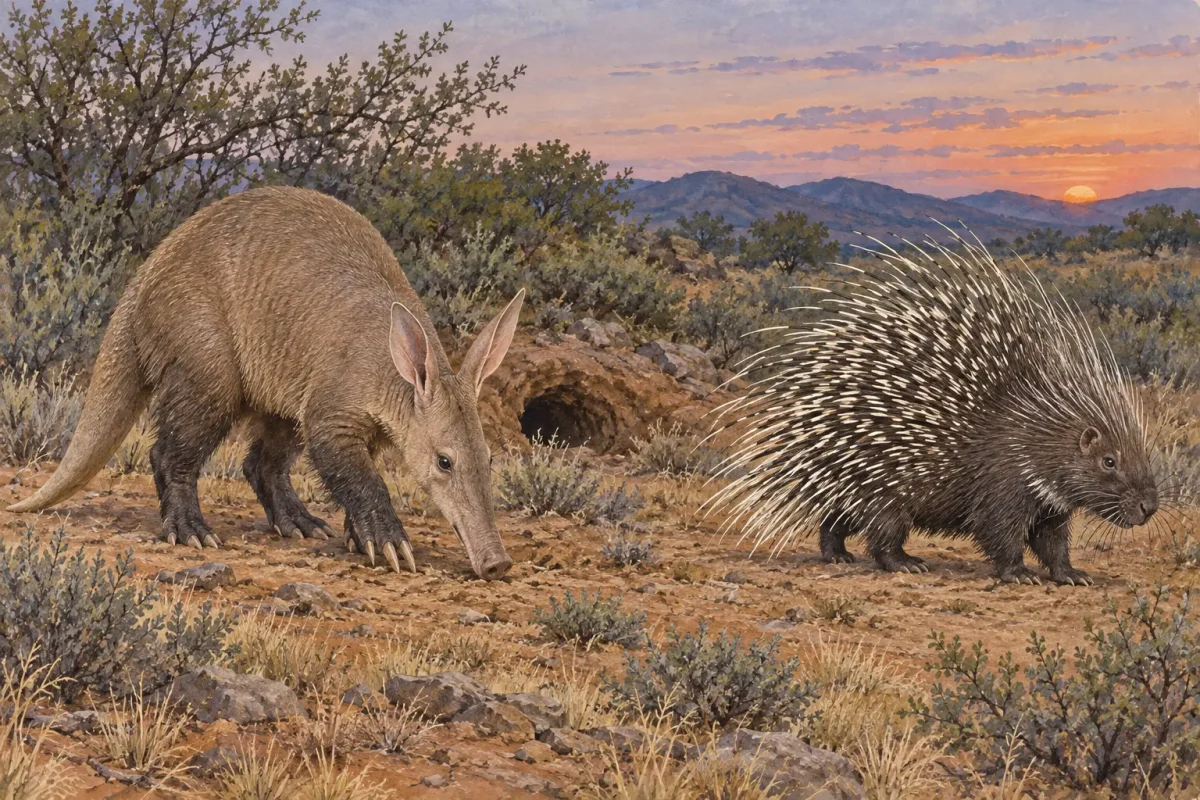
The aardvark is the only living species in its order. It is not a pig or an anteater, despite its nickname and ant-eating habits. Its powerful claws break into termite mounds, while its elongated snout and tongue help it reach insects inside narrow tunnels.
During the day an aardvark normally sleeps underground, sometimes in a burrow extending several metres. Its abandoned burrows are important shelters for many other animals. Because aardvarks are solitary, nocturnal and often travel quietly, even experienced guides regard a sighting as exceptional.
Where to look: The species occurs across much of sub-Saharan Africa wherever the soil is suitable for digging and ants or termites are plentiful. Carefully managed night drives in the Kalahari and Karoo are often recommended, particularly during cooler periods when animals may emerge before complete darkness.
6. Cape porcupine: Africa’s largest porcupine
The Cape porcupine is one of Africa’s largest rodents. Its back is protected by a mixture of long, flexible spines and shorter, heavier quills. Contrary to a persistent myth, porcupines cannot shoot their quills. Loose quills may detach when touched, and a threatened animal may reverse towards a predator with its quills raised.
Cape porcupines are mainly nocturnal and feed on roots, bulbs, bark, fallen fruit and other plant material. Tracks, digging and shed quills are often seen more frequently than the animals themselves.
Where to look: They occupy varied habitats across southern and parts of central and eastern Africa. Night hides and responsible after-dark drives are more promising than daytime safaris. Okonjima in Namibia has historically been known for hide-based nocturnal viewing, but current arrangements should always be checked directly.
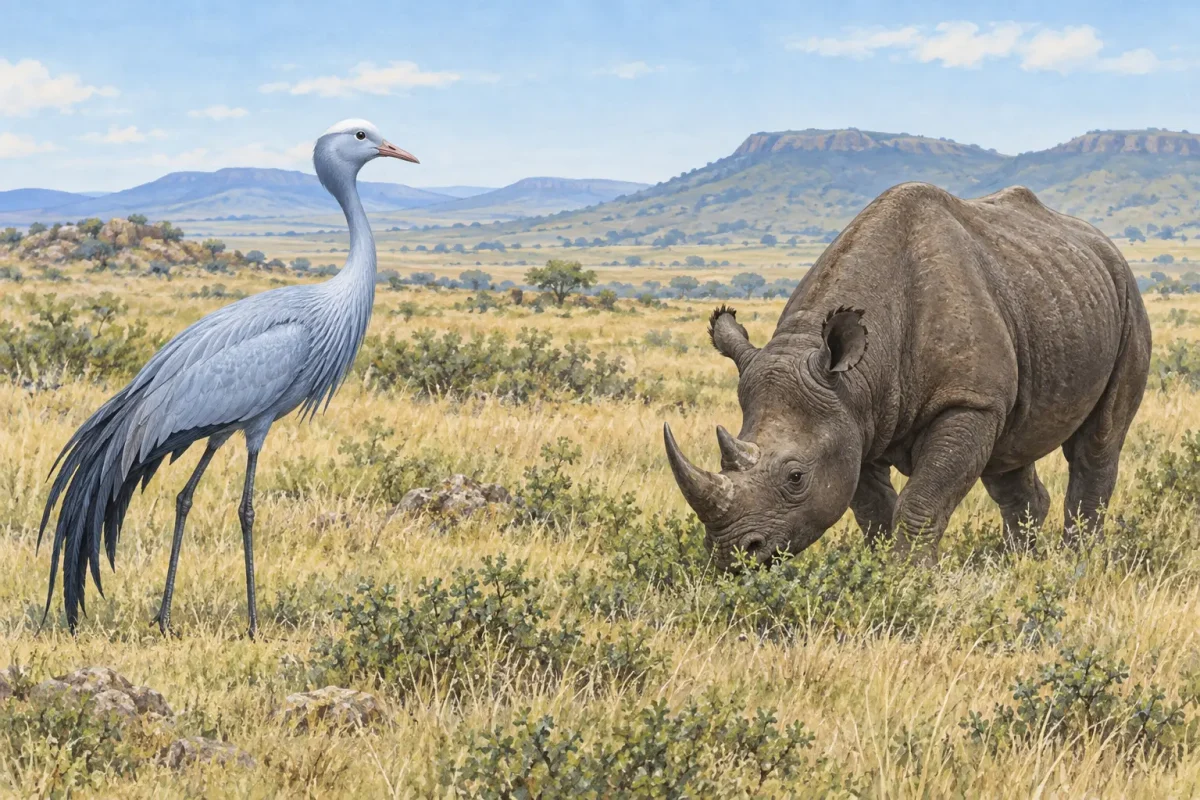
7. Blue crane: South Africa’s national bird
The elegant blue crane is South Africa’s national bird. Its blue-grey plumage, rounded head, long wing feathers and resonant call distinguish it from other cranes. Although it is strongly associated with South Africa, a smaller population also occurs in Namibia.
The species is classed as Vulnerable on the IUCN Red List. Habitat change, poisoning, disturbance and collisions with infrastructure have all contributed to conservation concern. Visitors should remain well away from nests and avoid causing a feeding group to take flight.
Where to look: Open grasslands and agricultural landscapes in South Africa, including parts of the Karoo and Overberg. Local birding organisations and reserve staff can provide recent, responsible viewing information.
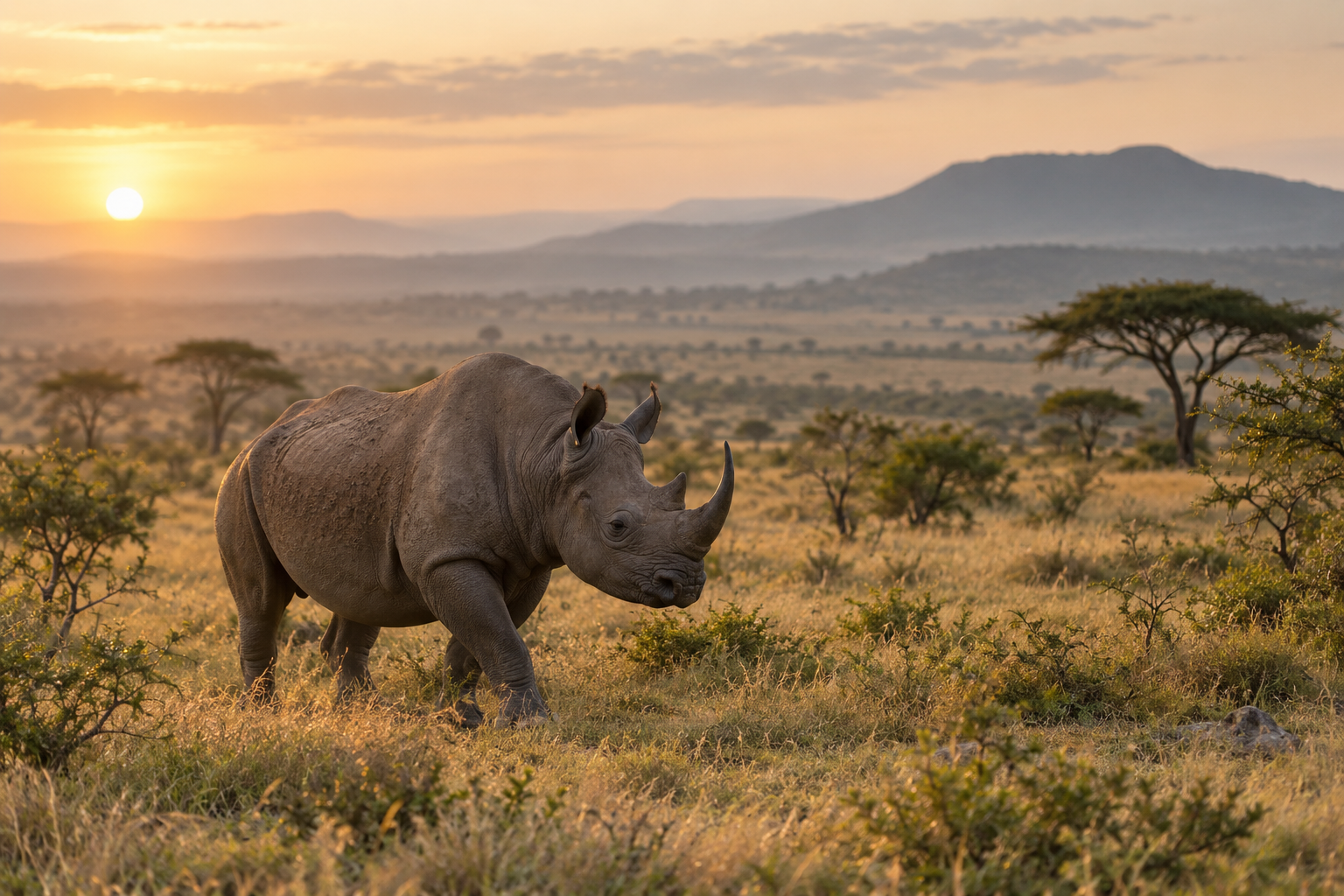
8. Black rhinoceros: a critically endangered browser
The black rhinoceros is Critically Endangered. Despite the name, colour is not a reliable way to distinguish black and white rhinos. The black rhino’s pointed, hooked upper lip is adapted for browsing leaves and twigs; the white rhino has a broader, square lip suited to grazing.
The white rhino species is not extinct. The northern white rhino subspecies is functionally extinct, with two females remaining, while southern white rhinos continue to survive in protected populations. Black-rhino conservation has achieved gains in some areas, but poaching and habitat pressure remain serious threats.
Where to look: Closely protected reserves in Namibia, Kenya, Tanzania, South Africa and Eswatini. Damaraland in northwestern Namibia is known for desert-adapted black rhinos. Always use reputable operators and never share a rhino’s precise live location publicly.
9. African wild dog: the continent’s painted hunter
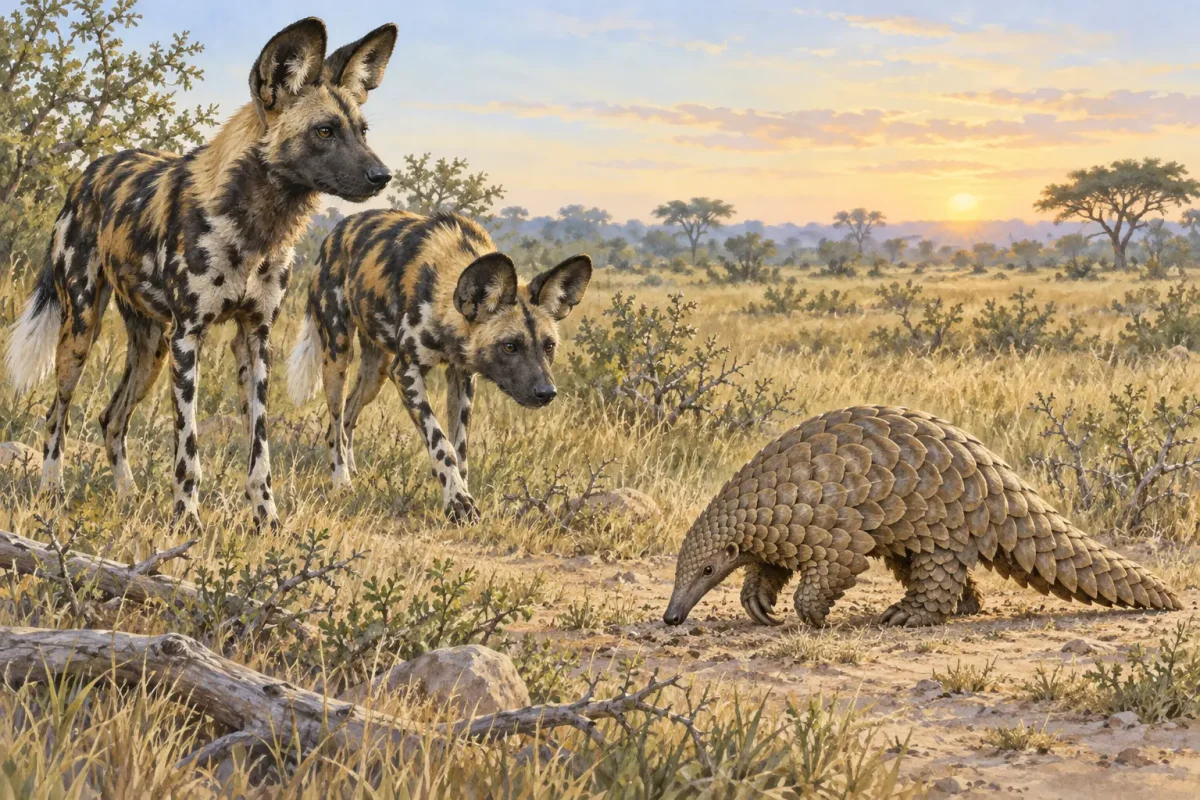
African wild dogs—also called painted dogs—live in close family packs. Every animal has a unique pattern of black, tan and white markings, making individuals recognisable to researchers and guides. Packs cooperate when hunting and caring for pups, sick animals and injured members.
The species is classified as Endangered. Its remaining populations are fragmented by habitat loss and roads, while conflict with people and infectious diseases transmitted by domestic animals create additional pressure. Packs range across very large territories, so they may disappear from one reserve for weeks before returning.
Where to look: Important viewing regions include northern Botswana, Zimbabwe, Zambia, Tanzania and northeastern South Africa. The Okavango ecosystem, Hwange and parts of the Luangwa Valley are widely associated with painted-dog sightings, but finding a pack always requires luck and patience.
10. Pangolin: Africa’s elusive scaled mammal
Africa has four pangolin species: the Temminck’s ground, giant ground, white-bellied and black-bellied pangolins. Their overlapping keratin scales protect most of the body. When threatened, a pangolin curls into a tight ball, leaving its softer underside concealed.
Pangolins feed primarily on ants and termites and are generally solitary. Different species occupy habitats ranging from dry savannah to tropical forest. All pangolin species face conservation threats, particularly illegal trafficking and habitat loss, so sightings and locations must be handled sensitively.
Where to look: Encounters are exceptionally unpredictable. Some reserves and conservation projects in South Africa, Namibia and Botswana monitor or rehabilitate pangolins, but responsible organisations will not stage handling opportunities or promise a sighting. Never support attractions offering pangolin selfies or direct contact.
How to improve your chances of seeing elusive wildlife
- Stay longer: several nights in one wildlife area usually provide more opportunity than rushing between reserves.
- Use specialist guides: tracks, calls and subtle movement are easily missed without local knowledge.
- Ask about ethical night drives: many of these species are nocturnal, but guides should avoid excessive spotlighting or disturbance.
- Manage expectations: choosing a destination solely for one elusive species can lead to disappointment.
- Protect locations: do not publish real-time coordinates for rhinos, pangolins or other animals vulnerable to poaching.
You can explore more ideas through our Africa travel guides, browse our wider destination guides, or use our step-by-step travel-itinerary guide.
Conservation information was reviewed against established sources available before January 2025, including the IUCN Red List and CITES. Conservation status, reserve access and wildlife populations can change, so verify current official guidance before booking. The five wildlife pictures are original AI-generated editorial illustrations and should not be used as precise field-identification plates.




That was awesome ? I was studying African animals so I decided to see this website IT IS THE BEST WEBSITE EVER!!!!!!!!!!!!!!!!!!!!!!!!!!!!!!!!!!!!!!!!!!!!!!!!!!!!!!!!!!!!!!!!!!!!!!!!!!!!!!!!!!!!!!!!!!!!!!!!!!!!!!!!!!!!!!!!!!’!!!!!!!!!!!!!!!!!!!!!
very good collections
I haven’t seen any of those and I want to see them all!! The Nyalas look beautiful.
I am gonna quote this in my research essay.
Warm regards. Are you currently a qualified journalist?
This is fantastic.
Great post. I enjoyed walking among the nyala in Mlilwane, Swaziland.