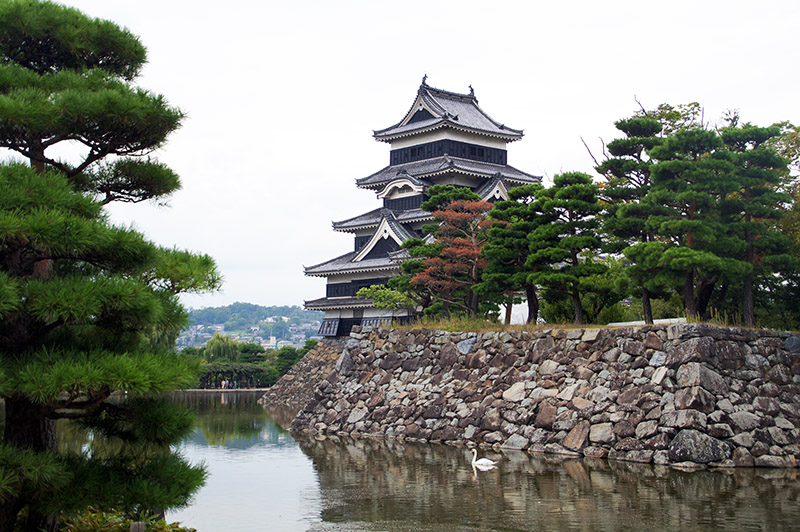
Gary and I visited Matsumoto (松本) on 22 September 2017 while travelling from Tokyo to Kanazawa. We had collected our Japan Rail Passes, booked the journey west and then decided to take what I described at the time as “a little detour” to Matsumoto Castle.
It was not little. We spent a long day on trains, reached Kanazawa that evening and somehow inserted a six-storey castle into the middle. Apparently travelling directly to our hotel lacked sufficient complication. Of course it did!
But the detour worked. Matsumoto’s black castle, moat and grounds gave the travel day a purpose beyond changing trains. The centre was compact enough to explore without staying overnight, too. If you are considering the same stop, this is what we actually fitted in, what I would add with more time and how to continue to Kanazawa without turning the plan into railway origami.
We made this journey in September 2017. Opening hours, admission prices and transport guidance were rechecked against official sources on 23 September 2026.
Is Matsumoto worth visiting for one day?
Yes, Matsumoto is worth visiting for one day if the castle interests you or the city fits naturally into your route. The station, historic centre and main sights are close enough to cover on foot. You can see the castle properly, walk around its moat and add the old merchant streets without manufacturing a frantic dawn-to-dark itinerary.
I would not divert across Japan solely to collect another castle photograph. But Matsumoto makes sense between Tokyo, Nagano, Kanazawa, Takayama or the Japanese Alps. It is particularly useful as a stopover: arrive, leave your luggage, spend two to five hours in the centre and continue.
One day in Matsumoto at a glance
| Best for | Castle history, original timber architecture and a useful stop between larger cities |
|---|---|
| Minimum useful stop | About 2½–3 hours, including the walk from the station |
| Comfortable visit | 4–5 hours for the castle, moat, lunch and the old streets |
| Our route | Tokyo → Matsumoto Castle stop → Nagano → Kanazawa |
| Current castle price | ¥1,200 adult e-ticket or ¥1,300 paper ticket |
| Main warning | The keep has very steep stairs, no lift and roughly 140 steps to the sixth floor |
My verdict: Matsumoto was an excellent stopover, not a substitute for two leisurely days in the Alps. Keep the plan compact and it earns its place.
How Matsumoto fitted into our Japan itinerary
Matsumoto sat between Tokyo and our three-night stay in Kanazawa. We had not booked a hotel there. Instead, we used the city to break up a travel day, then continued north to Nagano and took the Hokuriku Shinkansen west.
You can see the wider route in our two-week Japan itinerary by train. Our next base was Kanazawa, where we followed a fairly full one-day walking route through the castle, Kenroku-en and historic districts.
This is not the fastest way from Tokyo to Kanazawa. The direct Hokuriku Shinkansen is much simpler. But Matsumoto only improves the journey if you actually want to visit Matsumoto—which sounds obvious until route planning makes otherwise intelligent adults treat a railway map like a sticker album.
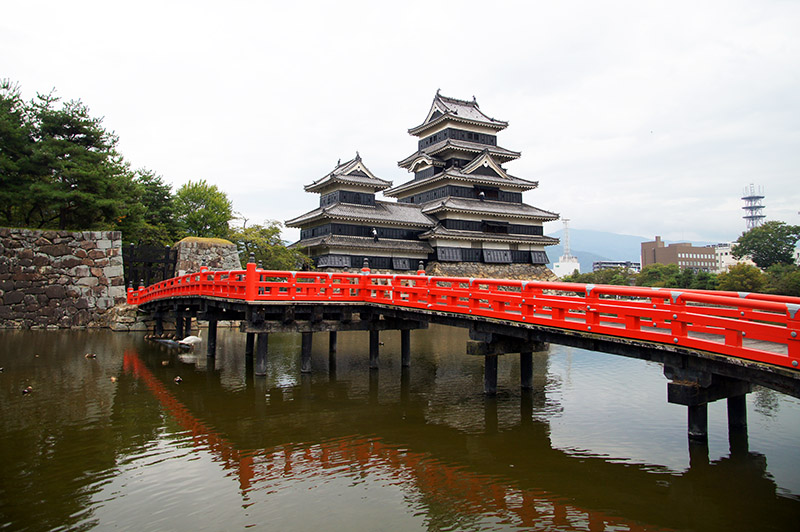
Our castle-centred Matsumoto stopover
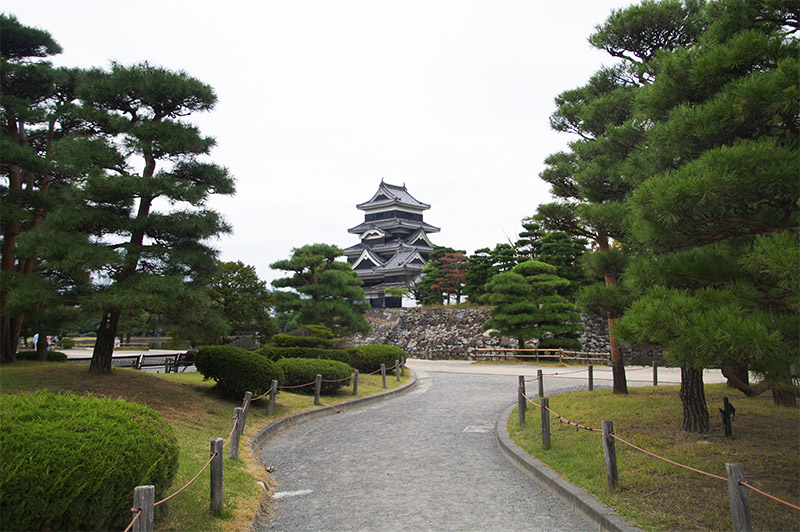
Our visit revolved around Matsumoto Castle, its moat and the surrounding grounds. That is the part of the day I can verify from our itinerary, photographs and messages. An older draft also stretched the stop into a broader city tour, but the evidence becomes thinner there, so I am not going to retrofit an immaculate food-and-museum itinerary onto a day that mainly involved a castle and a great deal of rail travel.
From Matsumoto Station to the castle
Matsumoto Castle is about a 15-minute walk from Matsumoto Station. Leave through the Castle Exit, which is the east side, and the route is straightforward. The Town Sneaker North Course bus takes roughly 10 minutes if walking is difficult or the weather has decided to make itself the main attraction.
For a stopover, leave your bags at the station before you set off. The official city guide lists lockers on three floors of Matsumoto Station. It also says oversized items can sometimes be stored for a fee at the castle management office or tourist information centre, subject to space. Do not build a tight connection around that backup; use a station locker if you can.
The black castle, moat and grounds
Matsumoto Castle is not simply “the oldest castle in Japan”, as I once rather confidently called it. The official description is more precise: its great keep is the oldest surviving example in Japan with five external storeys and six internal floors. Five connected structures form the National Treasure complex.
The dark timber cladding makes it look stern from a distance, particularly when reflected in the moat. Come closer and the composition becomes more complicated: the main keep, smaller north-west tower, connecting passage, south-east wing and moon-viewing tower were not all built for the same purpose or in the same period.
We visited in September, with green trees rather than blossom or snow. A photograph of the castle in winter arrived from my father a few days later and, irritatingly, it did look more picturesque. Naturally! Still, our version came with clear paths, moat reflections and no risk of sliding across ice in socks, so I have decided not to feel too cheated.
Inside Matsumoto Castle
The interior is why the castle deserves more than a circuit of the moat. This is an original timber keep, not a concrete reconstruction with a modern museum hidden inside. You remove your shoes, carry them in a bag and climb through increasingly tight wooden levels.
The stairs are steep enough to stop feeling like stairs. The official maximum angle is 61 degrees, and reaching the sixth floor involves about 140 steps. There is no lift. If you have restricted mobility, poor balance, small children or a heroic amount of hand luggage, admire the exterior instead of allowing a holiday checklist to bully you upwards.
Look for the practical architecture as you climb: narrow openings, heavy posts, weapon displays and the difference between defensive rooms and the later moon-viewing tower. My architectural interest means I can become absorbed by a large piece of joinery while Gary waits patiently for the building to resume being a building. Matsumoto rewarded that tendency.
A realistic one-day Matsumoto itinerary
If Matsumoto is your destination rather than a short stop, use the castle as the fixed point and add the historic streets around it. The timings below leave room to look at things, eat lunch and recover your luggage. They are not an endurance event disguised as a cultural experience.
| Time | Plan | Why it works |
|---|---|---|
| 8.30–10.00 | Matsumoto Castle, interior and moat | Arriving at opening reduces the risk of long queues and gives you time for the steep climb |
| 10.00–10.30 | Walk through the castle grounds | The exterior changes markedly from each side; do not leave after one photograph |
| 10.30–11.15 | Nawate Street and Yohashira Shrine | A compact pedestrian area between the castle and Nakamachi |
| 11.15–12.15 | Nakamachi Street | Old kura storehouses now contain craft shops, cafés and galleries |
| 12.15–13.15 | Lunch | Soba is the obvious regional choice, but choose somewhere you actually want to eat |
| 13.30 onwards | Museum of Art, Former Kaichi School or onward train | Pick one substantial extra rather than racing between all of them |
The Matsumoto City Museum of Art is the strongest afternoon addition if you are interested in Yayoi Kusama, who was born in the city. Former Kaichi School suits architecture and social history. If neither appeals, take the slower option: browse Nakamachi, drink coffee and continue your journey without apologising for the absence of a sixth attraction.
Matsumoto Castle prices, hours and time needed
When checked in September 2026, the official Matsumoto Castle visitor information listed the following:
| Adult timed e-ticket | ¥1,200 |
|---|---|
| Adult paper ticket bought on site | ¥1,300 |
| Child aged 6–15 | ¥400 |
| Children aged 5 and under | Free |
| Regular opening hours | 8.30am–5pm; last entry 4.30pm |
| Annual closure | 29–31 December |
| Typical time inside | 45–60 minutes, excluding queues and a circuit of the moat |
Golden Week, the mid-August Obon period and autumn foliage can bring long waits. The official city FAQ warns that the queue may exceed an hour at busy times. Go soon after opening if the interior matters to you, and allow 90 minutes for the castle complex rather than treating the published 45–60 minute average as a personal challenge.
How to get to Matsumoto and continue to Kanazawa
Tokyo to Matsumoto
The direct Limited Express Azusa runs from Shinjuku to Matsumoto. The journey is usually around 2½ hours, although individual services vary, and ordinary cars are all-reserved. JR East’s live booking system showed ¥6,730 for a standard adult ordinary-class reserved seat when checked for 24 September 2026. Azusa does not have ordinary unreserved-seat cars: its seat-not-specified ticket costs the same as a reserved-seat ticket. Ticketless offers may be cheaper, so use the JR East service information and live booking system for your date.
You can make Matsumoto a day trip from Tokyo, but that means about five hours on trains before you have walked anywhere. I would use it as an overnight destination or an onward stop unless your enthusiasm for timber castles is unusually vigorous.
Matsumoto to Kanazawa
There is no direct Matsumoto–Kanazawa train. Take the Limited Express Shinano to Nagano, normally about 50–55 minutes, then change to the Hokuriku Shinkansen for Kanazawa, roughly another hour. Build in transfer time and check the final connection before entering the castle.
That sequence is how Matsumoto joins this part of our Japan cluster: Jigokudani Monkey Park also branches from the Nagano side, while Takayama and Shirakawa-go connect towards the wider Japanese Alps route.
Our 2017 JR Pass covered the eligible JR legs we used. A rail pass is not automatically good value now, so compare the current pass price with point-to-point tickets. Our Japan travel budget guide explains the broader cost decisions.
When is the best time to visit Matsumoto?
Spring frames the moat with blossom, autumn brings colour and winter offers the possibility of snow against the black keep. Those are the photographic answers. The practical answer is a weekday outside Golden Week, Obon and peak autumn weekends, when you are less likely to spend part of your day watching the queue move one sock at a time.
September was warm, green and perfectly workable for us. It was not the castle’s most theatrical season. But we could walk easily, see the timber against clear reflections and continue to Kanazawa without winter delays. Pretty is not the only useful criterion.
Practical tips for a Matsumoto stopover
- Store your luggage at Matsumoto Station before walking to the castle. Lockers are spread across three floors, so check more than the first bank you see.
- Book the castle’s timed e-ticket if your transfer window is tight. It is currently cheaper than the paper ticket as well.
- Wear shoes that are easy to remove, plus socks you are content to display to an entire queue.
- Do not attempt the keep’s steep stairs if balance, knees or mobility make them unsafe. The exterior and grounds still justify the stop.
- Check your onward train before you begin. The Shinano and Hokuriku Shinkansen are not a turn-up-every-three-minutes metro service.
- Allow extra time during blossom, Golden Week, Obon and autumn foliage.
- If you only have three hours, protect the castle. Nawate and Nakamachi are additions, not reasons to hurry through the National Treasure.
- Carry a small day bag and send large luggage ahead when possible. Our route was manageable; it would have been far less charming while dragging a full suitcase around the moat.
What we would do differently
I would still include Matsumoto between Tokyo and Kanazawa. The castle gave us a memorable centrepiece and turned a necessary travel day into part of the trip. What I would change is the amount of slack.
Next time I would stay one night, arrive at the castle when it opened and leave the afternoon for the Museum of Art or Nakamachi. I would also forward the largest bag. There is nothing character-building about manoeuvring luggage through several rail changes; it merely tests whether your marriage has adequate suspension.
Also, I would resist treating Matsumoto as a collection of nearby attractions. The castle is the reason the stop works. Give it time, then let the rest of the city remain optional.
One day in Matsumoto FAQ
Is one day enough for Matsumoto?
Yes. One day is enough for Matsumoto Castle, its grounds, Nawate Street, Nakamachi and one extra museum or historic building. If you also want Kamikochi, an onsen or a substantial Alps excursion, stay longer.
Is Matsumoto worth a stopover between Tokyo and Kanazawa?
Yes, if you want to visit Matsumoto Castle and can spare at least 2½–3 hours in the city. It is slower than taking the direct Tokyo–Kanazawa route, but it turns a transfer day into a genuine sightseeing day.
How far is Matsumoto Castle from the station?
Matsumoto Castle is approximately a 15-minute walk from Matsumoto Station. The Town Sneaker North Course bus takes about 10 minutes from the station to the Matsumotojo-Shiyakushomae stop.
How long do you need at Matsumoto Castle?
The official average is 45–60 minutes inside. Allow about 90 minutes for the keep, grounds and moat, plus additional queue time during busy periods.
Is Matsumoto Castle the oldest castle in Japan?
It is more accurate to call Matsumoto the oldest surviving Japanese castle keep with five external storeys and six internal floors. It is one of Japan’s original castles and five connected structures are designated a National Treasure.
Is Matsumoto Castle accessible?
The grounds have accessible facilities, but the historic keep does not. Reaching the top involves around 140 steep, narrow steps at angles of up to 61 degrees, and there is no lift.
Visitors who present a disability certificate enter free, together with one caregiver. This does not make the keep itself accessible, but it is useful to know if you plan to explore the grounds and the parts of the site you can reach safely.
Can you store luggage at Matsumoto Station?
Yes. Lockers are available on the first, second and third floors of Matsumoto Station. Oversized luggage may sometimes be accepted for a fee at the castle management office or tourist information centre, but capacity is limited.
Our final verdict
One day in Matsumoto was enough for us to understand why the castle matters and still reach Kanazawa. Our stop was shorter than the itinerary above: a deliberate pause built around the black keep, its moat and the mildly absurd decision to add more stairs to an already long travel day.
I am glad we did it. Matsumoto did not need an inflated list of fifteen attractions to justify the detour. The castle was reason enough. Walk around the moat, look properly, and then go and catch your train.