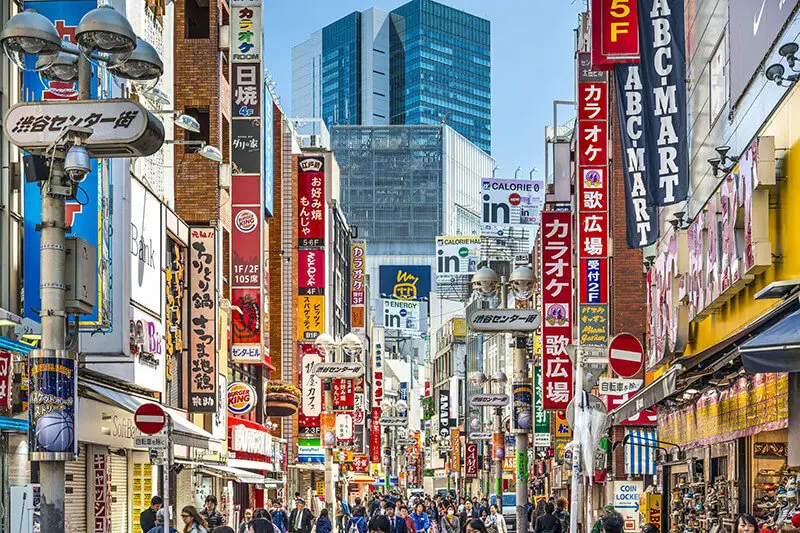
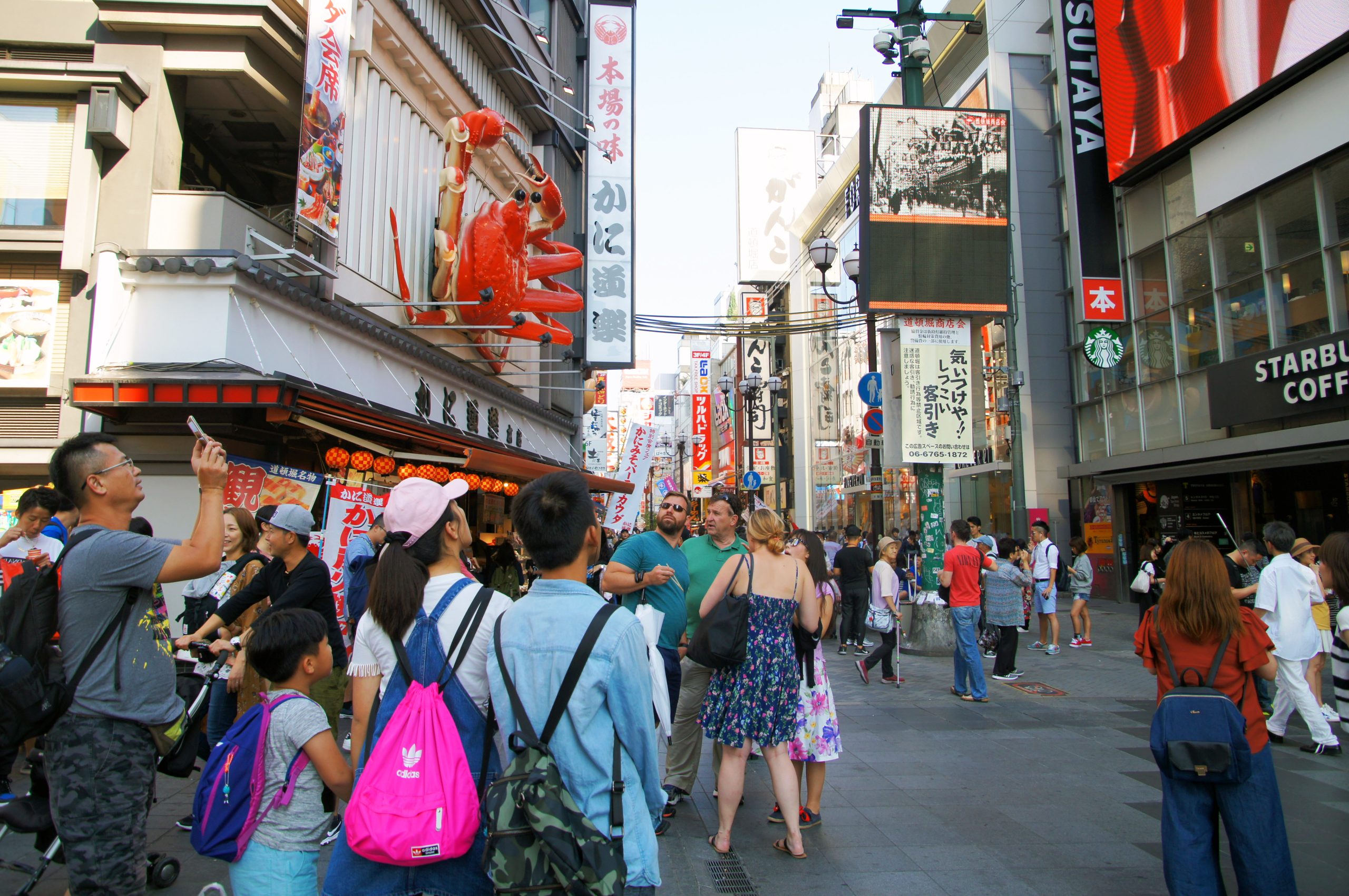
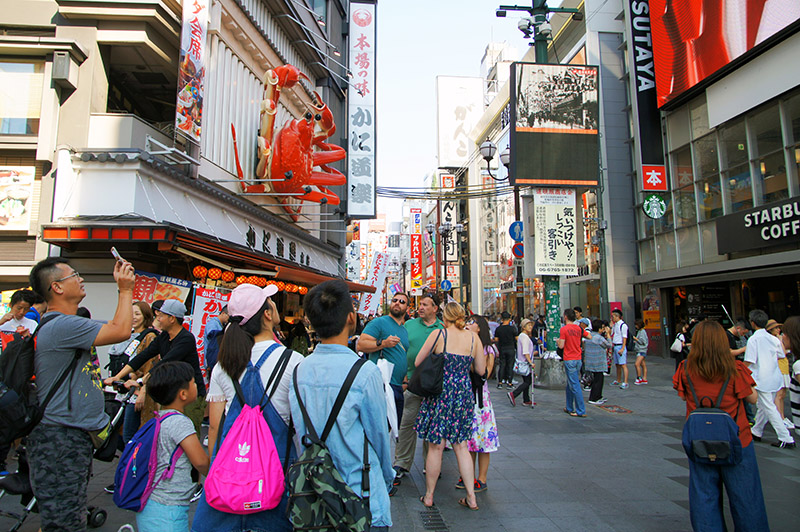
Dotonbori in Osaka is not subtle. A mechanical crab waves above the pavement, the Glico runner appears to be winning a race across the canal and every other restaurant seems to have attached dinner to the front of the building at several hundred times its natural size.
It’s crowded, noisy and shamelessly touristy. We liked it very much.
Gary and I visited Dotonbori in September 2017 during a rather ambitious day that began at Osaka Castle, continued through Shinsaibashi and ended with Kuromon Market and Den Den Town. I had apparently decided that our feet were an unlimited natural resource. Still, the route gave us a useful cross-section of southern Osaka: fashion, food, giant signs, a fish market and an electronics district that we immediately compared with Tokyo’s Akihabara.
This Dotonbori Osaka guide focuses on the canal district. Shinsaibashi is included because its covered arcade leads directly to Ebisubashi; Kuromon Market and Den Den Town appear as optional extensions rather than competing subjects. The route follows what we actually saw and ate, but it also fixes the timing mistake I would not repeat. Practical details and prices were checked against official sources on 24 September 2026. Our reactions are from our 2017 visit, because pretending I remember the price of an individual octopus ball nine years later would be ambitious even for me.
My quick answer: Dotonbori is worth visiting on a first trip to Osaka, particularly after dark. Go for the lights, food and people-watching rather than a peaceful encounter with everyday Japan. Allow two to three hours for Dotonbori itself, or half a day if you walk down through Shinsaibashi and add Hozenji Yokocho. Visit Kuromon Market earlier, while its stalls are open.
Is Dotonbori worth visiting?
Yes. Dotonbori is worth visiting because it concentrates the brash, food-obsessed side of Osaka into a few highly walkable streets beside the canal. You can see the Glico sign, inspect the enormous restaurant mascots, eat something hot from a busy counter and slip into the quieter Hozenji lanes without paying an admission fee.
But it is not an undiscovered neighbourhood. The main strip can be shoulder-to-shoulder, queues form at famous restaurants and some businesses are aimed squarely at visitors. If crowds make you miserable, come on a weekday, arrive before the evening peak and step away from Ebisubashi once you have taken the inevitable running-man photograph.
We found the food delicious and the whole district enjoyably excessive. I would not travel across Japan solely for one street of illuminated signs. I would, however, keep it in a first Osaka itinerary without hesitation. The neighbourhood does exactly what it advertises, and it advertises it with a moving crab.
| Quick fact | What to know |
|---|---|
| Best for | Osaka food, neon signs, evening atmosphere and people-watching |
| Cost | The streets, canal walk, Ebisubashi and Hozenji are free; food and cruises cost extra |
| Best time | Late afternoon into evening, so you see the change after the signs light up |
| Time needed | 2–3 hours for Dotonbori; 4–5 hours with Shinsaibashi and Hozenji |
| Nearest stations | Namba for Dotonbori; Shinsaibashi for the north-to-south shopping walk |
| Our visit | 26 September 2017, during our three-night Osaka stay |
Our Shinsaibashi to Dotonbori walk
We reached Shinsaibashi after visiting Osaka Castle. The change of mood was immediate. We had gone from moats and Toyotomi Hideyoshi to a covered shopping street full of younger shoppers, fashion stores and people who appeared to understand current trends. I did not trouble them with my opinions.
At the time, I described Shinsaibashi as Osaka’s equivalent of Harajuku. That is an impression rather than a literal comparison: Shinsaibashi is a broad retail district, while Harajuku has its own street-fashion history and several quite different pockets. But both gave me the same sense that everyone else had received a clothing memo I had misplaced.
The official Shinsaibashi-Suji guide describes the roofed arcade as roughly 600 metres long with around 380 years of trading history. Walk south through it and you emerge at Ebisubashi, the bridge beside Dotonbori’s Glico sign. It is an easy route to understand, although “easy” does not account for crowds, shop windows or Gary discovering something electronic that required a detailed inspection.
The route at a glance
- Start at Shinsaibashi Station. Enter Shinsaibashi-Suji and walk south through the covered arcade.
- Pause at Ebisubashi. This is the familiar view towards the Glico runner and canal.
- Walk Dotonbori Street. Look for the mechanical crab, octopus signs, food counters and the Kuidaore Taro drummer.
- Drop to the Tombori Riverwalk. The lower promenade gives you another angle on the bridges and illuminated buildings.
- Turn into Hozenji Yokocho. The stone alley and moss-covered Fudo statue are a welcome change of volume.
- Finish around Namba. Eat properly, continue into Ura Namba or take the train when your feet begin collective bargaining.
Our complete two-day Osaka itinerary shows how this walk fits after the castle and where the Osaka Aquarium belongs on a separate day. For a calmer arrival-day stop beside Osaka Station, see our Grand Front Osaka guide.
Things to do in Dotonbori
1. See the Glico sign from Ebisubashi
The Dotonbori Glico sign has existed in several forms since 1935. The official Glico history says the current sixth version was installed in 2014 and its logo was updated in 2022. It lights up from sunset until midnight, so you do not need to choose between seeing the runner and getting some sleep.
Ebisubashi is the standard photograph spot. Yes, lots of people copy the runner’s arms-up pose. Yes, we did too. Travel broadens the mind but does not always improve its originality.
2. Hunt for Dotonbori’s giant signs
Kani Doraku’s moving crab is the most famous, but it has competition from octopuses, dragons, gyoza and pieces of sushi large enough to alter the local skyline. These are advertisements, not historic monuments. But together they turn a commercial street into outdoor theatre.
This was what stayed with me: Dotonbori does not merely tell you what it sells. It bolts the product to the building, motorises part of it and makes sure you can see it from the opposite side of the crowd.
3. Walk beside the canal
The canal is older than the electric signs. Work began in 1612, financed by merchant Yasui Doton, and the surrounding streets later developed into a theatre and entertainment district. Restaurants eventually became the louder performance.
Use the Tombori Riverwalk to get below street level. The reflections are better after dark, and the lower path gives you a little distance from the main road. It is not empty or meditative. This is still Dotonbori. But your shoulders may drop by several millimetres.
4. Step into Hozenji Yokocho
Hozenji Yokocho is the useful counterpoint to the canal. The narrow stone lanes sit only a few minutes from the signs, yet they feel smaller and older, with restaurants, lanterns and Hozenji’s moss-covered Fudo statue.
Visitors pour water over the statue when they pray, which accounts for the moss. Be respectful around the temple and do not treat the ladle as another photo prop. You can enjoy the contrast without turning somebody else’s act of worship into content.
5. Decide whether the river cruise is worth it
We did not take the Tombori River Cruise, so I cannot give you a first-hand verdict. It is an optional extra rather than an essential part of the walk.
As checked on 24 September 2026, the official listing describes a 20-minute cruise departing every half-hour from 11am to 9pm. Adult tickets cost ¥2,000, junior-high-school-age students and older students pay ¥1,000, and the listed child fare is ¥500; some younger children travel free under the operator’s conditions. The boarding desk is at the Don Quijote Dotonbori store. Check the current official cruise information before relying on those times or prices.
What should you eat in Dotonbori?
Osaka is famous for its food scene, and I wrote at the time that Dotonbori was the heart of it. So what did we do? We ate, of course!
The foods I singled out in our trip notes were takoyaki, fresh crab, kushikatsu and my favourite, okonomiyaki. We did not keep itemised receipts for the individual snacks. Rather than attach 2026 menu prices to an unnamed 2017 meal—or invent a suspiciously precise memory—I have left those historical costs blank. Current prices vary sharply by portion, restaurant and whether the enormous crab above the door is part of the experience you are paying for.
Takoyaki
Takoyaki are soft batter balls cooked in moulded pans with a piece of octopus inside, then usually finished with sauce, mayonnaise, aonori and bonito flakes. They arrive extremely hot. That warning is less glamorous than a restaurant recommendation but may be more useful.
Okonomiyaki
Osaka-style okonomiyaki mixes cabbage and other ingredients into a savoury batter before cooking it on a hot plate. It differs from the layered Hiroshima version, which we also ate elsewhere on the trip. I enjoy both. Food does not always require a league table, although I appreciate that this is a disappointing position for the internet.
Kushikatsu and crab
Kushikatsu are breaded, deep-fried skewers of meat, seafood or vegetables. Crab ranges from small grilled portions sold near storefronts to full restaurant meals. Decide whether you want a snack or an occasion before joining a queue; the budgets are not remotely the same.
Choose a busy counter with clear prices, order one or two things first and eat beside the stall or in the space provided. Also, check the payment method before ordering and keep some cash available; card and IC-card acceptance varies by business. For more ideas beyond Osaka, our guide to what to eat in Tokyo covers the dishes we tried in the capital.
Should you add Kuromon Market and Den Den Town?
You can, but timing matters. Our actual route continued from Dotonbori to Kuromon Ichiba and then through the covered market towards Den Den Town. Geographically, that made sense. For seeing Kuromon at its liveliest, it was less clever.
The official market site lists roughly 150 shops along about 580 metres, selling seafood, meat, produce, sweets, pickles, kitchen goods and prepared food. Individual hours and closing days vary. Many fresh-food businesses operate mainly in the morning and afternoon, so visit in the late morning or early afternoon if the market is important to you and check the official Kuromon shop listings for particular traders. The information centre is currently listed as open from 9am to 6pm; that is not a promise that every stall keeps the same hours.
I would now do Kuromon first, then Den Den Town if anime, manga, games or electronics interest you, and save Dotonbori for the evening. That is the improved route. Our 2017 sequence remains proof that an itinerary can be technically possible and still deserve editing.
Den Den Town is often described as western Japan’s answer to Akihabara. We made the same comparison and found it less impressive. But that verdict depends on what you want to buy. The district has specialist shops for figures, models, retro games, electronics, manga and anime; if those are the point of your day, give it proper time. If they are not, Dotonbori is the stronger finish.
| Time | Suggested stop | Why this order works |
|---|---|---|
| Late morning | Kuromon Market | More food shops are likely to be trading |
| Early afternoon | Den Den Town, if it interests you | Specialist shops are the reason to go; skip it otherwise |
| Mid-afternoon | Shinsaibashi-Suji | Shop and walk south without rushing |
| Sunset onward | Dotonbori and Hozenji | The signs and canal are better after the lights come on |
When is the best time to visit Dotonbori?
Arrive in the late afternoon and stay into the evening. You will see the neighbourhood in daylight, find dinner before you become irrationally hungry and watch the signs take over as the sky darkens. The official Glico information says the sign is illuminated from sunset until midnight.
Weekday evenings should be easier than Friday or Saturday night, but this is one of Osaka’s best-known visitor districts and “quiet Dotonbori” is a fairly optimistic search term. Early morning gives you emptier photographs, not the full atmosphere or a useful selection of open restaurants.
September was hot during our trip—around 28°C on many days—and the long castle-to-Den-Den route became tiring. In humid weather, use the metro for the long gap from Osaka Castle and save your walking energy for Minami. Your feet do not care how efficient the route looked in a spreadsheet.
How long do you need in Dotonbori?
Allow two to three hours for Dotonbori, including a meal, the Glico sign, the canal walk and Hozenji. You can see the headline view in 30 minutes, but that turns a food and entertainment district into a photograph-and-depart exercise.
Give the wider route four to five hours if you begin at Shinsaibashi Station and browse the shops. Add another two hours for Kuromon and Den Den Town, more if specialist shopping is the reason you came. The walking distances are manageable. The distractions are not.
How much does Dotonbori cost?
Dotonbori is free to enter. Walking beside the canal, seeing the signs, crossing Ebisubashi and visiting Hozenji costs nothing. Your budget depends on what you eat, drink, buy and whether you add a cruise.
- Walking route: free
- Hozenji and Hozenji Yokocho: free
- Tombori River Cruise: ¥2,000 per adult when checked on 24 September 2026
- Food: variable; check displayed menus and portion sizes before ordering
The phrase kuidaore is often translated as eating until you drop or ruin yourself. Treat it as a comment on Osaka’s enthusiasm for food, not a budgeting instruction.
How do you get to Dotonbori?
Use Namba Station for the most direct arrival. The official Osaka tourism page lists access via the Nankai and Kintetsu railways and the Osaka Metro Midosuji, Sennichimae and Yotsubashi lines. The station complex is large, so follow signs for Dotonbori or Ebisubashi rather than trusting your inner compass. Mine becomes decorative in Japanese stations.
For the Shinsaibashi-to-Dotonbori walk, take the Midosuji Line to Shinsaibashi Station, enter Shinsaibashi-Suji and walk south until the arcade reaches Ebisubashi. Nipponbashi Station is useful for Kuromon Market and the eastern end of Dotonbori.
Check the official Dotonbori visitor page and the official Shinsaibashi-Suji guide for current access information.
Should you stay near Dotonbori?
Stay around Namba if food, shopping and late evenings matter most. You can walk back after dinner instead of studying the final-train timetable while holding a tray of something covered in sauce.
We stayed at Hotel Cordia Osaka near Higobashi Station, a quieter base between the Minami and Umeda districts. Our three-night booking from 25 to 28 September 2017 cost ¥35,640 for the room, excluding the local accommodation tax. That is a historical booking total, not a current quote. We liked the clean, modern hotel, but reaching Dotonbori required a metro ride or a fairly determined walk.
Choose Umeda instead if rail connections and day trips are more important than nightlife. We used Osaka as our base for a day trip to Himeji, which is worth keeping separate from this already enthusiastic walking day.
Practical tips for Dotonbori
- Go later, but not starving. Late afternoon gives you daylight and the illuminated evening without making every queue feel like a personal attack.
- Visit Kuromon first. Shop hours vary and many market traders finish earlier than Dotonbori’s restaurants.
- Step away from the main strip. Hozenji Yokocho and Ura Namba change the mood within minutes.
- Check prices before joining a queue. Famous frontage does not guarantee that a restaurant suits your budget or appetite.
- Eat where the seller expects you to eat. Use the counter or designated space and return rubbish to the shop when asked.
- Wear proper shoes. This route combines suspiciously well with the belief that one more district is always possible.
Our honest Dotonbori verdict
Dotonbori is touristy. It is also funny, hungry and wonderfully committed to the idea that a sign should move, glow or preferably do both. Those things are not mutually exclusive.
I would return, but I would change the order of the day. Kuromon would get the late morning, Shinsaibashi the afternoon and Dotonbori the evening. Den Den Town would remain optional unless we had a particular shop in mind. See? Personal growth. It has only taken nine years and several thousand words.
If you are planning a longer trip, use our two-day Osaka itinerary, then place the city within our two-week Japan itinerary by train. Our visual Japan travel guide links the rest of the destination series.
Dotonbori FAQs
Is Dotonbori worth visiting?
Yes. Dotonbori is worth visiting on a first trip to Osaka for its food, illuminated signs, canal atmosphere and people-watching. It is very touristy and often crowded, so visitors seeking a quiet local neighbourhood may prefer to spend less time on the main strip.
Is Dotonbori free to visit?
Yes. There is no admission charge for Dotonbori’s streets, Ebisubashi, the Tombori Riverwalk or Hozenji. Food, shopping and river cruises cost extra.
Is Dotonbori better during the day or at night?
Dotonbori is at its best from late afternoon into the evening. Arriving before sunset lets you see the neighbourhood in daylight and after its illuminated signs switch on. The official Glico information says its sign is lit from sunset until midnight.
How long should you spend in Dotonbori?
Allow two to three hours for a meal, the Glico sign, the canal and Hozenji. Allow four to five hours if you begin at Shinsaibashi and browse the shopping arcade on the way.
What food should you try in Dotonbori?
Popular Osaka foods include takoyaki, Osaka-style okonomiyaki and kushikatsu. Dotonbori also has crab restaurants, ramen shops, izakaya and many other choices. Check menu prices before ordering because quick snacks and full restaurant meals have very different costs.
What is the difference between Dotonbori, Namba and Shinsaibashi?
Dotonbori is the canal-side food and entertainment district. Namba is the wider transport, shopping and nightlife area around it. Shinsaibashi is the shopping district immediately north of Dotonbori; its covered arcade provides a direct walking route to Ebisubashi.
Can you visit Kuromon Market and Dotonbori on the same day?
Yes. Visit Kuromon Market in the late morning or early afternoon, because individual shop hours vary and many fresh-food traders close before Dotonbori becomes busiest. Save Dotonbori for sunset and evening.