Gary and I have visited three very different Japanese aquariums over three trips: Sumida Aquarium (すみだ水族館) in Tokyo, Osaka Aquarium Kaiyukan (海遊館) and Okinawa Churaumi Aquarium (沖縄美ら海水族館). Apparently one dark room full of fish was never going to be enough.
They are often bundled together on lists of the best aquariums in Japan, but they are not interchangeable. Sumida is compact, beautifully designed and easy to place beside Tokyo Skytree. Kaiyukan turns its enormous central tank into the spine of an absorbing two-to-three-hour route. Churaumi gives you the biggest sense of occasion, partly because the aquarium sits within Ocean Expo Park on Okinawa’s subtropical coast.
So, which is the best aquarium in Japan? Of the three we have personally visited, Osaka Aquarium Kaiyukan is our best all-round aquarium. Churaumi wins for the most memorable setting and biggest single spectacle. Sumida is the cleverest choice for a short Tokyo visit, particularly if you are already going to Skytree.
That is the short answer. The more useful answer depends on your route, your budget and how you feel about seeing very large animals in captivity.
This comparison covers the three Japanese aquariums we have actually visited: Sumida in September 2015, Kaiyukan in September 2017 and Churaumi in May 2019. Our reactions come from those visits. Admission prices, access details and major current features were checked against official sources on 25 September 2026.
The best aquarium in Japan: our quick verdict
- Best overall aquarium: Osaka Aquarium Kaiyukan
- Best single spectacle and setting: Okinawa Churaumi Aquarium
- Best design and easiest Tokyo half-day: Sumida Aquarium
- Best value at current standard adult prices: Churaumi
- Best without a car: Sumida, followed closely by Kaiyukan
- Our honest choice if we could revisit only one: Kaiyukan
Choose by route: Tokyo only – Sumida. Osaka or the Kansai region – Kaiyukan. Okinawa – Churaumi, but give the northern coast a proper day rather than treating it as a hurried return trip from Naha.
Sumida vs Osaka vs Churaumi: comparison table
| Aquarium | Best for | Allow | Adult price | Main drawback |
|---|---|---|---|---|
| Sumida Aquarium Tokyo | Design, penguins and an easy Skytree pairing | 1½–2 hours | ¥2,700 | Expensive for its compact size |
| Osaka Aquarium Kaiyukan Osaka | The strongest complete aquarium experience | 2–3 hours | Variable by date; check the official calendar | Dark, busy and ethically difficult because of the whale sharks |
| Okinawa Churaumi Aquarium Motobu, Okinawa | The Kuroshio Sea tank and a wider coastal day | 1½–2 hours inside; half to full day with the park | ¥2,180 | Roughly two hours by car or three by express bus from Naha Airport |
The price comparison is more revealing than I expected. Churaumi is the cheapest of these three at its current standard adult rate, despite offering the grandest headline tank. Sumida costs more, even though it is the smallest. But value is not only a calculation of litres of water per yen (a spreadsheet I am resisting creating).
How we compared these aquariums
This is not a scientific ranking of every aquarium in Japan. It’s a practical Japan aquarium comparison for travellers choosing between Tokyo, Osaka and Okinawa, not a catalogue of every tank in the country. We have not visited Tokyo Sea Life Park, Toba Aquarium, Port of Nagoya Public Aquarium or the many smaller regional institutions that deserve consideration. A suspiciously authoritative national top ten based on three visits would be nonsense, even by internet standards.
Instead, I compared the three experiences we know first-hand across the questions that actually affect a holiday: what the visit feels like, whether the route holds your attention, how easily it fits into an itinerary, current cost, time required, distinctive exhibits and the uncomfortable matter of animal welfare. I also separated the aquarium itself from its surroundings. That matters particularly at Churaumi.
If you are still assembling the wider trip, our Japan travel guide and two-week Japan itinerary will help you decide which of these places belongs naturally on your route.
Best overall: Osaka Aquarium Kaiyukan
Kaiyukan is our best all-round Japanese aquarium because the building, route and exhibits work as one experience. You begin high in the building and descend around the Pacific Ocean tank, returning to it at different depths and from changing angles. Rather than seeing the main attraction once and spending the rest of the visit trying to recreate the feeling, you keep meeting it again.
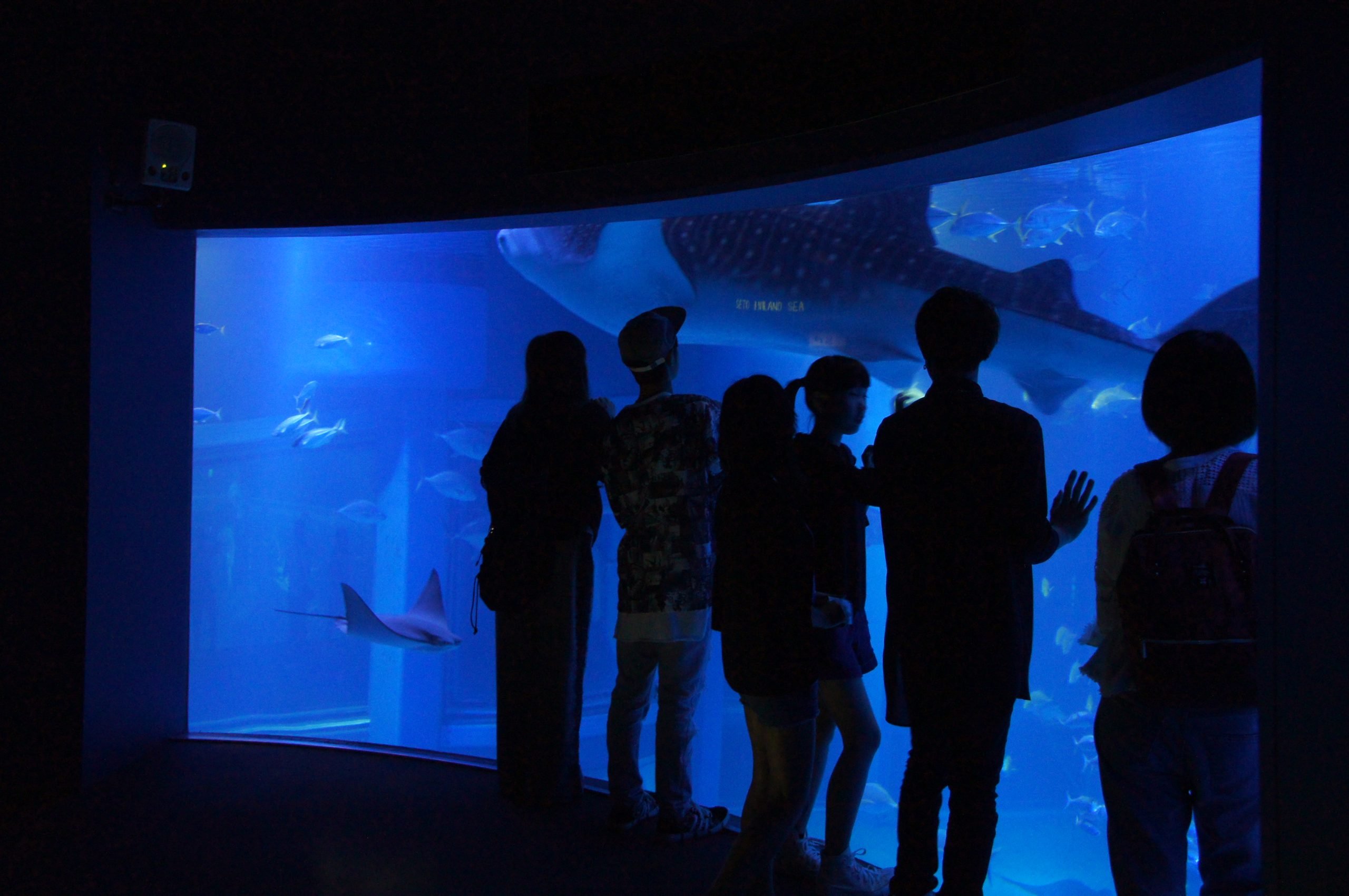
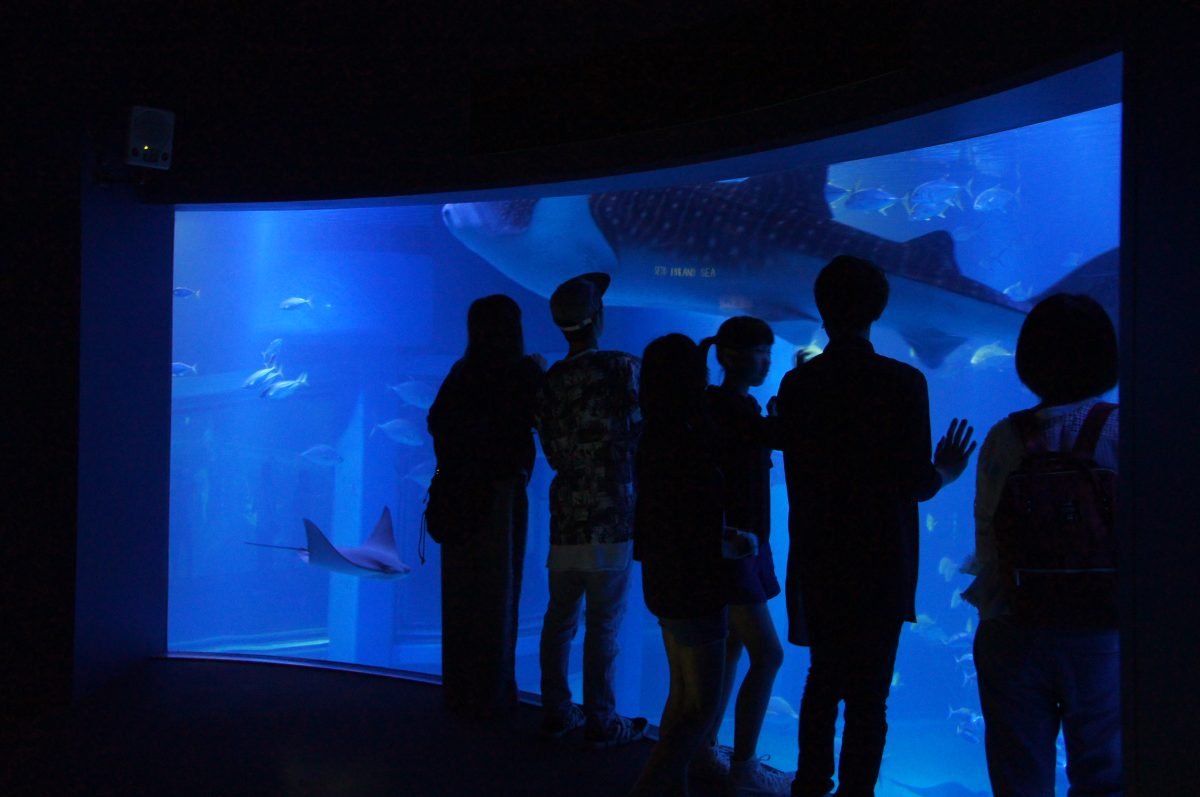
We visited after travelling to Osaka in September 2017. The interior was dark and atmospheric, and the route felt deliberately choreographed. Whale sharks and rays moved through the central water whilst the surrounding habitats shifted through regions of the Pacific Rim. It was less like wandering through a collection of unrelated tanks and more like following one long descent.
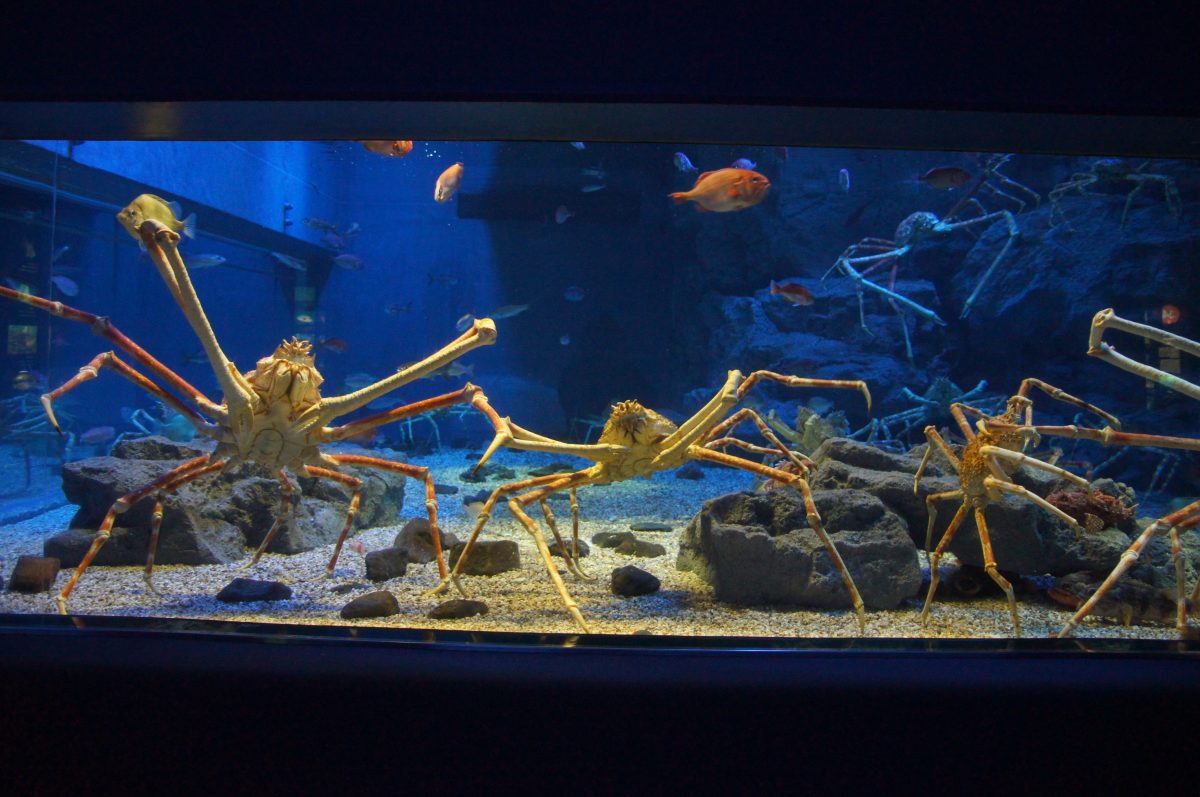
The whale sharks are the obvious draw, but the giant Japanese spider crabs lodged themselves rather firmly in my memory. They are fascinating and appalling in equal measure – all impossible legs and pure nightmare fuel. Naturally, I spent ages looking at them!
Kaiyukan is also straightforward to use. Osaka Metro’s Chuo Line reaches Osakako Station, and the aquarium is approximately five minutes away on foot. You can pair it with Tempozan Marketplace and the Ferris wheel, or give the aquarium a substantial afternoon before returning to the city for dinner. Our two-day Osaka itinerary shows how we fitted it into the rest of our stay.
But it’s not an uncomplicated winner. The galleries can become crowded, their darkness will not suit everyone, and the whale sharks raise serious welfare questions. Kaiyukan gave us the most satisfying aquarium route. That does not mean I can turn off the doubt simply because the architecture was effective.
Read our full Osaka Aquarium Kaiyukan review for the route, current ticket system, crowd advice and everything we saw.
Best spectacle and setting: Okinawa Churaumi Aquarium
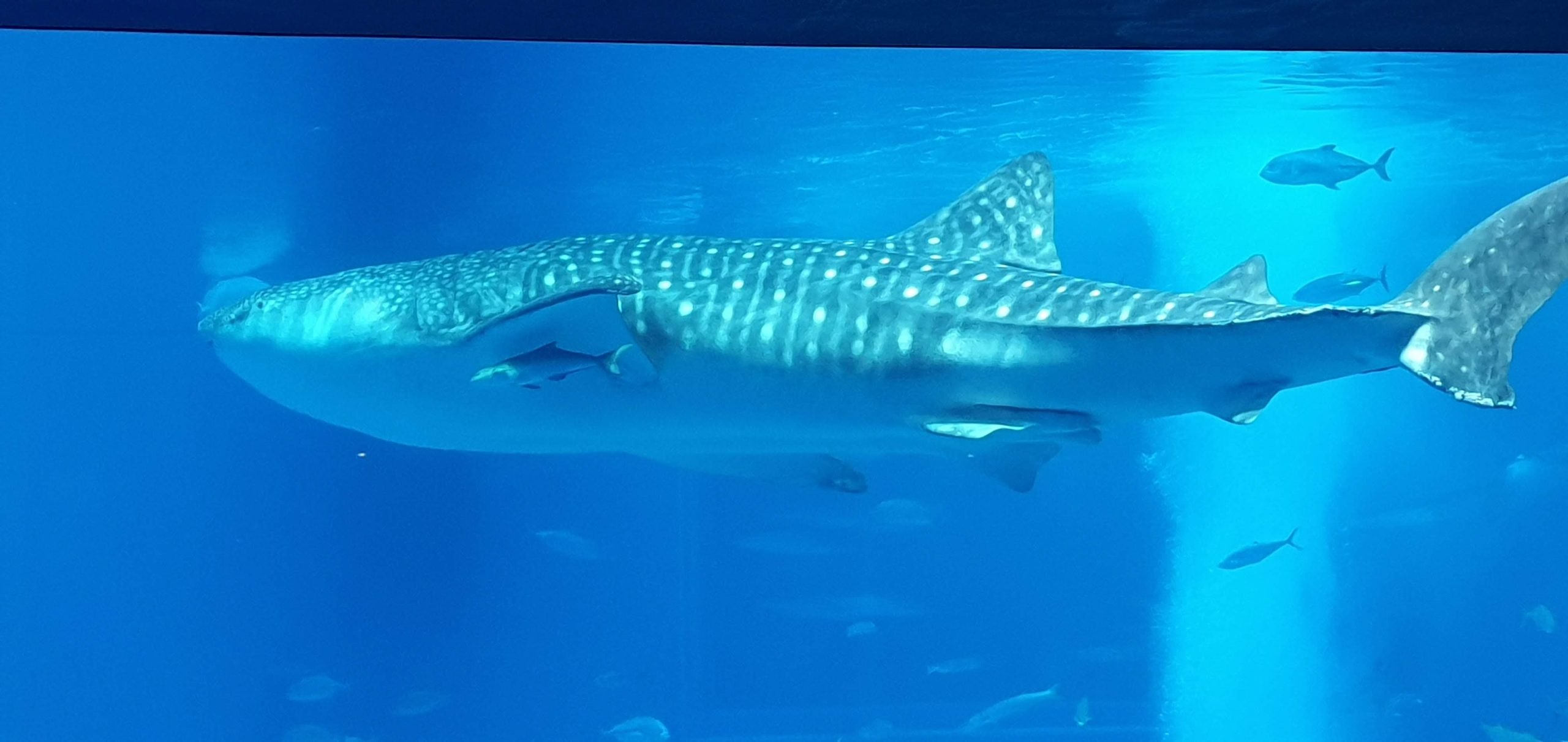
Churaumi produced the biggest single wow moment of our three visits. The Kuroshio Sea tank is vast, and seeing a whale shark move across that wall of water is difficult to forget. Manta rays and shoals of smaller fish fill the space around it, so the tank feels like a moving seascape rather than a single-animal display.
The setting changes the day too. Churaumi is part of Ocean Expo Park in Motobu, with sea views, outdoor areas and several surrounding facilities. Sumida and Kaiyukan are urban attractions; Churaumi feels like a destination. I remember the aquarium together with the coastal drive and the brilliant Okinawan light outside it.
We drove from Naha during our honeymoon and then continued to Pizza in the Sky, Cape Manzamo, Ryukyu Mura, Zakimi Castle and American Village. Yes, all in one day! The route is possible because we did it, but that is not the same as saying it was sensible. We reached later stops with one eye on the clock and the other wondering why past-us had been allowed to make the itinerary.
If I planned it now, I would make Churaumi the anchor of a northern Okinawa day and remove at least one afternoon stop. The official estimate is roughly two hours from Naha Airport by car using the expressway, or around three hours by express bus. Add the return journey and the surrounding park, and this is not a casual two-hour diversion.
Churaumi is the best value of the three at a standard adult admission of ¥2,180. It’s also the one I would choose if the surrounding landscape matters as much as the indoor exhibits. But if you are staying only in Naha and dislike long travel days, the transport may outweigh that advantage.
Our Churaumi Aquarium day-trip guide covers the exhibits and transport in detail. You can also see the full, slightly overenthusiastic route in our Okinawa Main Island road-trip itinerary.
Best design and easiest half-day: Sumida Aquarium
Sumida is the smallest of the three, but it is the one whose spatial design I admired most. The tanks felt open, the circulation was easy to read and the penguin pool became part of the room instead of another box viewed through one window. My architecture brain was pleased. My less sophisticated brain wanted to take a penguin home.
We visited during our first Japan trip in 2015 and allowed around two hours. The aquarium sits on floors 5 and 6 of Tokyo Solamachi in Tokyo Skytree Town, immediately beside Tokyo Skytree Station and connected to Oshiage Station. That convenience is its strongest practical advantage.
Our day combined Skytree, Sumida Aquarium, the Edo-Tokyo Museum and sumo in Ryogoku. It was ambitious, because Tokyo had not yet taught us humility, but the aquarium itself fitted neatly. You can visit without sacrificing an entire sightseeing day, which neither Kaiyukan nor Churaumi quite manages.
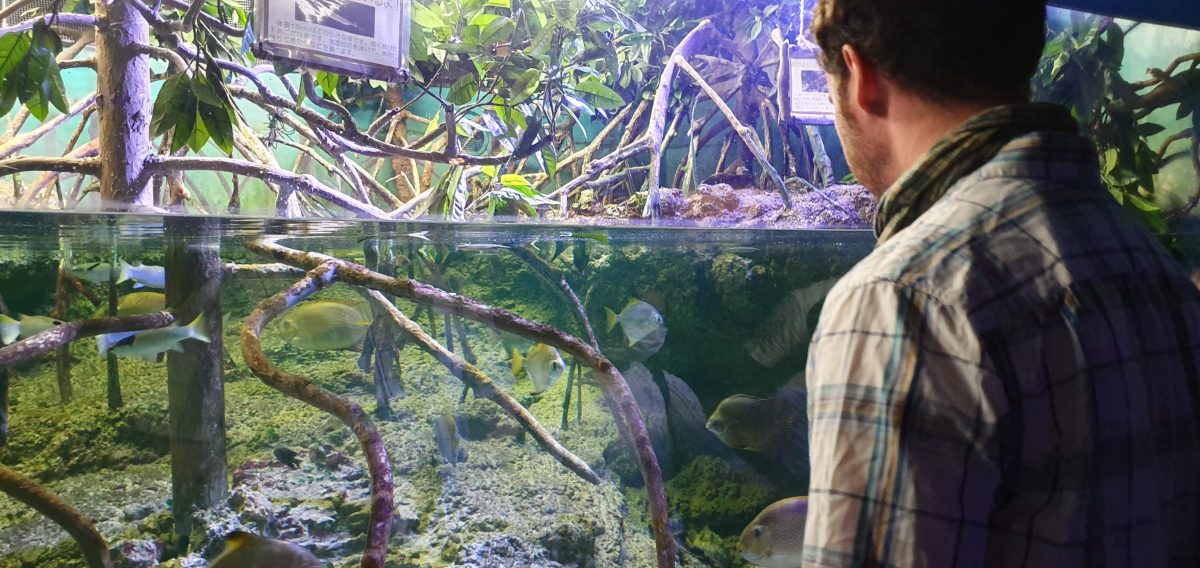
Sumida’s planted Natural Aquascape tanks, Magellanic penguins and Ogasawara-themed displays give it a distinct identity. The aquarium was partly renovated after our visit, adding the Big Petri Dish jellyfish display and Aqua Base in 2020, so a current visit is not identical to the one described in my memories.
The catch is the ¥2,700 adult admission. That is a high price for a typical 90-minute visit, particularly beside Churaumi’s current rate. I would choose Sumida for design, convenience and a calm indoor interval – not for scale or maximum value.
Read our full Sumida Aquarium review, then use our Tokyo itinerary to place it sensibly alongside Skytree and Ryogoku.
Which Japanese aquarium wins each category?
Best for a first aquarium visit in Japan: Kaiyukan
Kaiyukan gives you the most complete stand-alone aquarium experience. Its descending route is easy to follow, the Pacific Rim idea holds the galleries together and there is enough variety to justify making it one of your main Osaka activities.
Best for families: it depends on the children and the route
Sumida is easiest with younger children because it is compact, indoors and simple to combine with food and facilities at Solamachi. Kaiyukan suits families who want a substantial aquarium visit without a car. Churaumi can make the best full family day, but only if everyone tolerates the journey and you leave enough time for Ocean Expo Park.
Best value: Churaumi
At ¥2,180 for a standard adult ticket, Churaumi currently costs less than Sumida and the Kaiyukan dates shown on the current calendar. The aquarium itself takes around 1½ to 2 hours on average, but the wider park can turn that admission into a much longer visit. Transport from Naha is the hidden cost, so it is the best value only when Okinawa is already part of your trip.
Best rainy-day choice: Sumida
Sumida is entirely indoors and embedded in a large shopping complex, with Skytree and restaurants close by. Kaiyukan also works well in bad weather, although you will have a short outdoor walk from the station. Churaumi’s aquarium remains useful in rain, but the coastal park loses part of its charm when the weather is determined to throw itself sideways.
Best architecture and visitor route: a split decision
Sumida wins for openness, clarity and the relationship between visitor and exhibit. Kaiyukan wins for narrative movement: the long spiral around one central body of water is more dramatic. If you enjoy buildings as much as fish, both are interesting for entirely different reasons.
What about whale sharks and animal welfare?
This comparison cannot honestly treat whale sharks as though they were simply bigger exhibits.
Seeing them at Kaiyukan and Churaumi was extraordinary. It also made me uncomfortable. A huge tank can look limitless from the visitor side of the glass and still be profoundly restricted for an animal adapted to travelling through open water. I am not a marine biologist, and a tourist visit cannot tell me whether an individual animal is healthy or distressed. So I will not turn a clean window and an educational panel into a confident welfare verdict.
All three aquariums publish information about research, breeding or conservation activity. That work matters, but it does not automatically settle the ethical argument about captivity. If keeping whale sharks is a firm boundary for you, skip Kaiyukan and Churaumi. Sumida has no whale sharks, although its indoor penguin and fur-seal habitats may still trouble you.
My own view has changed since our first visit in 2015. I can acknowledge that these encounters affected me, admire the design and still question whether my enjoyment is sufficient justification. It’s not a tidy conclusion. But tidiness would be suspicious here.
Which aquarium should you choose for your Japan itinerary?
Choose Sumida Aquarium if you are staying in Tokyo, already want to visit Skytree, have around two hours or need a reliable indoor plan. It is especially suitable when design and atmosphere matter more to you than sheer size.
Choose Osaka Aquarium Kaiyukan if you want the strongest aquarium experience in its own right. It deserves a half-day and works naturally within an Osaka stay. If your itinerary already includes Tokyo and Kansai, this is the one I would prioritise.
Choose Okinawa Churaumi Aquarium if you are travelling to Okinawa and can build a northern-island day around it. Go for the Kuroshio Sea tank, but stay for the wider park and coast. I would not add Okinawa to a mainland trip solely for the aquarium; the islands deserve more than being used as an elaborate fish-tank transfer.
KAT’S VERDICT – DO NOT CROSS JAPAN FOR THE WRONG WINNER
Kaiyukan is our overall winner, but the best aquarium is normally the one that belongs on the route you already want. Losing half a holiday to transport so you can obey a ranking rather defeats the point.
Current prices and planning links
- Sumida Aquarium: adults ¥2,700. Check the official price page and dated-ticket availability.
- Osaka Aquarium Kaiyukan: prices vary by date. Current adult dates begin at ¥2,700, with some peak dates higher. Check the official ticket calendar for your day.
- Okinawa Churaumi Aquarium: adults ¥2,180, high-school students ¥1,440, primary and junior-high students ¥710, and children under 6 free. Check the official admission page and opening calendar.
Prices, hours, animal displays and timed-entry arrangements can change. Use the figures above for comparison, then confirm your date before paying. For the wider holiday costs, see our guide to travelling in Japan on a budget.
Frequently asked questions
What is the best aquarium in Japan?
Of the three we have visited, Osaka Aquarium Kaiyukan is the best all-round aquarium. Churaumi has the most memorable main tank and setting, whilst Sumida is the best compact option in Tokyo. Japan has many other aquariums we have not visited, so this is a first-hand comparison rather than a claim to have ranked every one.
Is Osaka Aquarium or Churaumi Aquarium better?
Kaiyukan is better as a self-contained aquarium experience because its descending route repeatedly returns you to the central Pacific Ocean tank. Churaumi is better for one enormous spectacle and a wider coastal day in Ocean Expo Park. Choose according to whether your trip includes Osaka or Okinawa rather than making a special cross-country detour.
Which of these Japanese aquariums have whale sharks?
Osaka Aquarium Kaiyukan and Okinawa Churaumi Aquarium display whale sharks. Sumida Aquarium does not. Animal populations and displays can change, so check the official aquarium sites before travelling if seeing a particular species is important to you.
How long do you need at each aquarium?
Allow roughly 1½–2 hours at Sumida, 2–3 hours at Kaiyukan and 1½–2 hours inside Churaumi. Give Churaumi at least half a day if you also want to explore Ocean Expo Park, and a full day if travelling from Naha and adding northern Okinawa stops.
Do you need to book aquariums in Japan in advance?
I would book Sumida and Kaiyukan ahead for weekends, public holidays and other busy dates. Both sell dated or timed online tickets, and Kaiyukan warns that same-day visitors may have to wait for an available entry time. Churaumi sells web and on-site tickets; check its current rules before travelling rather than assuming every aquarium uses the same system.
Is Sumida Aquarium worth visiting if you are also going to Osaka Aquarium?
Yes, if Sumida fits naturally beside Tokyo Skytree and you enjoy aquarium design, penguins or jellyfish. No, if you are short on time and mainly want scale: Kaiyukan is the stronger stand-alone aquarium and makes Sumida optional rather than essential.
Our final verdict
Kaiyukan is our best overall aquarium in Japan, Churaumi gave us the most memorable setting, and Sumida impressed me most as a piece of visitor-focused design.
I would revisit any of them, although less uncritically than I did the first time. That is probably the fairest conclusion: an aquarium can be beautiful, educational and genuinely moving whilst still leaving you with questions about what should live behind the glass.
For most first-time Japan itineraries, choose the aquarium already on your path. Tokyo gives you Sumida, Kansai gives you Kaiyukan and Okinawa gives you Churaumi. Conveniently, the fish have organised themselves by region.