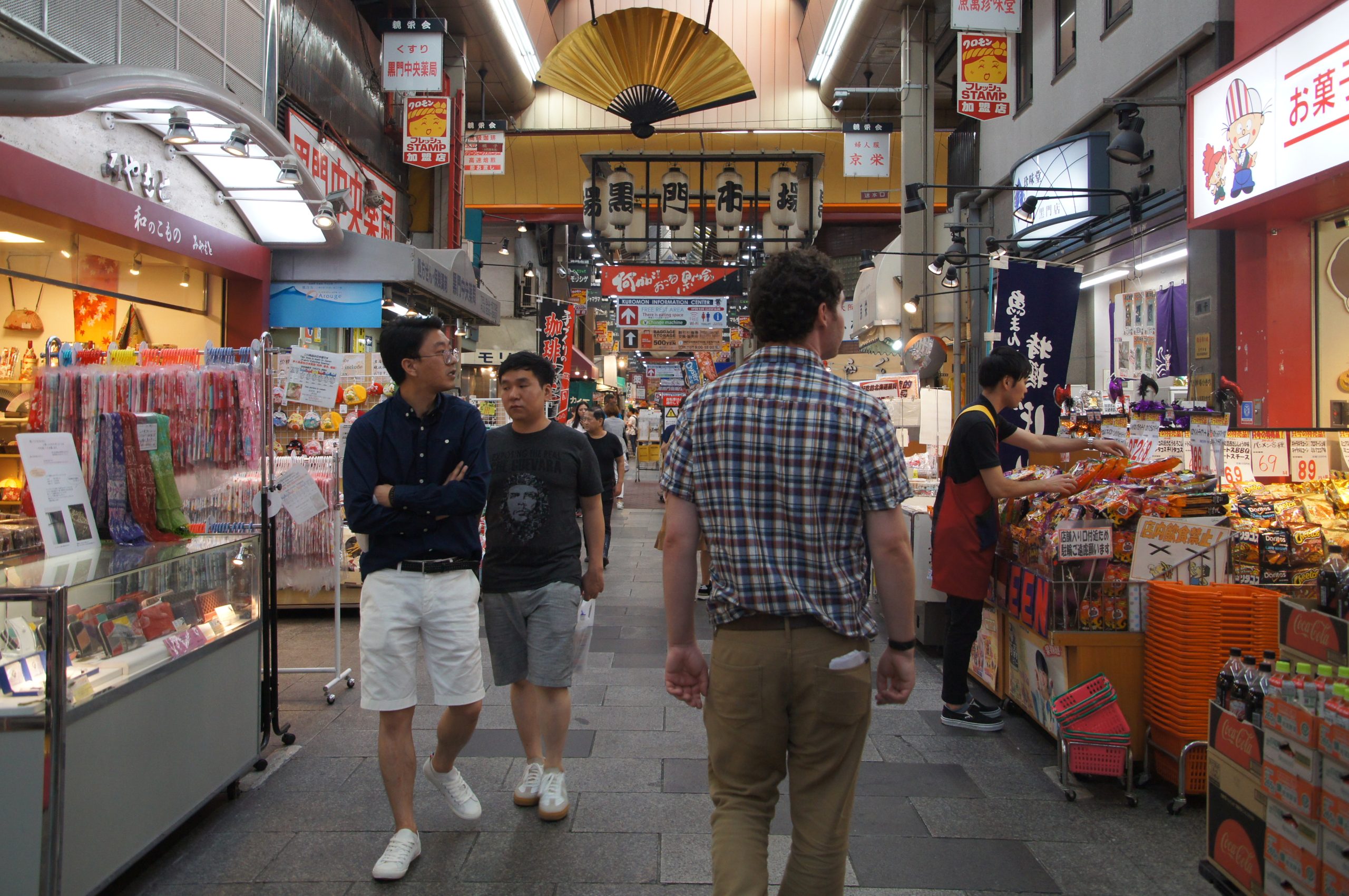
Kuromon Market should have been one of the hungriest stops on our Osaka itinerary. Instead, Gary and I arrived after eating in Dotonbori and walked through it on our way to Den Den Town. This is not, I now realise, the textbook way to investigate a food market.
We still saw the covered arcade and its displays of fish and seafood, but we treated Kuromon more as a route than a meal. That makes this a slightly unusual Kuromon Market review. I cannot give you a heroic tally of everything we ate because we did not eat our way through it. But I can tell you whether it is worth adding to an Osaka itinerary, how to visit it more sensibly than we did and what to look for when you arrive.
Our visit was on 26 September 2017, during the long sightseeing day covered in our two-day Osaka itinerary. Practical facts in this guide were checked against the official market information and other established sources available before January 2025. Opening times and stall prices can change, so use the links below before making a special journey.
My quick answer: Kuromon Market is worth visiting if you want a compact Osaka food-market experience and are prepared to go while the fresh-food shops are trading. Come hungry, compare the displayed prices and allow roughly 45–90 minutes. It’s easy to combine with Namba, Dotonbori and Den Den Town. But if you have already eaten and only want to tick off another sight, you may end up doing exactly what we did: walking through a very promising lunch.
Is Kuromon Market worth visiting?
Yes, for most first-time visitors staying around Namba. Kuromon Ichiba is a covered food market where shops sell seafood, meat, fruit, vegetables, pickles, sweets and prepared dishes. It’s central, easy to understand and close enough to Dotonbori that you do not need to sacrifice half a day to reach it.
It’s particularly worthwhile if food is one of your reasons for visiting Osaka. You can browse the displays, choose one or two things to eat and see ingredients that may not appear in the same form at home. The market is also covered, which becomes rather persuasive when Osaka is raining or roasting.
But Kuromon is not an undiscovered local secret. It is well known to overseas visitors, some stalls are geared towards sightseeing appetites and a popular item is not automatically a bargain. Go because you want the market itself—not because every Osaka checklist insists upon it.
| Quick fact | What to know |
|---|---|
| Japanese name | Kuromon Ichiba Market (黒門市場) |
| Best for | Seafood, prepared food and a compact Osaka market visit |
| Entry | No market ticket; you pay only for what you buy |
| Best time | Late morning to early afternoon, before more fresh-food shops finish trading |
| Time needed | About 45–90 minutes; longer for a sit-down meal |
| Nearest station | Nippombashi Station; Namba is also walkable |
| Our visit | 26 September 2017, after Dotonbori and before Den Den Town |
What was our Kuromon Market visit actually like?
Our day began at Osaka Castle, continued through Shinsaibashi and reached Dotonbori, where we ate. From there we walked southeast to Kuromon Market and carried on towards Den Den Town. On a map, it was quite efficient. From the perspective of lunch, less so.
I described Kuromon at the time as a fish market not far from Dotonbori. We walked through the covered arcade because it formed part of our route to Osaka’s electronics district. The surviving notes do not record a dish, purchase or Kuromon price, so I am not going to develop a suspiciously detailed memory several years later. The food we praised that day belonged to Dotonbori.
What I would change is simple: I would visit Kuromon before eating elsewhere. A food market needs an appetite. Arriving full reduces a row of grilled seafood, sushi and fruit to a visual exercise, which is a bit like entering a bakery immediately after Christmas lunch.
What is Kuromon Ichiba Market?
Kuromon Ichiba is a roofed market arcade in Osaka’s Chuo ward, close to Nippombashi and Namba. The official Kuromon Market website describes roughly 150 shops along about 580 metres. The traders include fishmongers, butchers, greengrocers, pickle shops, confectioners and restaurants. You will also find kitchen goods and food prepared to eat there.
The market’s roots reach back to the late Edo period. Osaka’s official tourism history traces it to around 1822–23, when fish traders gathered near Enmyoji temple. It was rebuilt after the Great Namba Fire of 1912 and again after the Second World War. Food markets, it seems, are stubborn things.
It’s often called “Osaka’s Kitchen”. That label is useful, but it can make the place sound like one single attraction with a front desk and coordinated opening hours. It isn’t. Kuromon is a collection of independent businesses, so each shop decides when it opens, closes and takes a day off.
The arcade is long rather than labyrinthine. You can walk the main stretch without a map, although side lanes and the temptation to investigate every tray of seafood will slow you down. This is hardly a complaint.
Is Kuromon Market a tourist trap?
Kuromon is touristy. That is not quite the same thing as saying the entire market is a trap.
The market contains real food businesses, but its central location and reputation also attract large numbers of visitors. Some food is presented in convenient tasting portions, and the most photogenic seafood or beef can be expensive. I cannot honestly compare today’s prices with our 2017 spending because we did not record a purchase there.
Treat it as you would any busy market. Check the price before ordering, compare a few nearby stalls and decide whether you are buying lunch, a taste or a small performance involving a blowtorch. If the figure makes you wince, keep walking. There will be another display shortly.
If your priority is an everyday wholesale market with no visitor gloss whatsoever, Kuromon may disappoint you. If you want an accessible food stop that fits neatly into a Namba sightseeing day, its popularity is part of the convenience.
What should you eat at Kuromon Market?
The following are market categories to look for, based on the official trader listings and established Kuromon guides—not a list of things we personally ate. I would rather be mildly disappointing here than turn somebody else’s lunch into our anecdote.
Seafood and sushi
Fish and shellfish are Kuromon’s headline act. Depending on the season and trader, you may see tuna, eel, crab, sea urchin, oysters, scallops and sushi. Some businesses sell raw ingredients; others prepare small portions for immediate eating. Look closely at the unit price and portion size before pointing enthusiastically at the largest crab leg.
Grilled food
Grilled scallops, prawns, fish, eel and meat skewers are practical if you want one hot item rather than a full meal. Watch where the stall expects you to eat it. Japan is not generally a place for wandering down the pavement while dropping sauce on your shoes, a rule I support mainly because my shoes usually suffer first.
Prepared food beyond seafood
Established Kuromon guides also feature takoyaki, oden, yakitori, wagyu beef, seafood rice bowls and other ready-to-eat dishes. Availability changes between traders and seasons, so treat these as things to look for rather than a compulsory shopping list. We did not eat them at Kuromon. Our appetite had already been deployed elsewhere.
Fruit, sweets and snacks
Kuromon is not solely seafood. The official directory also lists fruit, cakes, Japanese sweets, pickles and other specialist foods. These are useful if raw fish before noon is not your personal vision of happiness. They also make it easier for two people with very different appetites to browse without holding emergency negotiations.
My approach would be to share several small portions rather than commit immediately to the first expensive display. But if you want a particular restaurant or seasonal ingredient, check that trader’s own hours before you go.
What are Kuromon Market’s opening hours and best time to visit?
Kuromon does not have one universal set of opening hours. Each shop sets its own schedule. Established visitor information has commonly placed many traders somewhere within the morning-to-early-evening period, while the official directory shows that individual businesses can open earlier, close later or take different weekly holidays.
Late morning to early afternoon is the safest general window. You avoid making breakfast compulsory, but you still reach more fresh-food businesses before they sell out or close. Sundays and public holidays can bring additional closures, so check the official shop pages if one particular stall matters to you.
Our own afternoon sequence was good for walking but poor for giving Kuromon centre stage. I would aim for roughly 10.30am to 1pm, then continue elsewhere. That is my planning recommendation, not an official market timetable.
How long do you need at Kuromon Market?
Allow 45–90 minutes for a first visit. The lower end is enough for a steady walk with one snack. The upper end gives you time to compare stalls, eat several things and pause without treating lunch as a timed examination.
Add more time if you want a sit-down meal or enjoy photographing food displays. You can physically cross the 580-metre market much faster, as we demonstrated. That is not necessarily the same as experiencing it.
How much does Kuromon Market cost?
There is no admission ticket. Your budget depends entirely on what you order.
I found older online guides quoting individual snack prices, but those figures belong to their visit dates and are not reliable forecasts for yours. Kuromon’s seafood also varies by species, weight, season and preparation. A precise generic “market budget” would therefore be false precision wearing a sensible hat.
Use the displayed price as your starting point, confirm whether it is per piece, portion or weight, and agree the total before food is cooked. Bring some yen rather than assuming every independent stall accepts your preferred card. Also, set your own ceiling before a very handsome piece of seafood begins making financial decisions on your behalf.
How do you get to Kuromon Market?
The market address is 2-4-1 Nipponbashi, Chuo-ku, Osaka. Nippombashi is the nearest station; the market is only a few minutes away on foot. From the Namba area, allow roughly ten minutes to walk, depending on your starting point and your obedience to traffic lights.
Dotonbori is also close enough to combine on foot. This is how we reached Kuromon, although I recommend reversing the meal logic: market first, Dotonbori later.
How should you combine Kuromon, Dotonbori and Den Den Town?
These areas sit close together, but they come alive at different times. Kuromon suits the late morning and lunch period. Den Den Town works in the afternoon. Dotonbori becomes more theatrical as the signs light up.
| Order | Stop | Why it works |
|---|---|---|
| 1 | Kuromon Market | Arrive hungry while more food shops are trading |
| 2 | Den Den Town | Browse electronics, games, manga and anime shops during afternoon opening hours |
| 3 | Namba or Shinsaibashi | Use the shopping streets as the link towards the canal |
| 4 | Dotonbori | See the signs after dark and eat again if Osaka has done its work properly |
If you also want Osaka Castle, keep an eye on your legs. We put all of these districts into one day and completed it, but “possible” and “pleasantly paced” are not synonyms. Our Osaka itinerary shows the complete route; the Osaka Aquarium fits better on a separate day.
Practical tips for visiting Kuromon Market
- Arrive hungry. This sounds obvious. We still managed to get it wrong.
- Check individual shop hours. The arcade is not one business with one timetable.
- Read the whole price sign. Confirm the portion, weight and total before ordering.
- Carry some cash. Payment options differ between independent traders.
- Eat where the stall directs you. Use the counter or designated space rather than blocking the arcade.
- Use the information centre if you need a pause. The official market site lists a rest area and toilet on Minami-Komonkai Street, generally open from 9am to 6pm. Check the page before relying on those hours.
- Check the directory for dietary needs. The official listings include vegetarian, vegan and halal filters, although you should still confirm ingredients with the individual trader.
- Share first. Small portions let you try more before your appetite stages a retreat.
- Do not plan around one stall without checking. Closures and selling out are both possible.
Our honest Kuromon Market verdict
Kuromon Market is worth visiting, but it deserves better planning than we gave it. Its main advantage is not that it is secret or cheap. It’s that a large, varied food market sits within easy walking distance of Namba, Dotonbori and Den Den Town.
I would return in the late morning, arrive hungry and give it at least an hour. I would compare a few stalls, choose something that genuinely appealed and resist the strange travel impulse to eat the item with the greatest online fame. You are allowed to dislike sea urchin. Osaka will recover.
Would I cross Japan solely for Kuromon? No. Would I include it in a first Osaka food day? Yes—especially if you are already exploring the southern city centre. Just put it before Dotonbori. Learn from us!
Kuromon Market FAQ
Is Kuromon Market free to enter?
Yes. There is no admission ticket for the market arcade. You pay for any food, drink or goods you buy.
What time should I visit Kuromon Market?
Late morning to early afternoon is the safest general window because individual traders keep different hours. Check the official directory if you want a particular shop.
Should I visit Kuromon Market or Dotonbori?
Choose Kuromon for a daytime food-market visit and Dotonbori for evening signs, crowds and a larger restaurant district. They are close enough to do both: Kuromon first, Dotonbori later.
Can you visit Kuromon Market with children?
Yes, but the arcade can become busy and some displays include raw seafood. Keep children close, avoid blocking the working shopfronts and choose food in manageable portions.
Does Kuromon Market have toilets and somewhere to sit?
Yes. The official Kuromon Information Centre lists a toilet and rest area on Minami-Komonkai Street. Its published hours are 9am to 6pm, but check before your visit.
Is Kuromon Market good on a rainy day?
The main market arcade is covered, so it is a useful wet-weather stop. You will still need to walk outside between the station, market and surrounding neighbourhoods.
Continue planning: Use our two-day Osaka itinerary to fit Kuromon into the wider route, compare it with our Grand Front Osaka guide, read our Hotel Cordia Osaka review for where we stayed, or build the rest of the trip with our two-week Japan itinerary. All Japan articles are collected in the Japan travel guide.