The London Underground is brilliantly efficient, impressively extensive and, at rush hour, capable of making a tin of sardines look positively spacious.
I used to take the Tube to work every day. My survival strategy involved headphones, a book and the ability to move through a ticket barrier without breaking stride. Most London Underground etiquette is not written down, but commuters follow it with the seriousness of an ancient civic code.
If you are visiting London for the first time, do not worry. Nobody expects you to know every line or glide through Bank station like you were born beneath it. Follow these simple rules and you will avoid most accidental commuter crimes.
London Underground etiquette at a glance
- Stand on the right of escalators and walk on the left.
- Have your card or device ready before reaching the barrier.
- Let passengers leave the train before you board.
- Move along the platform and into the carriage.
- Take your backpack off when the train is crowded.
- Keep doorways, escalators and passageways clear.
- Offer priority seats when someone needs them more.
- Keep music, videos and conversations at a considerate volume.
1. Check your route before joining the crowd
Tokyo may have confused me more, but London has a particular talent for presenting you with three corridors, two staircases and a sign that appears to point through a wall.
Use the official TfL Journey Planner or TfL Go before you travel, and check live service updates. Planned engineering work and unexpected disruption can turn a very sensible route into an accidental tour of Zone 4.
If you need to stop and work out where you are, step to one side first. Do not stop immediately beyond a ticket barrier, at the bottom of an escalator or in the middle of a narrow passage. Londoners are not necessarily unfriendly; they may simply be trying not to collide with you.
2. Have your payment ready
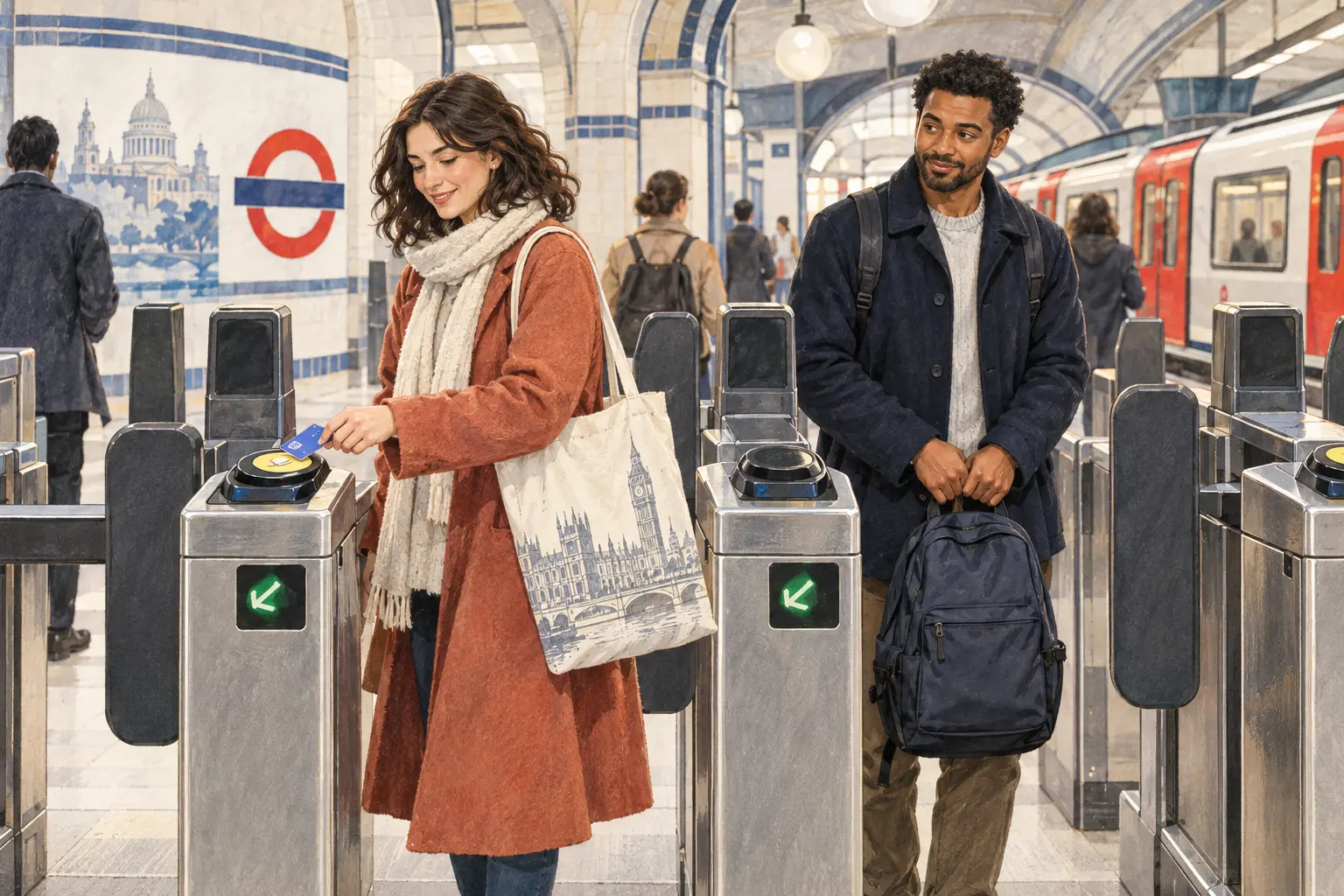
You can use an Oyster card or a compatible contactless card or device to pay as you go. Touch in at the start and out at the end of a Tube journey. Use the same card or device at both ends; tapping in with a phone and out with the physical card linked to it can create two incomplete journeys.
Have it ready before you reach the yellow reader. The ticket gate is not the ideal location to begin an archaeological dig through the bottom of your handbag.
Each adult needs a separate card or device. TfL’s pay-as-you-go guidance explains contactless payments, Oyster cards, fare caps and possible overseas bank charges.
3. Stand on the right of the escalator
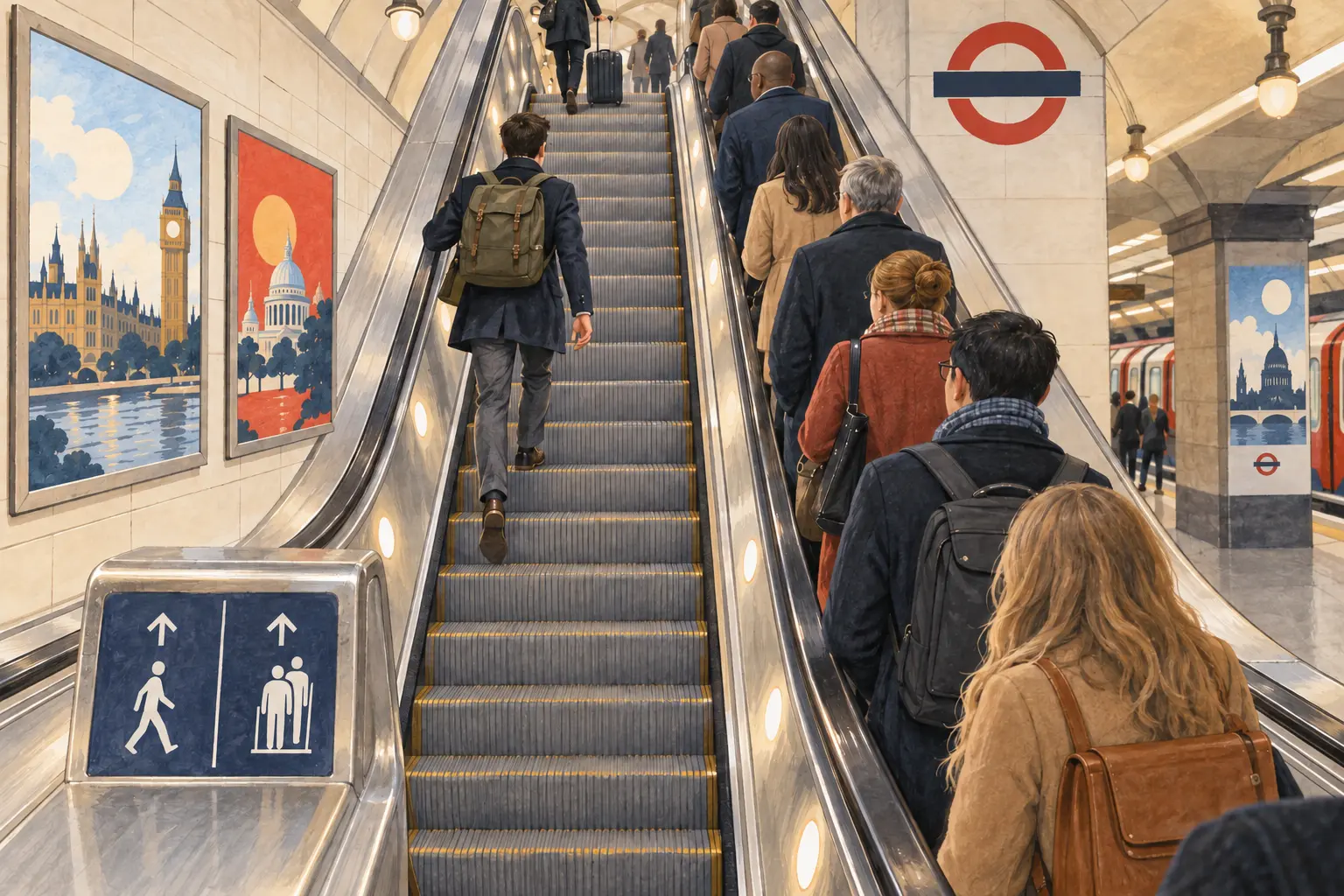
This is the rule visitors hear most often because Londoners care about it with startling intensity: stand on the right and leave the left side free for people who are walking.
Keep luggage directly in front of or behind you so it does not block the walking side. When you reach the top, keep moving until there is space to stop safely. If stairs or escalators are difficult for you, check step-free access in advance and take the time you need.
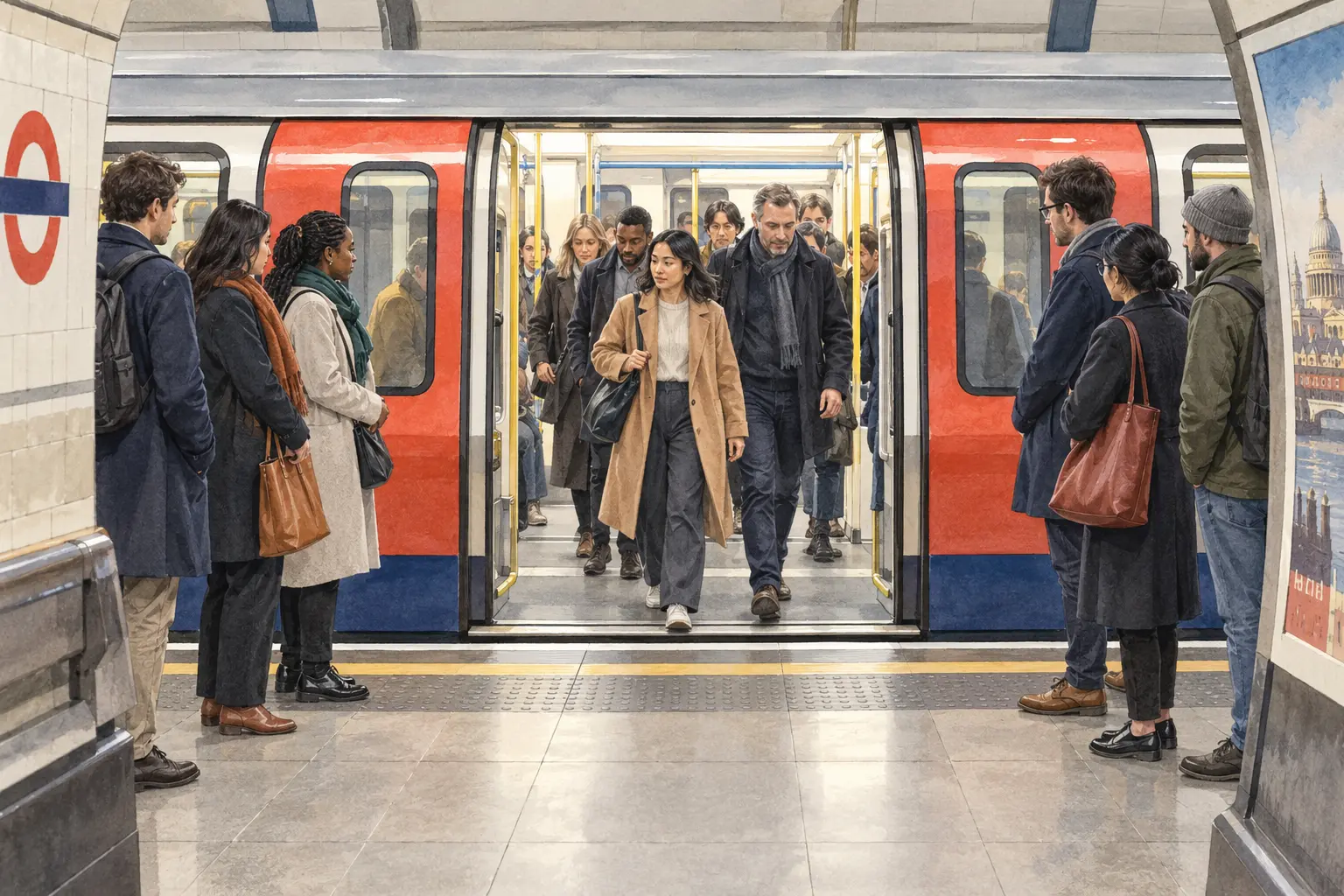
4. Let people off before boarding
Stand to either side of the doors and allow passengers to leave before you step on. This is partly good manners and partly simple geometry: the carriage cannot fit more people until some of the existing people escape.
If passengers briefly step onto the platform to let others out, allow them to re-board first. Never hold or force closing doors. Another train will usually follow, and no appointment is improved by becoming personally acquainted with the door alarm.
5. Move down the platform
People naturally gather near station entrances and the bottom of escalators, which means the middle carriages can be much busier than those farther along the platform. Follow signs and staff instructions, stay behind the safety line and move along when there is space.
This can make boarding easier and may give you a slightly less intimate journey with several hundred strangers.
6. Move into the carriage
Once aboard, move away from the doors if there is room. Standing in the doorway when space exists farther inside prevents other passengers from boarding and makes every station stop more awkward.
If your stop is approaching on a crowded train, begin moving towards the doors sensibly. A quiet “excuse me” works remarkably well. There is no need to start elbowing through the carriage three stations early.
7. Take off your backpack
A backpack occupies much more space than its owner realises and has a habit of swinging into seated passengers. On a busy train, take it off and hold it low between your feet or in front of you. Keep suitcases close and never leave luggage where it creates a trip hazard or blocks the doors.
8. Keep the volume down
You are allowed to talk on the Tube. Contrary to my rather dramatic original version of this article, conversation is not a criminal offence. The real rule is consideration: avoid shouting, use headphones and do not play videos or music aloud.
Morning commuters may look as though speech has not yet been invented. This is normal. Let them stare peacefully into the middle distance.
9. Respect personal space where possible
At busy times, personal space becomes an abstract concept. You can still avoid leaning on other passengers, reading their messages over their shoulders or using a handrail as your private backrest.
Avoid eating anything messy or strongly scented, and take all rubbish with you. Nobody wants to discover that the mysterious substance on the seat is your abandoned lunch.
10. Offer seats thoughtfully
Priority seats are intended for people who may need them, including disabled passengers, older people, pregnant passengers and people travelling with very young children. Some needs are invisible. TfL also provides “Please offer me a seat” and “Baby on board” badges.
Offer rather than assume, and accept the answer gracefully. If somebody declines, there is no need to stage a prolonged British politeness contest in the aisle.
11. Be patient with children, luggage and accessibility needs
Tourists with suitcases and parents with buggies are not deliberately attempting to ruin the commute. They may be navigating an unfamiliar and sometimes inaccessible system. Give people time, avoid crowding them and offer practical help when appropriate.
If you are travelling with children, hold hands near platforms and escalators, prepare them before getting on or off, and avoid splitting the group across closing doors. For luggage-heavy airport journeys, checking step-free routes before leaving can prevent a great deal of carrying and swearing.
12. Follow staff instructions and stay aware
Keep behind platform markings, hold the handrail on escalators and follow announcements or station staff during disruption. If you see something that concerns you, tell a member of staff or use the help point.
The Underground can feel overwhelming on a first visit, but its unwritten rules are really just about keeping millions of journeys moving: be prepared, leave space, notice the people around you and do not stop at the top of an escalator.
One final Londoner’s tip
Try to avoid the busiest commuter periods when you can, particularly if you have children or large luggage. Travelling slightly later can make the Underground feel like an entirely different form of transport.
London Underground etiquette FAQs
Do you stand on the left or right on London Underground escalators?
Stand on the right and leave the left side clear for people who are walking. Keep luggage out of the walking side and move away from the escalator exit before stopping.
Can visitors use contactless payment on the Tube?
Compatible contactless cards and devices can be used to pay as you go. Always touch in and out with the same card or device. Overseas transaction charges may apply, so check with your card issuer.
Should you talk on the London Underground?
Yes. Talking is perfectly acceptable, although keeping conversations at a considerate volume is appreciated—particularly on a quiet early-morning train.
What should you do with a backpack on a crowded Tube?
Take it off and hold it low in front of you or between your feet. This creates more room and stops the bag knocking into other passengers.
Is the London Underground accessible with a buggy or wheelchair?
Accessibility varies by station and route. Check TfL’s current step-free information before travelling, because “step-free to platform” and “step-free to train” are not always the same thing.
Once you have mastered the Tube, use it to reach our Churchill War Rooms visitor guide or explore more ideas in our London travel section.
Which unwritten Tube rule did you learn the hard way?
Comment below and let us know!
Did you enjoy this article?
Share it with your friends and family on Facebook, Twitter and Pinterest.




I think the public transport systems in the major cities of the world are in the same league and these tips would apply anywhere, be it the metros in Paris or Hong Kong, etc.
Having never been to London I find this post very helpful. I know how crazy the NYC system can be, and it sounds pretty similar. I’m ashamed to say I committed some of these faux-pas the first time I rode the NYC subway :(
Great advise about continuing to move down the train until it’s loaded. This is a problem in America, for sure.
“If you are walking you should be to the left, if you are standing please keep to the right.” YES! I wish more people did this. Every time I fly back to the US, the first thing I always notice in the airports is how people don’t follow this rule.