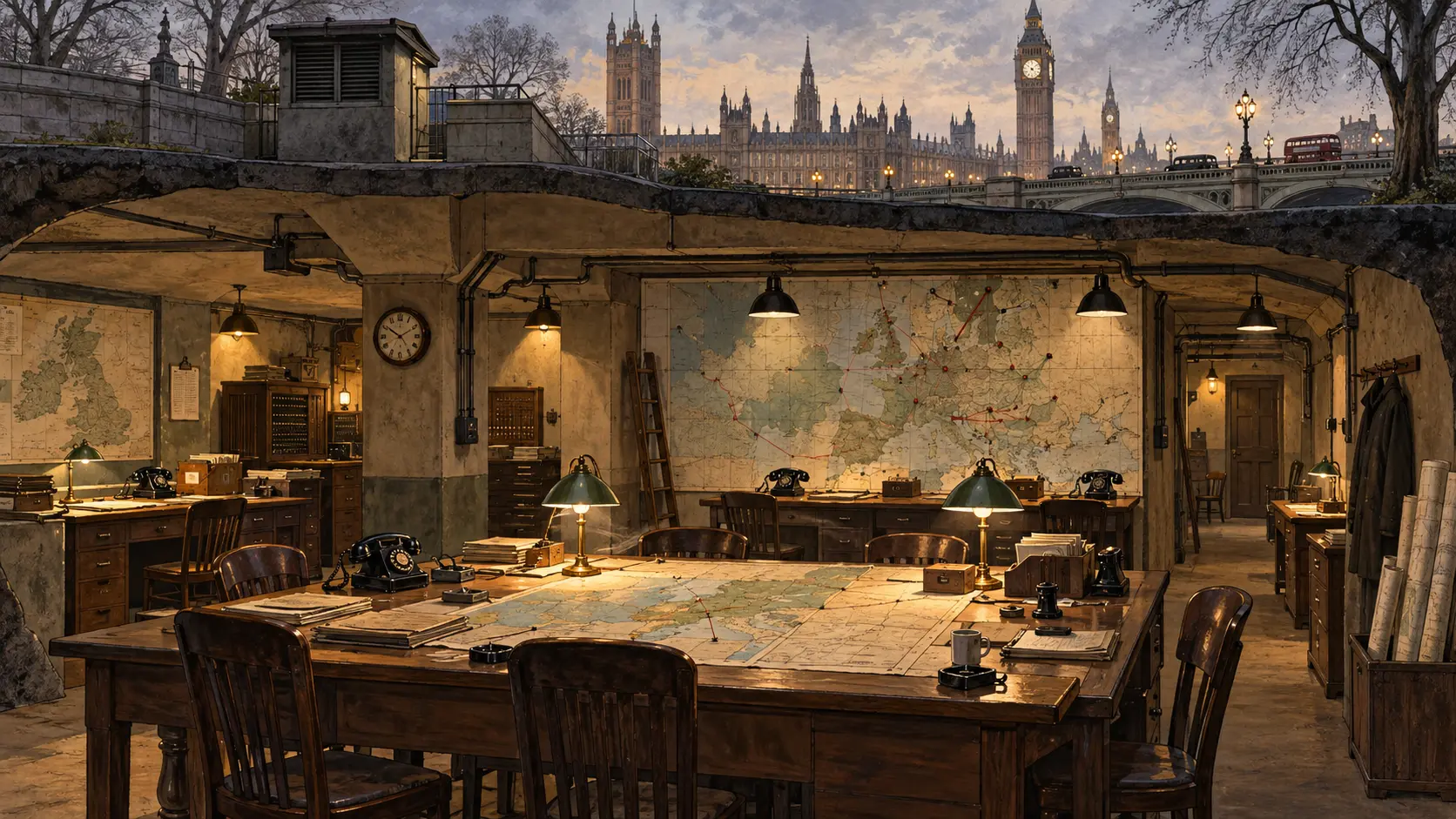
If you have ever wondered what lies beneath the grand government buildings of Westminster, the Churchill War Rooms provide a rather extraordinary answer. Hidden below street level is the underground headquarters from which Britain’s wartime government worked during the Second World War.
The corridors are narrow, the offices are surprisingly modest and many rooms look as though their occupants have only just stepped away. Maps still cover the walls, telephones sit waiting on desks and the little details make the place feel much more immediate than a conventional museum. There is an eerie atmosphere to it all—you can almost smell Churchill’s cigars.
This guide explains what you can see, how much time to allow and what to check before booking. It replaces my much shorter 2016 article, whose fixed £19 ticket price had become thoroughly out of date.
Are the Churchill War Rooms worth visiting?
Yes, especially if you enjoy twentieth-century history, political history or places that retain a strong sense of their original purpose. The attraction combines two connected experiences: the preserved Cabinet War Rooms and the Churchill Museum.
The historic rooms are the most atmospheric part. Instead of simply reading about decisions made during the war, you stand in the compact spaces where ministers, military staff, typists, telephonists and other personnel worked. The Churchill Museum adds documents, objects and interactive displays about Churchill’s long and complicated life.
It is not a cheap London attraction, and visitors hoping for enormous underground tunnels may find the scale more intimate than expected. But it is one of those museums where the building itself is the central exhibit. That makes it quite different from viewing wartime objects in a modern gallery.
What exactly are the Churchill War Rooms?
The site was originally known as the Cabinet War Rooms. A collection of basement rooms beneath the government offices in Whitehall was adapted to provide a protected working headquarters in anticipation of war. It became operational shortly before Britain declared war on Germany on 3 September 1939.
This was not a purpose-built, deeply buried bunker in the way people sometimes imagine. The complex was assembled from existing basement spaces and strengthened. A thick protective concrete layer, known as the Slab, was later installed overhead, but those working below were never completely safe from a direct hit.
The War Rooms remained in use throughout the Second World War. When the war ended, key areas were closed and left largely intact. The Cabinet War Rooms opened to the public in 1984. The later Churchill Museum was added in 2005, and the combined attraction is now called Churchill War Rooms and is part of Imperial War Museums.
Highlights to look for during your visit
The Cabinet Room
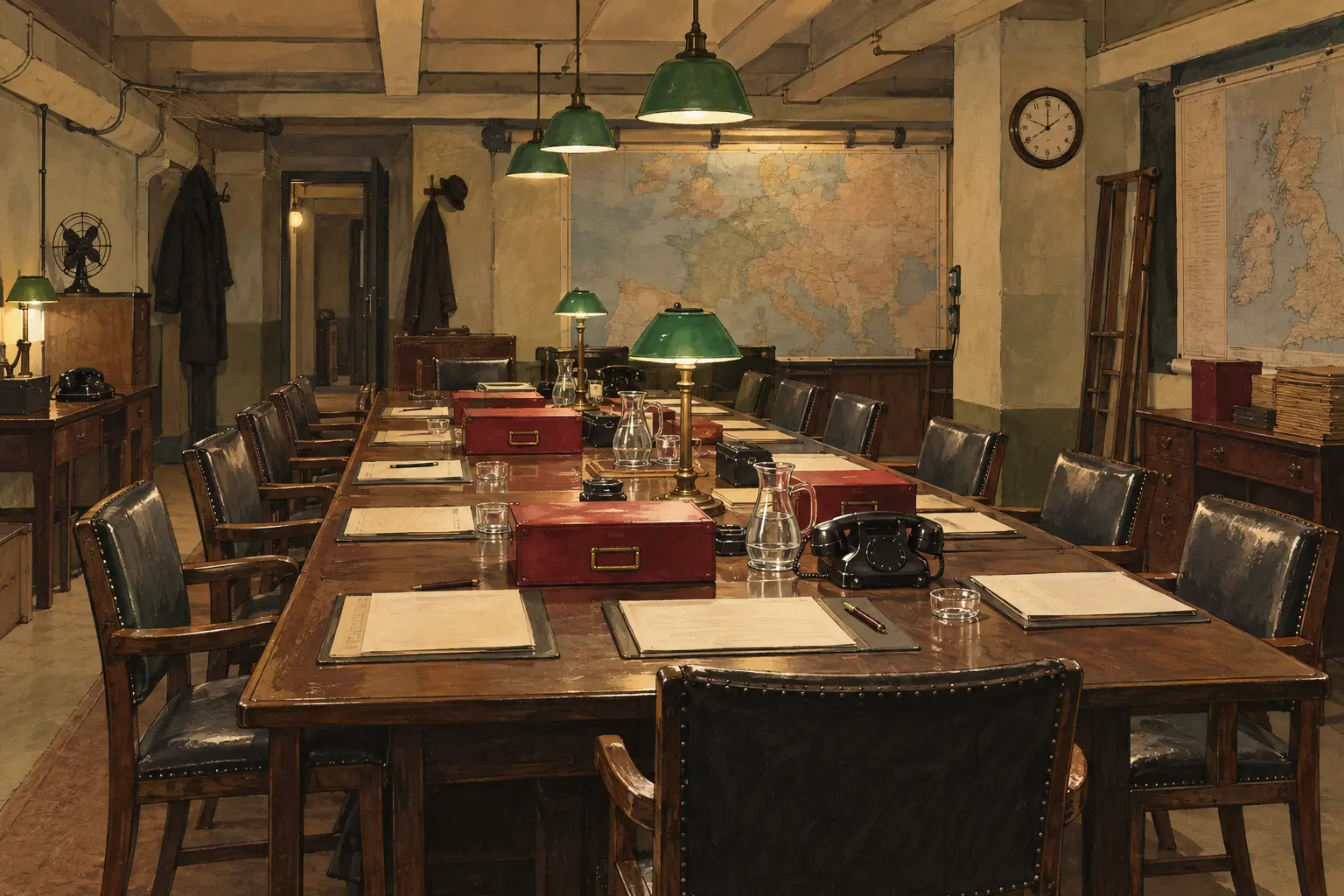
This is where Churchill and his senior ministers met. The room is staged to evoke a meeting in October 1940, during the Blitz. It is surprisingly compact for a place associated with decisions of such consequence. Churchill’s chair sits prominently at the table, and the arrangement gives you a vivid sense of the personalities gathered in a confined, pressured space.
The Map Room
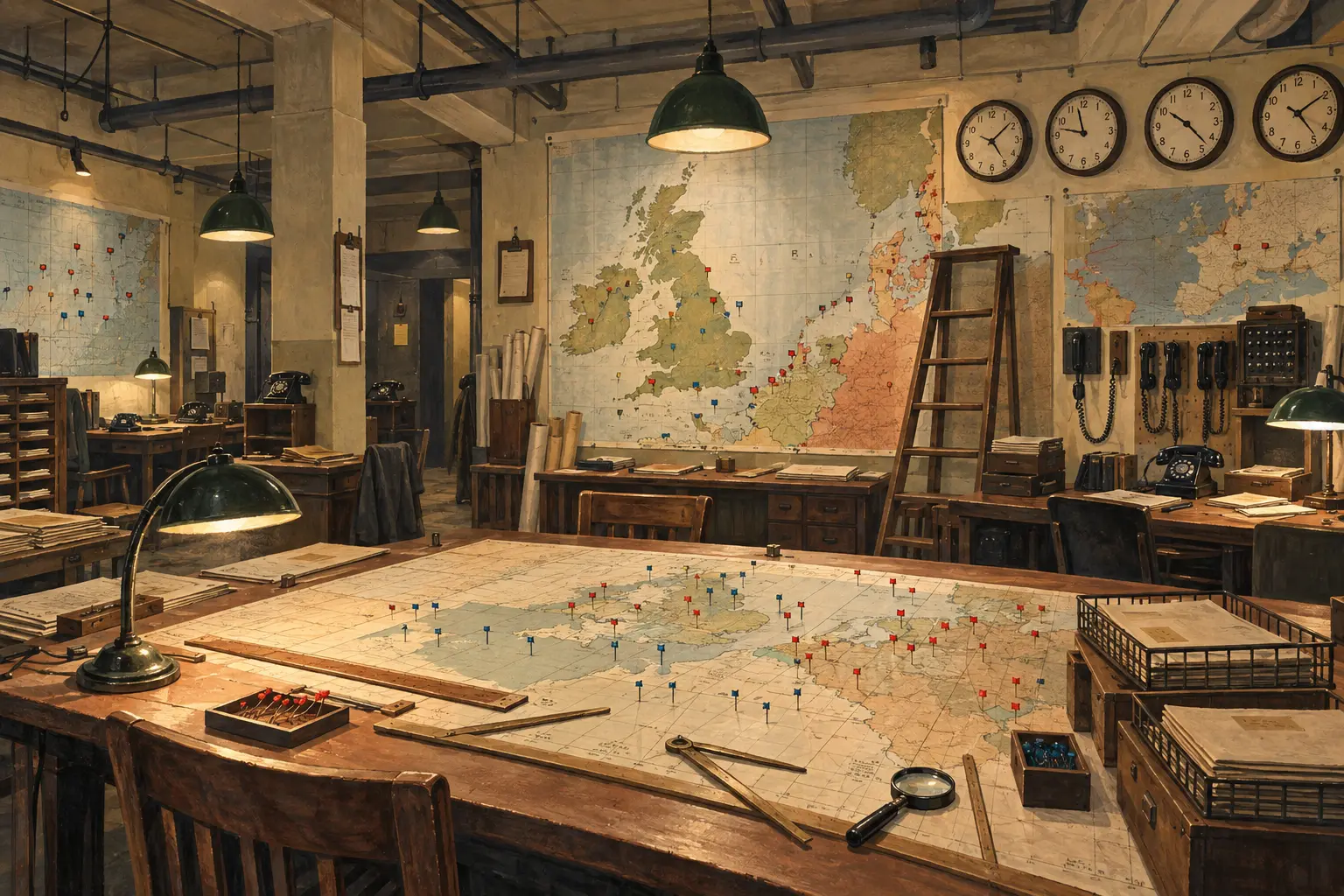
The Map Room was the information centre of the underground headquarters. Officers gathered and summarised military information around the clock, tracking developments across the different theatres of war. Maps, coloured pins, charts and telephone equipment make this one of the most absorbing rooms on the route.
Look closely at the marks and handwritten details rather than hurrying past. They help turn an enormous global conflict into the daily work of people receiving, checking and communicating information.
Churchill’s bedroom
Churchill had a private bedroom in the complex, although it was used more for work and occasional rest than as his regular sleeping quarters. The room includes a desk and broadcasting equipment. It offers a more personal counterpoint to the formal Cabinet Room.
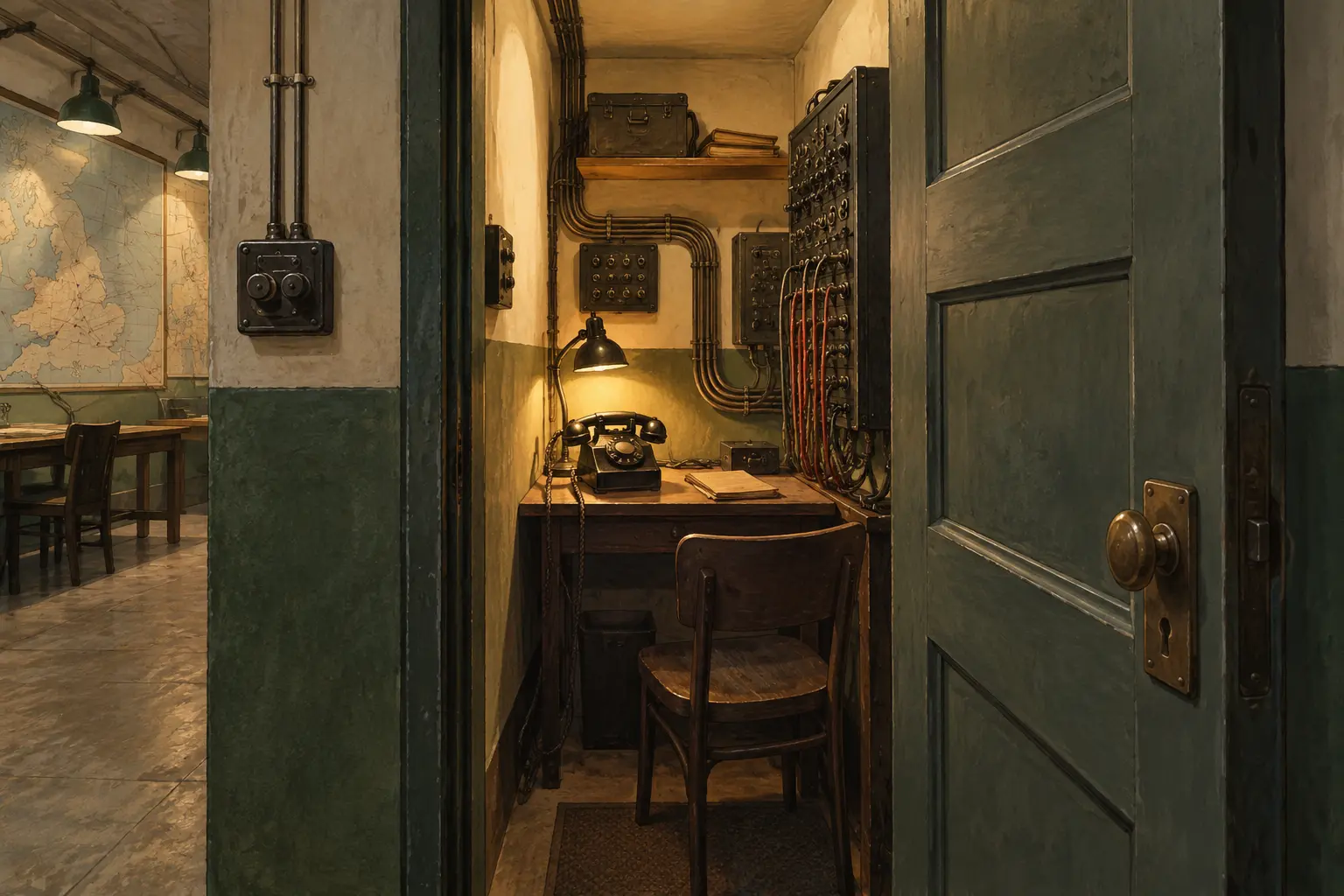
The Transatlantic Telephone Room
One of the most intriguing spaces is a tiny room disguised as a private lavatory. It housed secure telephone equipment used for conversations with the United States. It is an excellent example of how secrecy was woven into the everyday-looking fabric of the site.
The Churchill Museum
The Churchill Museum broadens the story beyond the war years. It follows Churchill’s life through politics, military service, writing, painting, family life and public reputation. Give yourself time here: the volume of material can be easy to underestimate after the drama of the underground rooms.
A thoughtful visit should also leave room for complexity. Churchill’s wartime leadership is central to the museum, but his long career, imperial outlook and political decisions remain subjects of historical debate. He was a consequential figure, not a simple character from a patriotic poster.
How long do you need at the Churchill War Rooms?
Allow at least two hours for a first visit. Around two and a half to three hours is more comfortable if you like reading displays, listening to the audio guide or exploring the Churchill Museum properly. Serious history enthusiasts could remain longer.
- About 90 minutes: possible for a selective visit, but likely to feel rushed.
- Two to three hours: a sensible allowance for most visitors.
- Half a day: worthwhile if you want to examine the museum displays in depth.
The route contains confined spaces and can become busy, so progress is not always quick. If you are combining the visit with another timed attraction, leave a buffer rather than planning your day to the minute.
Tickets, prices and opening times
Book through the official Imperial War Museums website. Prices, concessions, opening hours and entry arrangements change, so it is far safer to check the live calendar than rely on a figure copied into a travel article.
Advance booking is sensible because the underground site has limited capacity and popular times can sell out. Read the arrival instructions on your ticket carefully; timed-entry rules may specify how late you can arrive. Check the official accessibility information at the same time if anyone in your party has mobility, sensory or other access requirements.
Where are the Churchill War Rooms?
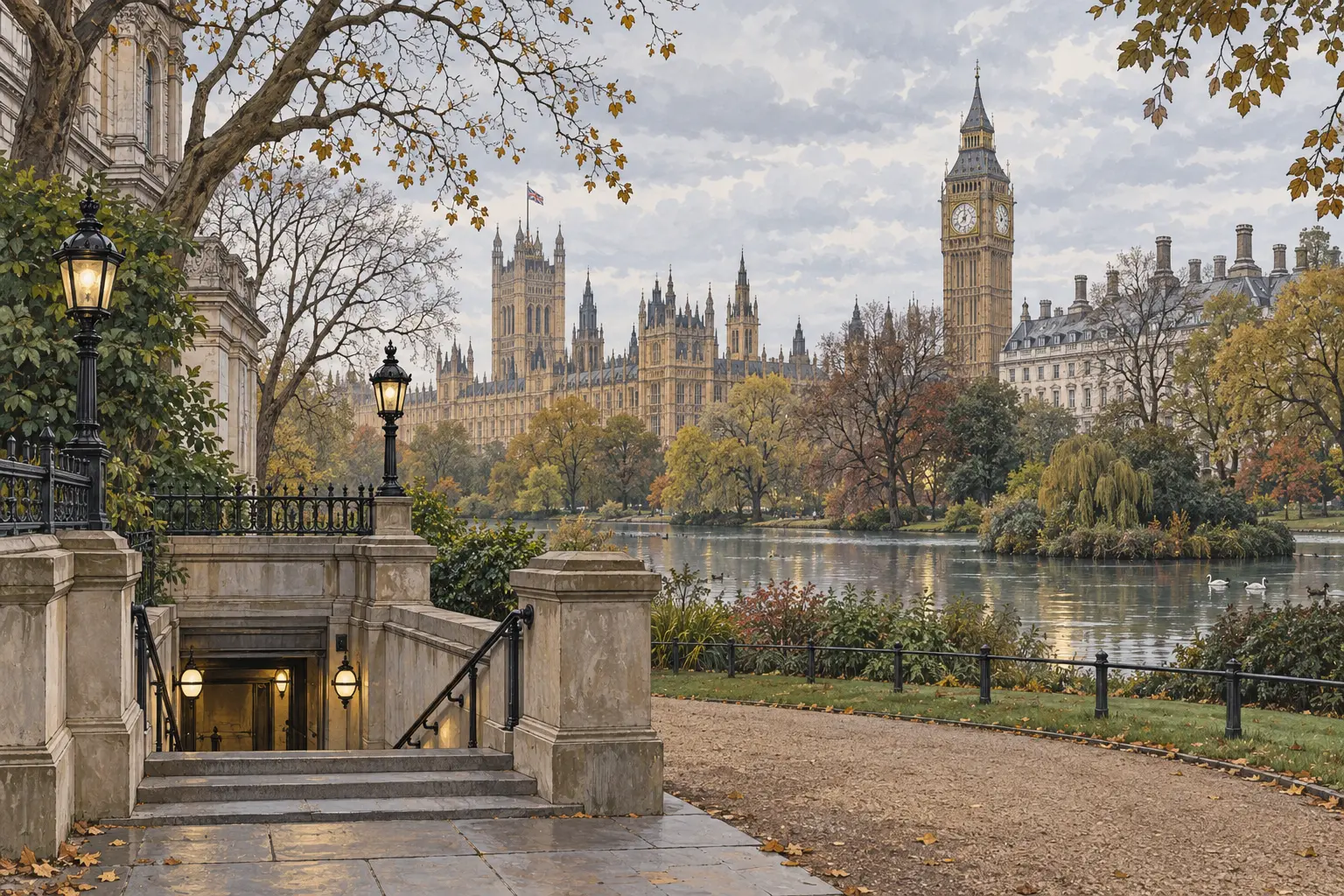
The entrance is on Clive Steps, King Charles Street, close to the junction of Whitehall and Horse Guards Road in Westminster. It is within easy walking distance of the Houses of Parliament, Westminster Abbey, St James’s Park and Trafalgar Square.
- Westminster Underground station: useful for the Jubilee, District and Circle lines.
- St James’s Park Underground station: another convenient option on the District and Circle lines.
- Charing Cross: practical if arriving by National Rail and happy to walk through Whitehall.
London transport and station access can change, so check your route on the day. The entrance is below street level and not as visually obvious as the neighbouring landmarks; allow a few minutes to locate Clive Steps rather than circling Westminster in an increasingly un-Churchillian mood.
Tips for a better visit
- Book a quieter slot if you can. The narrow corridors feel much more atmospheric when they are not packed.
- Do not skip the audio guide. Where included or available, it can add context that is difficult to fit onto labels.
- Wear comfortable shoes. You will be standing and moving slowly for a substantial part of the visit.
- Expect a warm, enclosed environment. Layers are useful, particularly if you arrive bundled up for a cold London day.
- Pause at the small details. Telephones, sugar cubes, handwritten notes and sleeping arrangements often say more about daily life than the grand narrative.
- Check photography rules when you arrive. Museum policies and restrictions can change.
What to visit nearby
The location makes the War Rooms easy to build into a Westminster day. Our Houses of Parliament tour guide is the most natural companion article, while the London weekend-break guide can help place it within a longer itinerary.
- Houses of Parliament and Big Ben: roughly a short walk south.
- Westminster Abbey: another major historic site nearby.
- St James’s Park: ideal when you need daylight and open space after several hours underground.
- Whitehall and Trafalgar Square: an easy northbound walk past several government landmarks.
Avoid cramming all of them into a frantic checklist. The War Rooms reward concentration, and Westminster crowds can make even short distances take longer than expected.
Final thoughts
The Churchill War Rooms are compelling because they make history feel physical. The low ceilings, crowded desks and preserved maps strip away some of the distance created by textbooks. You see not just famous leaders, but the working environment of the many people who kept information moving while London was being bombed overhead.
It is a serious and sometimes claustrophobic place, but also full of intensely human details. If you have time for only one paid wartime-history attraction in central London, this is a strong choice—and certainly one you are unlikely to confuse with an ordinary museum gallery.
Have you visited the Churchill War Rooms? Share the detail that stayed with you most in the comments below.