
Written by Gary
Co-author and amateur historian
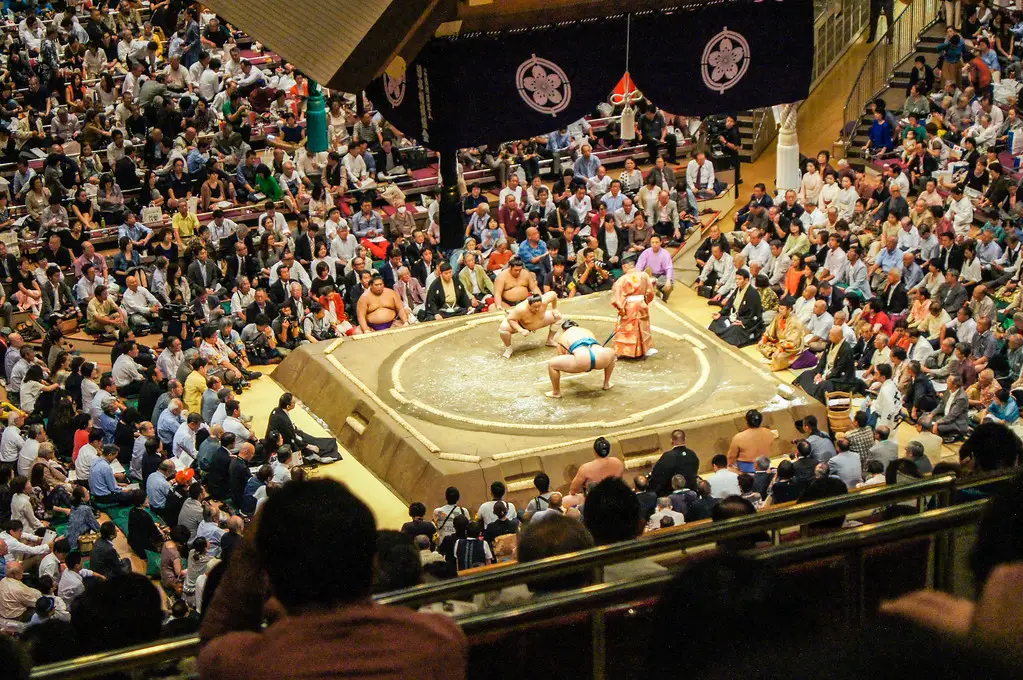
For four minutes you can feel the tension build in the air. Salt is sprinkled, feet are stamped and intimidation is radiated. A four-minute build-up for a 10 seconds release, but what a release! The collision of power and weight coming together can be felt in the entire room and I love it.
That, in essence, is what sumo wrestling is all about. Our incredible holiday to Japan just happened to coincide with the September sumo tournament. Tokyo also hosts tournaments in January and May. And we were lucky enough to get some tickets for the Tokyo tournament at the famous arena Ryōgoku Kokugikan in Sumida.
We watched the top-division bouts on one day of the September 2015 tournament, from the upper chair seats. Everything further down about tickets, prices and timings is current, checked on the Japan Sumo Association’s website on 29 September 2026.
The short version
- Tokyo’s tournaments are held in January, May and September, at Ryogoku Kokugikan.
- Buy tickets through Ticket Oosumo English, linked from the Japan Sumo Association’s website. Sales open about a month before each tournament, and popular days can sell out on the first day.
- For two people, book chair seats. Boxes are sold whole, for four.
- Be in your seat by about 15:30 if you want to see the top-division ring-entering ceremony. The day finishes at around 18:00.
- Worth planning a trip around. I’d never seen sumo before we went and came away hooked.
What a sumo tournament day actually feels like
Most of a bout is the build-up, and it follows the same pattern every time.
Before the wrestlers begin each fight they sprinkle some salt around the ring to purify it. They then take up their positions, in a low crouch facing each other.
For several minutes the wrestlers eye each other up, dropping themselves and rising up again. This is a form of intimidation. It is intended to put off the opponent.
And then it changes very quickly. The wrestlers collide and immediately start trying to grab, toss, push or pull each other. Within seconds, one can give by the smallest amount and the bout is finished.
So if you’re hoping for non-stop action, this isn’t it. The long ritual and the short burst are the whole point, and that rhythm repeats bout after bout, all afternoon.
Before some bouts you’ll see colourful banners carried round the ring. These are kensho, and each one is a sponsor of the bout that’s about to start. They’re easy to mix up with the ring-entering ceremonies, but those happen separately, before each of the top two divisions begins.
How a tournament day runs, and when to arrive
A ticket covers the whole day, and the rank of the wrestlers climbs as it goes on. The lower divisions start in the morning. The big names don’t appear until late afternoon.
The approximate timings below are based on the September 2026 tournament. Check the schedule for your own tournament, because timings can change, especially over the final three days.
| Part of the day | Approximate time |
|---|---|
| Doors open, days 1–12 | 08:45 |
| Lower-division bouts | From about 09:25 |
| Juryo ring-entering ceremony | About 14:15 |
| Juryo bouts | About 14:35 |
| Makuuchi ring-entering ceremony | About 15:40 |
| Yokozuna ring-entering ceremony | About 15:55 |
| Makuuchi bouts | About 16:10 |
| Highest-ranked wrestlers | After about 17:00 |
| Bow ceremony | About 17:55 |
| Finish | About 18:00 |
Days 13–15 run differently. Doors open later and the final day finishes earlier, so check the schedule for the day you’re going rather than relying on this table.
In 2015 we didn’t get to the Kokugikan until around 4:30pm, because we’d spent the day sightseeing around east Tokyo first (more on that further down). Arriving that late was fine for the top-division bouts, which were what we’d come for. But going by the usual timetable, it almost certainly meant we’d missed the Makuuchi and Yokozuna ring-entering ceremonies.
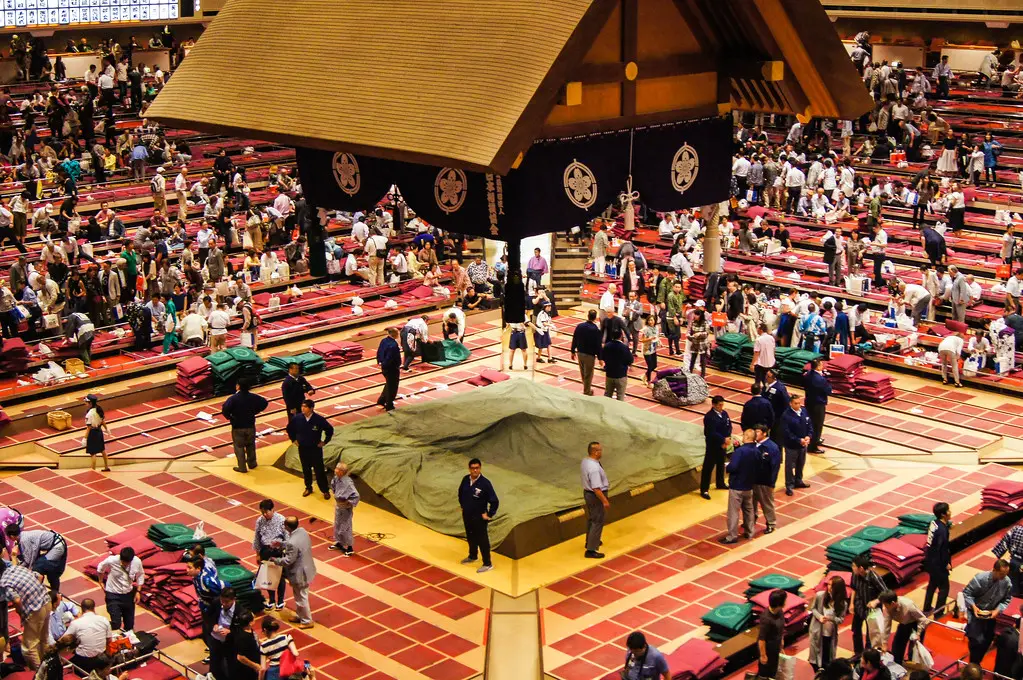
If those ceremonies matter to you, aim to be in your seat by around 15:30. You could also come in the morning, while the lower divisions are on and the hall is still quiet, and give yourself time to look around. Or turn up in the early afternoon as the Juryo division gets going and the seats start to fill.
Your ticket allows one re-entry, so you don’t have to sit inside from morning until 6pm. You could come early, pop out for lunch and head back in for the top division.
Choosing your seat at Ryogoku Kokugikan
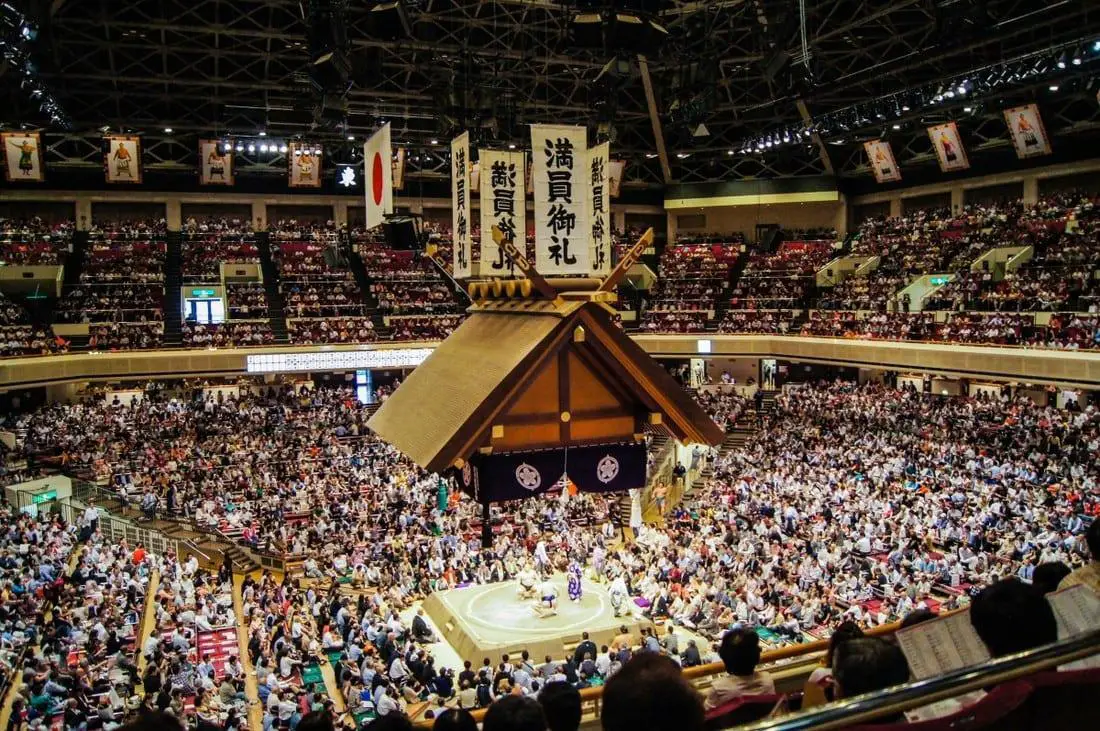
The dohyo sits on a raised clay platform in the centre of the arena, with the ring itself marked out by straw bales. Above it hangs a roof that resembles a Shinto shrine, with coloured tassels dangling from the corners.
How close you want to be makes a big difference, both to the price and to how you’ll be sitting.
If you aren’t used to sitting on your knees in the Japanese style then you might want to dodge the cushions. We sat on the balconies and still had a great view during the day’s match.
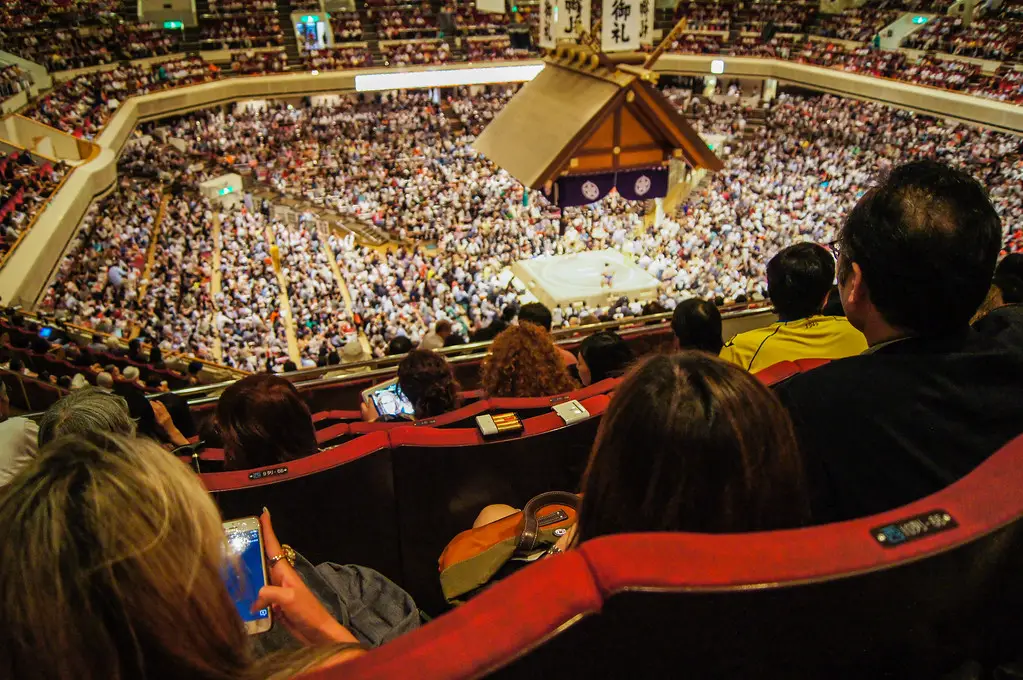
That still holds. The upper chair seats are ordinary seats, sold one at a time. Box seats get you nearer the ring, but you take your shoes off and sit on cushions on the floor with nothing to lean back on. They’re also sold as whole four-person boxes, so two of you still pay for four places.
| Seat | Where | Price: weekday / weekend or holiday | Good for | Watch out for |
|---|---|---|---|---|
| Chair C | Upper level | ¥3,500 / ¥4,000 per person | Keeping costs down; couples | Furthest of these from the ring |
| Chair B | Upper level | ¥5,000 / ¥5,500 per person | Couples who want a closer chair seat | Costs more than Chair C |
| Box C | Lower level | ¥34,000 / ¥38,000 per four-person box | Groups of four happy to sit on the floor | Sold as a whole box; cushions, no backrest |
| Box B | Lower level | ¥40,000 / ¥42,000 per four-person box | Groups of four who want to be nearer the ring | Same floor seating and whole-box pricing |
| Ringside | Immediately around the ring | Not on the standard price list | Adults who want to be as close as possible | 16+ only; no food, drink, cameras or phone use |
Prices are the Japan Sumo Association’s published prices at the time of writing, including tax. A separate handling fee is added when you buy.
Ringside really does mean ringside. Wrestlers have been known to go flying off the dohyo into the front rows, which is why those seats come with much stricter rules.
For two people, I’d choose chair seats rather than paying for an entire four-person box. If there are four of you and you’re genuinely comfortable sitting on the floor for several hours, a box makes a lot more sense. With younger children, I’d stick with chairs.
How to get tickets for a Tokyo tournament now
This is the bit of the old post that has changed the most.
We had our tickets sorted before we flew to Japan in 2015, and that part of the advice still stands. This isn’t something to leave until you arrive. What has changed is how you buy them, so please don’t follow the ticket instructions on older travel blogs, including earlier versions of this one.

When tickets go on sale
Tokyo hosts three of Japan’s six annual grand tournaments, all at the Kokugikan, which seats over 10,000 people. At the time of writing, the next Tokyo tournaments are:
| Tournament | Dates | Advance sale opens |
|---|---|---|
| January 2027 | 10–24 January 2027 | 5 December 2026 |
| May 2027 | 9–23 May 2027 | 10 April 2027 |
| September 2027 | 12–26 September 2027 | 7 August 2027 |
Dates from the Japan Sumo Association’s tournament schedule, checked 29 September 2026.
Popular days can sell out on the day tickets are released, so be ready when sales open.
Buying on the official English site
For visitors, the official route is Ticket Oosumo English, linked from the Japan Sumo Association’s English website. A handling fee is added to each ticket on top of the seat price, so check the total before you confirm, especially on a ¥3,500 chair seat.
If your date sells out
Ticket Oosumo has an official face-value resale system, so a sold-out day doesn’t necessarily mean you’ve missed your chance.
Keep checking the official resale rather than heading straight to a third-party reseller.
Sites to avoid
The Japan Sumo Association warns against buying from resale sites and says tickets bought through them may be refused at the entrance. Its notice names Ticket Ryutsu Center, Ticketjam, Buy Sumo Tickets, viagogo and StubHub.
Buy Sumo Tickets is the one this post used to send readers to, so if you’ve followed our older advice, please don’t use it now.
On the day: food, re-entry and a few rules
The Kokugikan is a short walk from Ryogoku Station, which is served by the JR Sobu Line and the Toei Oedo Line.
Hang on to your ticket stub if you pop out, as that’s what gets you back in.
You’re asked not to bring your own food or drink into the Kokugikan. There are bento, snacks and drinks for sale inside, including the arena’s own yakitori, and eating at your seat is fine everywhere except ringside.
Everyone aged four and over needs their own ticket.
Then, at around six, it’s all over. The streets fill up with spectators heading home.
This, however, is also a great time to head to a local eatery to enjoy a bowl of Chankonabe. This traditional sumo meal is high protein (obviously as sumo wrestlers need to build-up their mass), so be sure to have an empty stomach if you plan on finishing it.
Just don’t expect a cheap dinner. In 2015 the chanko restaurants around Ryogoku were charging roughly ¥3,000 and up.
Just enough sumo to follow the bouts
So what is Sumo wrestling? For those that have never heard of it, don’t make the mistake of comparing it to WWE wrestling – there’s no Hulk Hogan hitting someone over the head with a chair here.
Two wrestlers try to either throw each other out of the ring or force a part of their opponent’s body (other than the soles of the feet) onto the floor. That’s it.
It didn’t start out as a sport, though. Its roots are in Shinto ritual, which is where the salt comes in, and the gyoji (referees) still wear traditional court-style robes.
Professional wrestlers are known as rikishi, and they live and train in sumo stables, or heya. Every stable has a strict hierarchy, and a wrestler’s rank shapes his daily life as well as his place in the sport. He grows his hair long for the chonmage topknot, a style that goes back to the samurai of the Edo period.
During a tournament, the lower divisions compete first. Juryo, the second-highest division, follows later, with Makuuchi, the top division, taking over in the afternoon.
After the final bout of the day, a designated wrestler performs the bow ceremony, or yumitori-shiki, on behalf of the winner of that final bout. This isn’t the same as winning the whole 15-day tournament. The tournament champion receives the Emperor’s Cup.
And size isn’t everything. Smaller, lighter wrestlers can sometimes outmanoeuvre much bigger opponents, and historically wrestlers weren’t always built like the enormous rikishi most people picture today.
In Tokyo when there’s no tournament?
Tokyo only hosts grand tournaments in January, May and September. The other three are held in Osaka in March, Nagoya in July and Fukuoka in November.
If your Tokyo dates don’t line up with one, you can still visit the small Sumo Museum inside Ryogoku Kokugikan. Outside tournaments it’s free, generally open on weekdays from around 10:00 to 16:30, and usually closed at weekends and on national holidays. Check its calendar, because other closures apply. During tournaments, you need a tournament ticket to get in.
It isn’t a substitute for watching sumo, but it’s easy to combine with the Edo-Tokyo Museum next door (see the next section).
Travel tip: I would highly recommend that you plan your two-week trip to Japan around the same time as the sumo tournament in Tokyo. So in January, May or September.
Fitting sumo into your Tokyo day
We tried to fit rather a lot into our sumo day in 2015.
We started at Tokyo Skytree, visited Sumida Aquarium in the Solamachi complex and then went across to the Edo-Tokyo Museum before arriving at the Kokugikan at around 4:30pm. The museum was the bit that suffered. We ended up rushing it because we had the sumo to get to.
So I wouldn’t copy our day exactly.
If sumo is the priority, pick one thing for the morning, then head to Ryogoku in time to be inside by around 15:30. That way you’ve a much better chance of catching the top-division ring-entering ceremony than we did. Our Skytree and Ryogoku day guide has a version of the day built around tournament tickets.
The Edo-Tokyo Museum next door reopened on 31 March 2026 after its long renovation, so pairing it with the tournament is possible again. It’s normally closed on Mondays, and our Edo-Tokyo Museum guide covers how long to allow.
For the rest of your Tokyo planning, our five-day Tokyo itinerary splits the city into manageable areas rather than cramming everything into one day. And if you haven’t picked a base yet, our guide to where to stay in Tokyo can help with that.
Final thoughts
I’d never seen an actual game of sumo before I went to Japan but I certainly don’t regret attending the tournament as I am now hooked.
Whenever the sumo tournaments come up in Japan I always get NHK World, the Japan channel, on and watch it daily.
If your trip coincides with a tournament, start at the Japan Sumo Association’s official site and follow its link to Ticket Oosumo English, rather than relying on old ticket advice, including the original advice in this article.
An earlier version of this post pointed readers to buysumotickets.com. The Japan Sumo Association now lists that site among resale sites it warns against, so please use the official route instead.
If I were planning it again, I’d build the day around the sumo rather than tacking it onto the end of a full day, and I’d be in my seat in time for the top-division ring-entering ceremony.
Have you been to a sumo tournament in Japan? Let us know in the comments where you sat and what you thought!
This is so cool! Hope the sumo experience was awesome. Man would love to experience the Sumo match.
This looks awesome! Hope you have (had) a nice weekend! :-)
Lisa | Joy Della Vita Travelblog
Thanks Lisa! Have you ever been to Japan? And yes I had a wonderful relaxing weekend.