
The Palace of Westminster – home to the Houses of Parliament – has stood at the heart of British political life for centuries. With parts of the site dating back almost 1,000 years, it is one of London‘s best-known buildings and forms the backdrop to countless images of the capital.
But can you actually go inside the Houses of Parliament? Yes, you can. Visitors can explore the Palace of Westminster on a guided tour or self-guided multimedia tour, taking in famous spaces including Westminster Hall, Central Lobby, the House of Lords and the House of Commons.
Most people will recognise the Palace’s striking façade, but far fewer know what actually happens inside. In fact, it is a bit of a mystery. The complex rituals of the British political system are enough to confuse anyone, never mind someone who hasn’t grown up in this country.
Now I am going to let you in on a secret. My grandad, Bruce Millan, was a Scottish Labour politician, European Commissioner and Secretary of State for Scotland. He therefore spent a good chunk of his life in the Houses of Parliament, and my stepdad has visited the building on many occasions.
Seeing the interior of the Houses of Parliament for myself had therefore long been on my to-do list. Somehow, I was convinced that it would bring me a little closer to my grandad, who sadly passed away three years before my visit.
You can probably imagine how excited I was when I was invited to try the then-new self-guided audio tour in 2016, and why I took up the offer without a moment’s hesitation. The experience has since evolved into a multimedia tour, but much of the route through this extraordinary building remains the same.
So, what is a tour of the Houses of Parliament actually like, what can you see inside, and is it worth visiting? Here’s what we discovered.
Updated September 2026: I originally visited the Houses of Parliament in 2016. I’ve updated this guide with current information about visiting, tickets and photography rules while keeping my original experiences and impressions from the tour.
Disclosure: I was provided with a complimentary tour when I originally visited in 2016. All opinions and experiences described in this article are my own.
HOW TO VISIT THE HOUSES OF PARLIAMENT
There are in fact three ways to take a sneak peek inside the Houses of Parliament.
- You can stand as an MP and persuade tens of thousands of people to vote for you at the next general election. Granted, this is probably a bit too much hassle for most people.
- If you’re a UK resident, you can contact your local MP to find out about visiting Parliament, including free tours available to constituents. You can also visit the public galleries of the House of Commons and House of Lords when Parliament is sitting if you want to see British politics in action.
- Visitors can simply buy a ticket for a guided or self-guided tour of the Houses of Parliament. Public tours generally take place on Saturdays throughout the year, with additional dates available during parliamentary recesses. As the Palace of Westminster is a working building, dates and access can change, so it’s best to check the current schedule and book your tickets online in advance. Popular dates can sell out, and advance tickets are cheaper than buying them on the day.
To be honest, I had no idea that you could just buy a ticket for a tour of the Houses of Parliament. But I am glad you can. Gary and I went on a self-guided audio tour one Saturday afternoon, and it was brilliant. The experience has since evolved into a multimedia tour, but visitors still get to explore some of the most impressive parts of the Palace at their own pace. This is a really fun thing to do on a free weekend and we would highly recommend it.
If you are looking for other free things to do in your spare time, check out this very comprehensive list of London museums.


ENTRANCE AND SECURITY
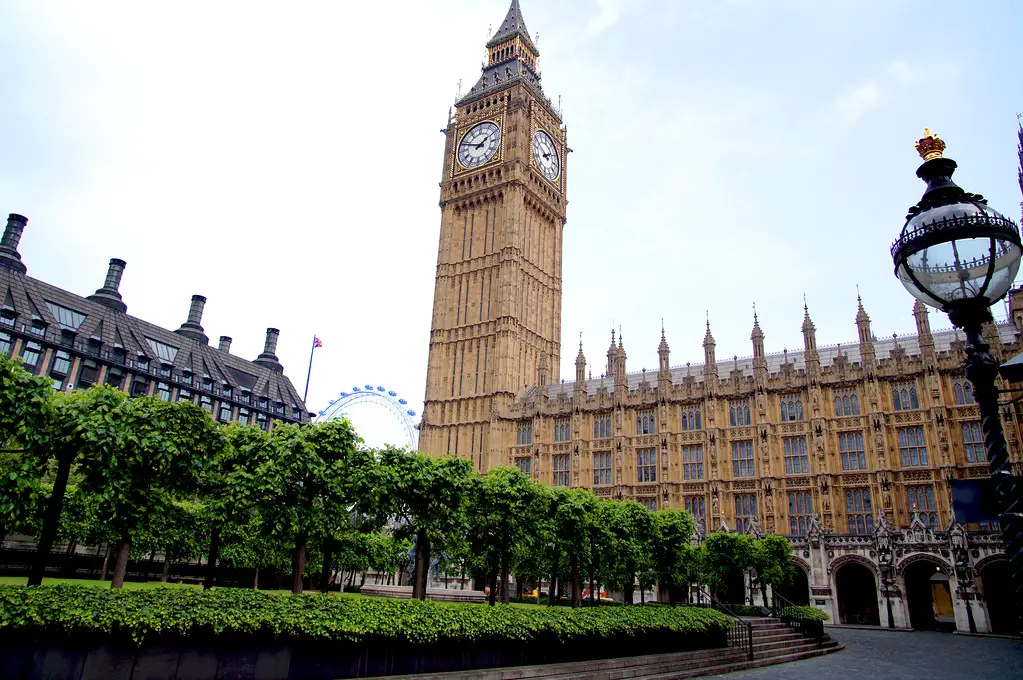
The entrance to the Houses of Parliament is at the Cromwell Green Visitor Entrance. Here you will be asked to show your tickets to a police officer. You’ll need to pass through airport-style security before entering the Palace, so allow plenty of time before your booked tour.
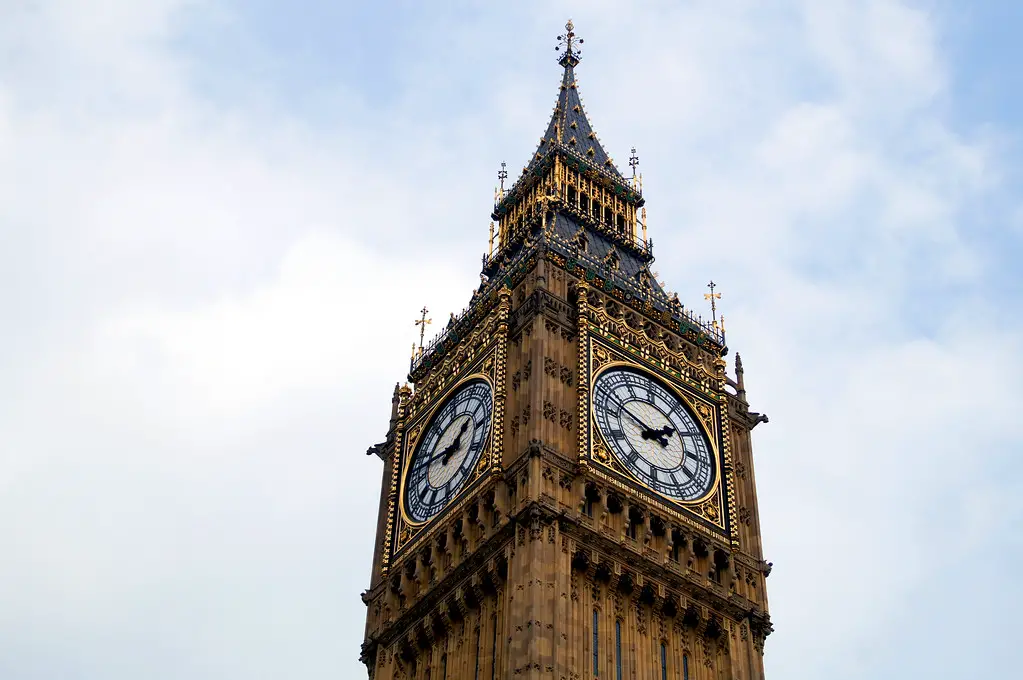
Fully scanned and searched, we were handed security badges and sent on to the courtyard below Big Ben. Despite what many of us call it, Big Ben is actually the nickname of the Great Bell inside the Elizabeth Tower.
We continued on into the medieval Westminster Hall to collect our audio guides and start the tour.
WESTMINSTER HALL
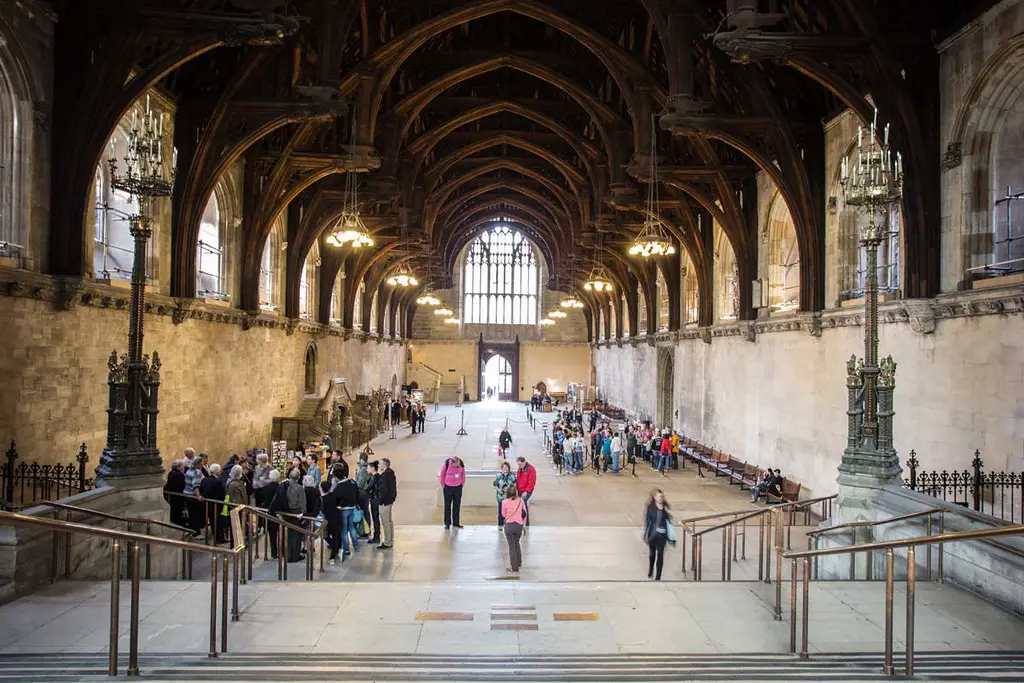
The cavernous Westminster Hall – dating back to 1097 – is the oldest surviving part of the Palace of Westminster. Together with the Jewel Tower, it is one of the few parts of the medieval palace to survive the devastating fire of 1834, after which much of the Palace of Westminster was rebuilt in its current Victorian neo-Gothic style.
Completed in 1099, Westminster Hall was designed to impress. Originally built by William II as a magnificent royal hall, it was a place for feasts, entertainment and great state occasions. Over the centuries, however, the Hall has played many different roles. It became home to important law courts and was the setting for famous trials, including those of William Wallace, Guy Fawkes and Charles I. It was also used for lavish coronation banquets for new monarchs.
It’s one of the largest undivided medieval spaces in the world, topped by its spectacular hammer-beam roof, and continues to be used for major ceremonial occasions and historic addresses. Nelson Mandela addressed both Houses of Parliament here in 1996, while Barack Obama did the same in 2011.
Remember to look out for the plaques on the floor marking famous historic events, including the trials of Thomas More and Charles I. I had chills run down my spine as I stood on the spot where Nelson Mandela addressed both Houses of Parliament in 1996.
Photography rules have changed since my visit. Visitors are currently allowed to take photographs in designated areas, including Westminster Hall and St Stephen’s Hall, but photography is not permitted throughout the tour route.



ST STEPHENS HALL
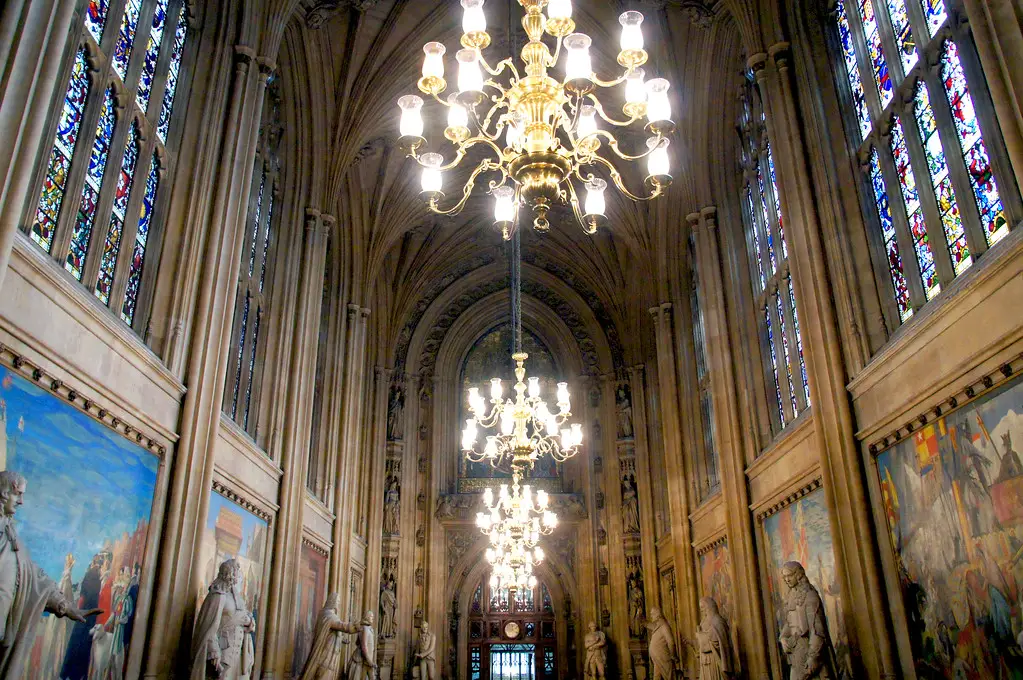
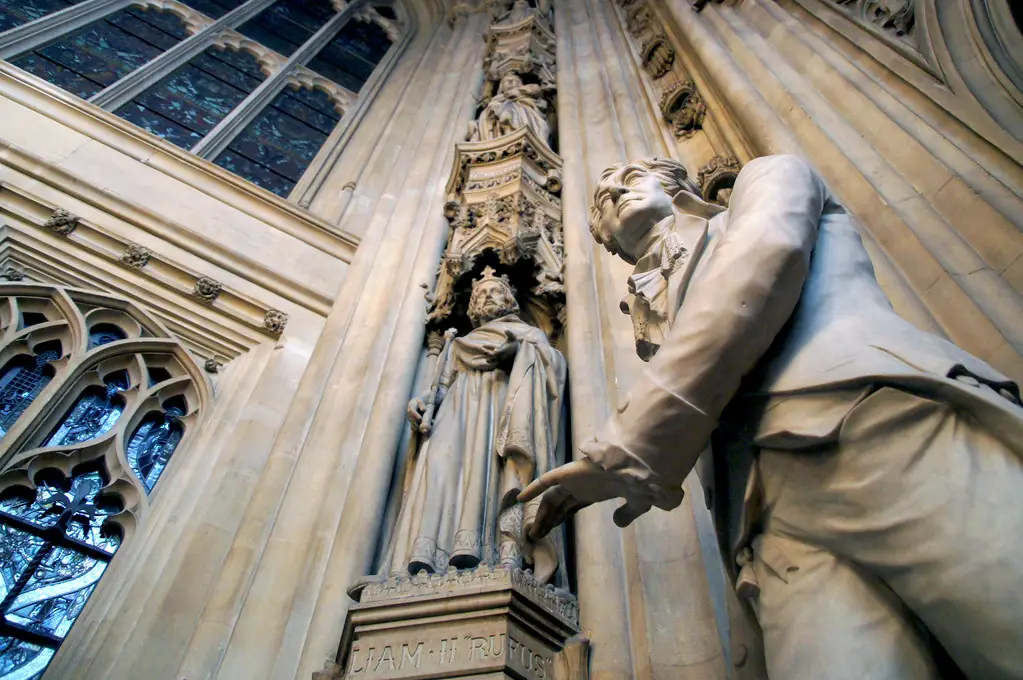
From Westminster Hall, the tour continues into St Stephen’s Hall. After the devastating fire of 1834, architect Charles Barry won the competition to design the new Palace of Westminster. He worked extensively with Augustus Welby Pugin, whose influence can be seen throughout the Palace’s elaborate Gothic interiors, furniture and decorative details.
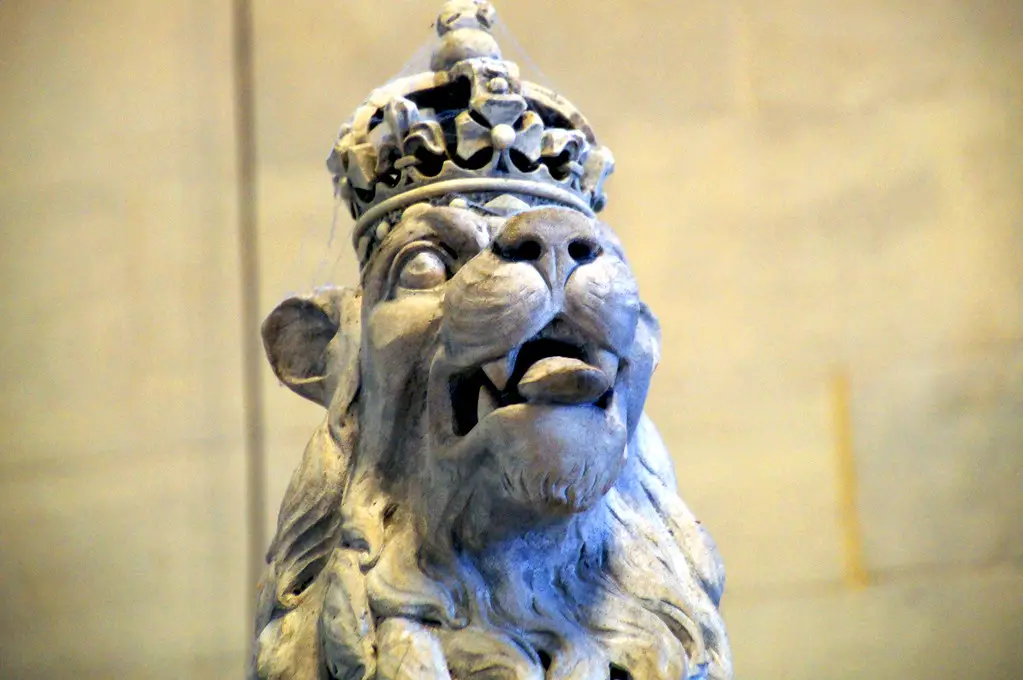
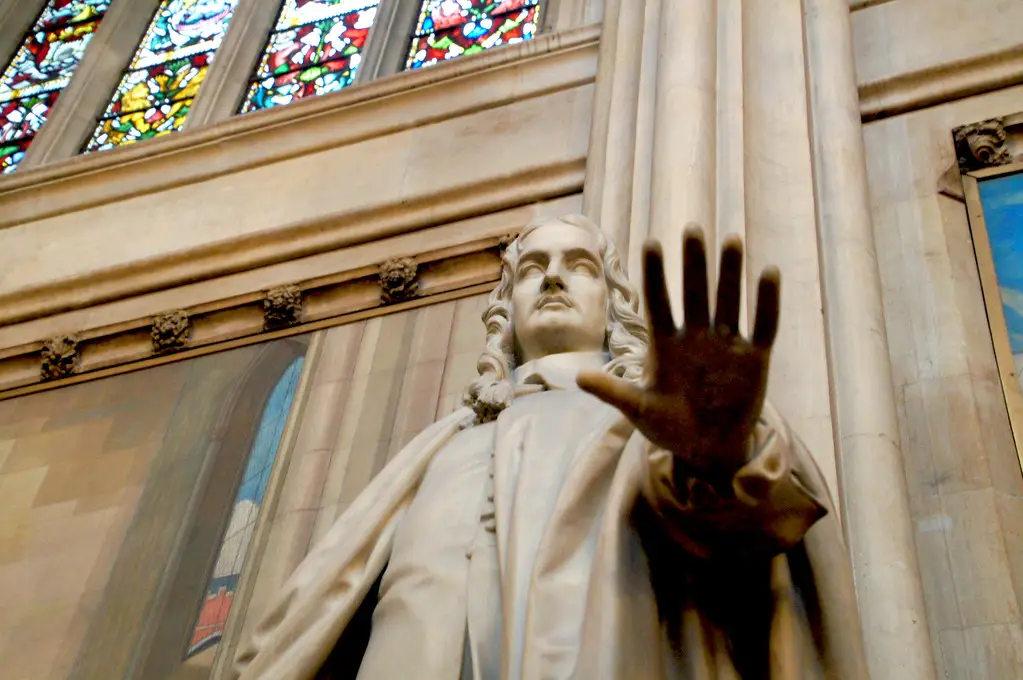
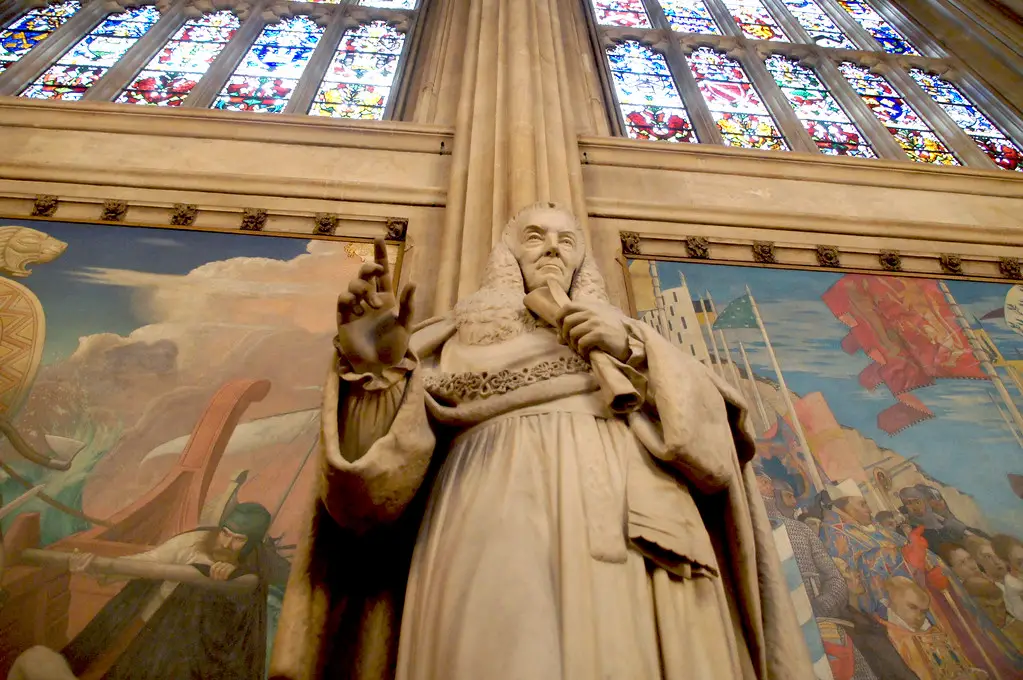
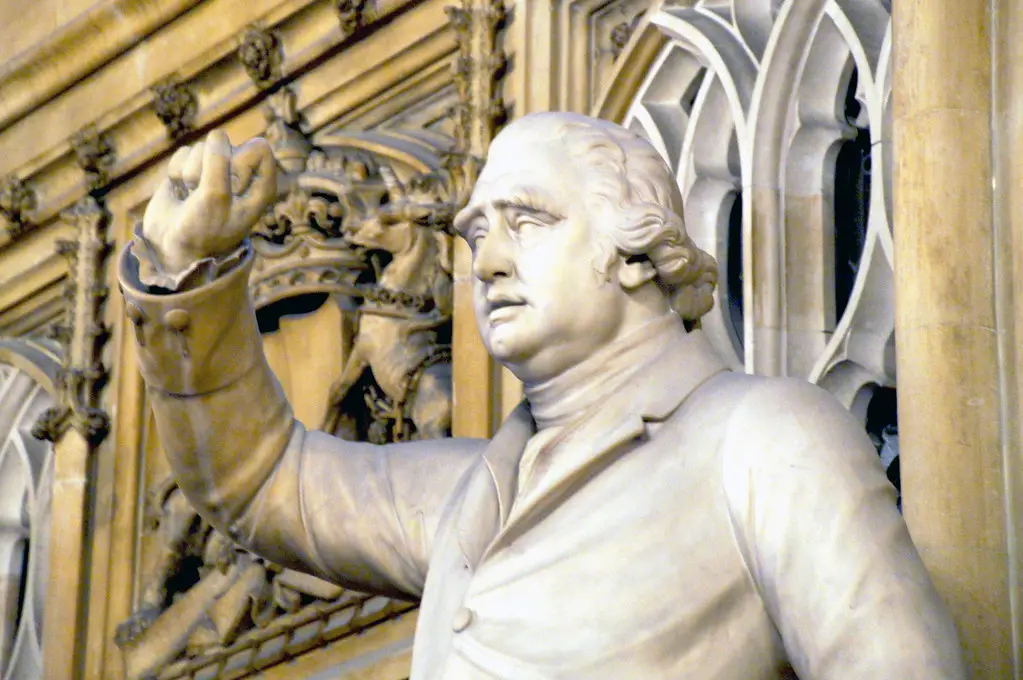
The Houses of Parliament were rebuilt in their splendid Victorian neo-Gothic style, drawing heavily on medieval architecture and art. The building is covered in symbolic details, both inside and out, and St Stephen’s Hall is a particularly impressive example, with its richly decorated walls, intricate architecture and numerous statues.
St Stephen’s Hall is stunning, and I was so glad we were able to take at least a couple of photos in here. Photography rules have changed since my visit, but visitors are currently still permitted to take photographs in St Stephen’s Hall.



THE CENTRAL LOBBY ROOM
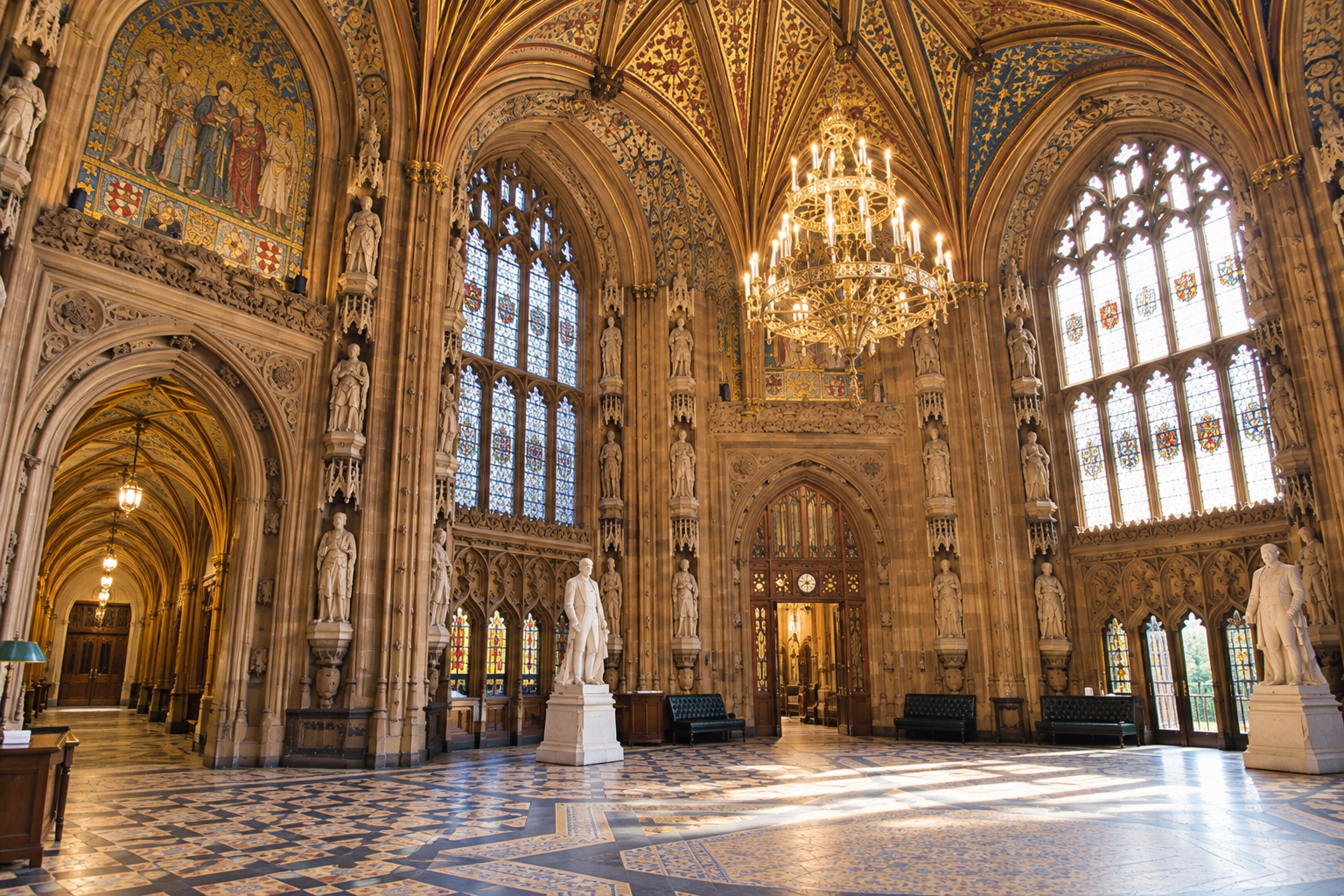
The tour then continues into Central Lobby, which sits at the heart of the Palace of Westminster and acts as a crossroads between the House of Lords and the House of Commons. If all the doors along the route are open, you can see from the Sovereign’s Throne in the Lords Chamber at one end all the way through to the Speaker’s Chair in the Commons at the other.
Central Lobby is an impressive octagonal space, with corridors leading off in four directions. Above the archways are beautiful mosaics representing the patron saints of England, Scotland, Wales and Ireland, while the interior is filled with intricate carvings, mosaics and other symbolic details.
You might recognise Central Lobby from political news coverage, as its distinctive interior has long been used as a backdrop for interviews and reports from Parliament. It is also where members of the public can ask to see their local MP when Parliament is sitting – a tradition associated with the term “lobbying”.
The House of Lords and House of Commons are accessed from opposite sides of the Lobby, making this quite literally the central point between the two Houses of Parliament.
AI-generated illustration
THE QUEEN’S ROBING ROOM
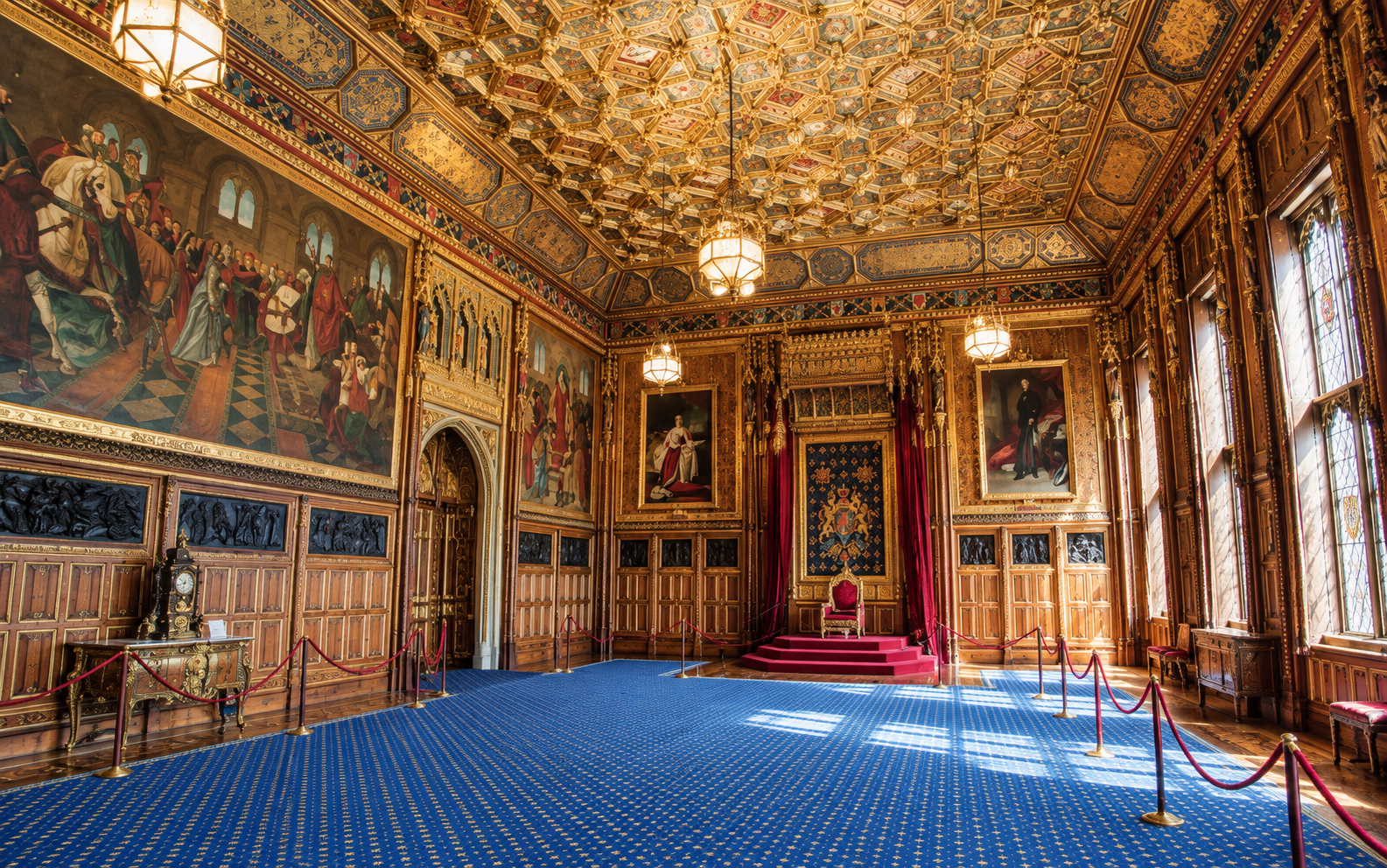
As the tour moves further through the building, it follows the ceremonial route taken by the monarch during the State Opening of Parliament. After entering the Palace of Westminster through the Sovereign’s Entrance, the King proceeds to the Robing Room, where he puts on the Imperial State Crown and ceremonial robes before making his way towards the House of Lords.
The Robing Room is one of the Palace’s most richly decorated interiors, with a series of paintings depicting scenes from Arthurian legend. It also features an elaborate Chair of State, created for Queen Victoria, with a special footstool. Queen Victoria was less than five feet tall, so the footstool would certainly have made the rather imposing chair a little more practical for her!
AI-generated illustration
THE ROYAL GALLERY
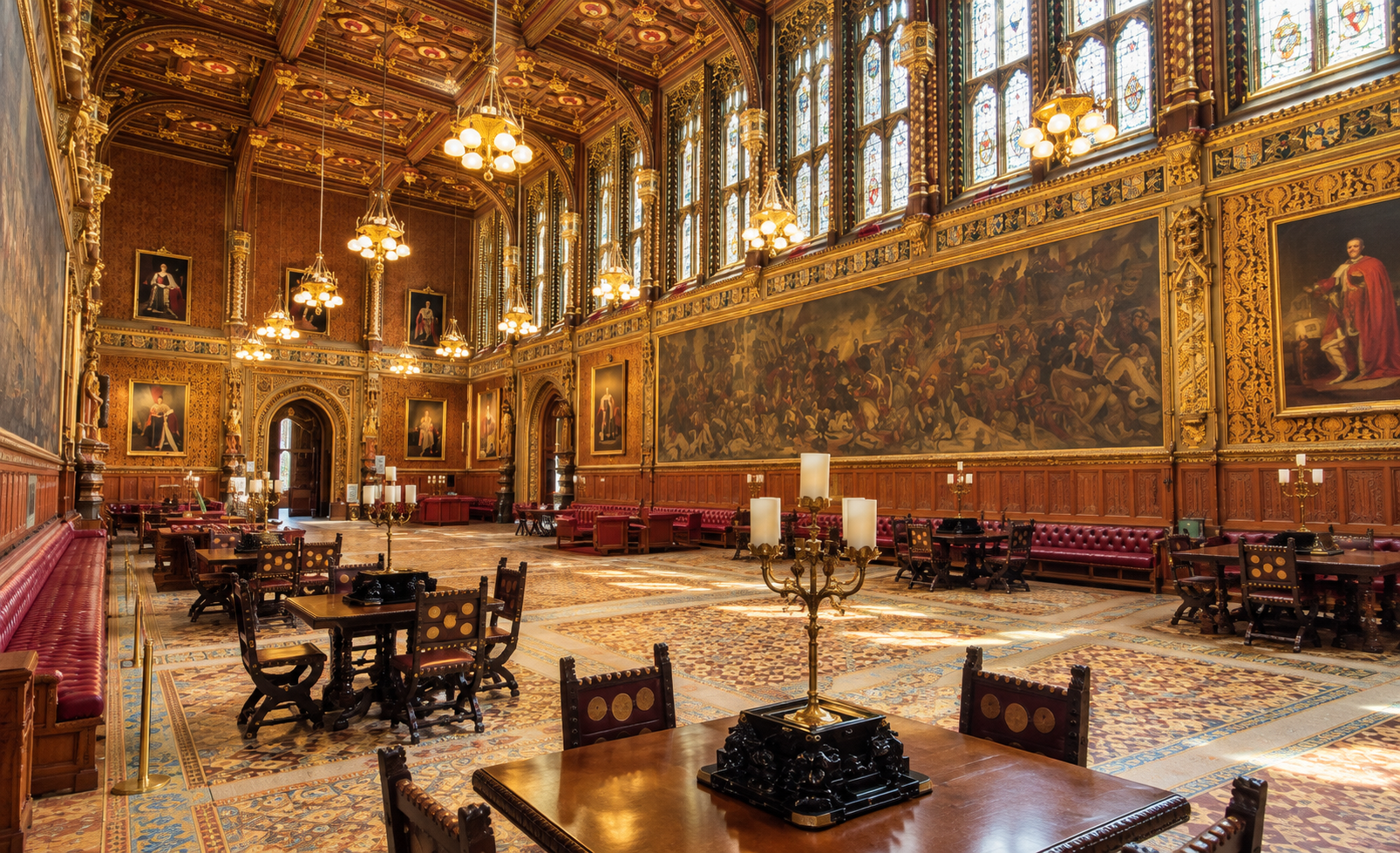
The Royal Gallery is a magnificent room between the Lords Chamber and the Robing Room. It is one of the largest rooms in the Palace and is richly decorated in red and gold. Dominating the room are two enormous frescoes depicting famous British military victories. One shows the death of Nelson at the Battle of Trafalgar, while the other depicts the meeting of the Duke of Wellington and Marshal Blücher after the Battle of Waterloo.
The walls are also lined with portraits of British monarchs, adding to the distinctly royal feel of the room. An alcove contains an ornate Book of Remembrance commemorating members of the House of Lords and their sons who died during the Second World War.
There are also some particularly poignant reminders of the war. On the floor in front of the Book of Remembrance is a piece of timber taken from a jetty used during the evacuation of Dunkirk in 1940. Nearby is a box divided into five sections containing sand from Utah, Omaha, Gold, Juno and Sword – the five Allied landing beaches used during the D-Day landings in Normandy.
AI-generated illustration
THE PRINCES CHAMBER
The next room on the tour is the Prince’s Chamber, an anteroom to the House of Lords where members can meet and discuss parliamentary business. The room is richly decorated with portraits of figures from the Tudor dynasty, including Henry VIII and his six wives.
The chamber also contains a series of paintings depicting important events from Tudor history, including scenes relating to the Spanish Armada. At the centre of the room stands an imposing marble statue of Queen Victoria, accompanied by figures representing Justice and Mercy.
THE HOUSE OF LORDS
Then it’s on into the House of Lords, one of the most lavishly decorated parts of the Palace, filled with deep reds and gleaming gold. Having seen the chamber so many times on TV, the biggest surprises for me were the beautiful stained-glass windows, intricate wood carvings and frescoes above the benches. That, and the forest of microphones hanging down to capture every word of the debates.
At the front of the chamber is the magnificent gilded Sovereign’s Throne, where the monarch sits during the State Opening of Parliament. In front of it is the Woolsack – a large red, wool-stuffed seat used by the Lord Speaker. Its unusual name dates back to the medieval period and reflects the enormous importance of the wool trade to the country’s economy.
The Woolsack is still stuffed with wool today, though unfortunately we weren’t allowed to test out how comfortable it is! In fact, visitors aren’t allowed to sit on any of the benches, with plenty of signs around the chamber reminding you not to do so.
At this point it’s worth mentioning that this is a fairly long tour. The current multimedia tour takes around 90 minutes, so comfortable shoes are definitely a good idea.
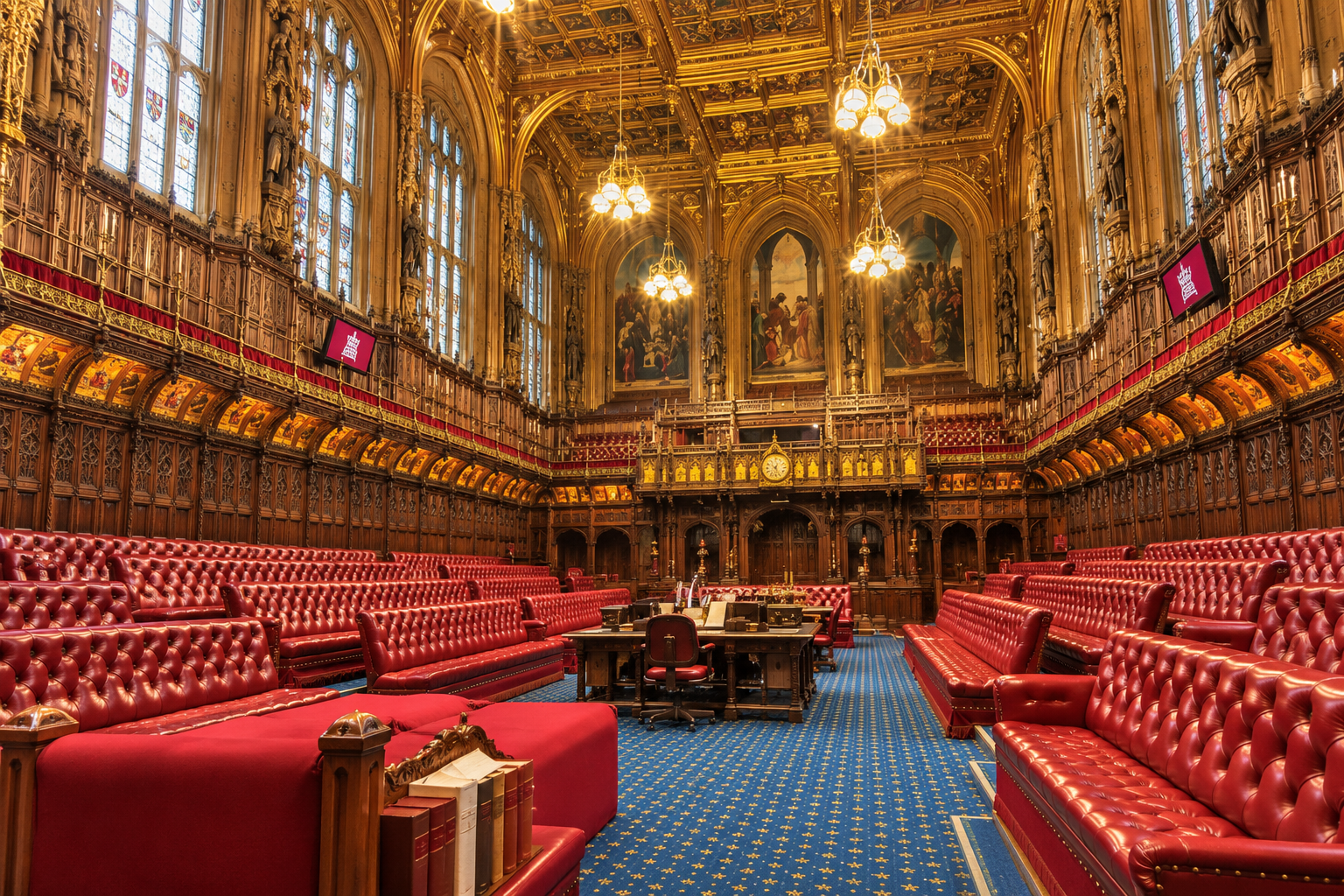
AI-generated illustration
MEMBER’S LOBBY
The Members’ Lobby lies just outside the House of Commons and is decorated with paintings, busts and statues commemorating prominent figures from British political history. Among the most imposing are statues of former Prime Ministers Winston Churchill, David Lloyd George, Clement Attlee and Margaret Thatcher.
If you look closely at the entrance to the Lobby, you can still see evidence of the Second World War. The stonework around the arch bears visible bomb damage from the air raid of May 1941, when the House of Commons Chamber was destroyed. Rather than repairing every trace of the damage, some of it was deliberately left as a reminder of the Palace’s wartime history.
THE HOUSE OF COMMONS
The final room to visit on the tour is the House of Commons. While the public can visit the Chamber, by tradition the monarch does not enter it. Instead, during the State Opening of Parliament, MPs are summoned to the House of Lords to hear the King’s Speech.
What struck me most as I moved from the House of Lords to the House of Commons was just how different the two chambers felt. The House of Lords glows in shades of gold, red and blue and is filled with elaborate decoration. In contrast, the House of Commons is much simpler and more subdued, with its instantly recognisable green leather benches and dark woodwork.
The Commons Chamber was destroyed by bombing during the Second World War and subsequently rebuilt under architect Sir Giles Gilbert Scott, reopening in 1950. Scott was also responsible for Battersea Power Station and the iconic red telephone box. The new Chamber retained the intimate proportions of its predecessor and is surprisingly small when you see it in person.
In fact, there aren’t enough seats for every MP, which helps create the famously crowded and intense atmosphere during important debates. The Speaker’s Chair sits at one end of the Chamber, with the Government benches to the Speaker’s right and the Opposition benches to the left.
I never felt closer to my grandad than in that moment, picturing him sitting there on one of the Government benches, calmly but passionately getting involved in the heated debates at hand.
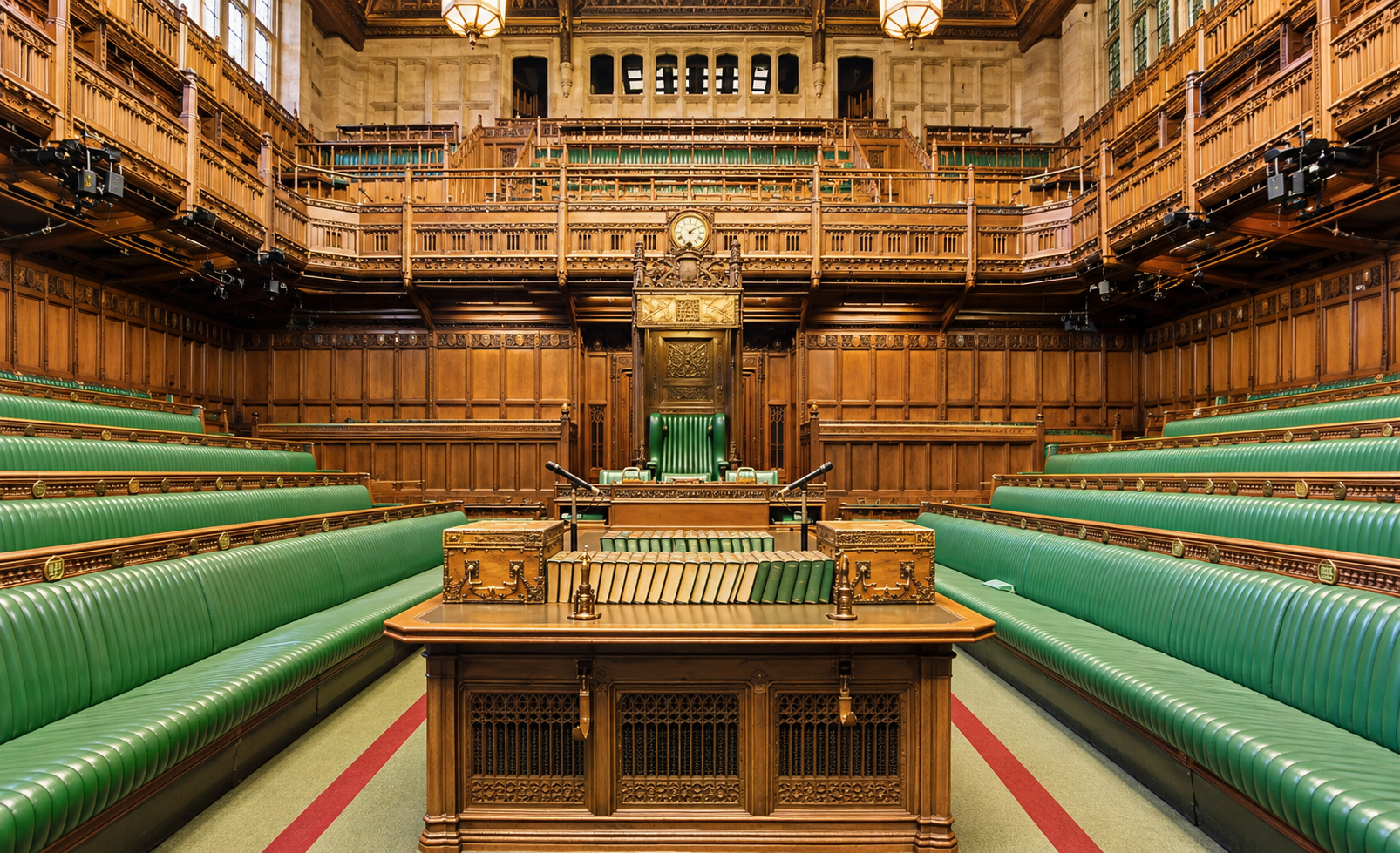
AI-generated illustration
THE AUDIO TOUR OF THE HOUSES OF PARLIAMENT
When we visited in 2016, Parliament had recently introduced its new self-guided audio tour. The experience has since evolved into a multimedia tour, but visitors can still choose between exploring the Palace independently or joining one of the guided tours.
We really enjoyed walking around the Houses of Parliament at our own pace, while other visitors were being shown around in groups. Audio guide in hand, it was easy to avoid the larger tour groups if we didn’t mind varying our walking pace a little.
We made sure to listen to every chapter of the audio guide, including the optional sections, and were really impressed by the amount of detail. It was particularly fascinating learning about the processes and traditions of Parliament while actually standing in the rooms where they happen.
For example, I had no idea that when MPs are called to vote, division bells ring around the Parliamentary Estate and in a number of nearby buildings to alert them. MPs then have a limited amount of time to reach the division lobbies before the doors are locked. Hearing about traditions like this while standing inside Parliament really brought the building to life.
One of the biggest advantages of choosing the self-guided option is the freedom to explore at your own pace. You don’t need to worry about standing at the front of a group to hear your guide or keeping up with everyone else. Instead, you can take your time looking around the Houses of Parliament and spend longer in the spaces that particularly interest you.
The original audio guides we used were easy to follow, with separate adult and family versions following the same route. Our tour was presented in the style of a live news broadcast, with time-travelling reporters covering stories connected to Parliament, from Magna Carta in 1215 to the Gunpowder Plot in 1605.
Today, the self-guided experience has developed into a multimedia tour, which can be followed using a supplied multimedia handset or on your own device. It covers more than 15 stops around the Palace, including Westminster Hall, Central Lobby and the chambers of the House of Commons and House of Lords. The current tour takes around 90 minutes, although exactly how long you spend exploring is ultimately up to you.

WHY VISIT?
From the Commons, it’s back to Westminster Hall and the end of the tour. The Palace of Westminster is a fascinating place to visit, and we definitely learnt a huge amount about the history and traditions that lie at the heart of British politics.
Having learnt the theory, though, I came away wanting to go back and see it all in practice – to experience the Houses of Parliament as a working building, packed with MPs and filled with the noise and atmosphere of a lively debate. So next time, I’ll be heading for the public gallery to see how it’s really done!
I found the tour fascinating and would definitely recommend it. There’s a real sense of living history as you walk through the Palace, particularly because these spectacular historic rooms aren’t simply preserved for visitors – they are still at the centre of British political life today.
Given its incredible architecture, extraordinary history and continuing political importance, I would personally recommend visiting the Houses of Parliament over the Tower of London and even Windsor Castle. I think there’s more to see inside the Palace than many people realise, and the sheer scale and grandeur of the building gives it something of a ‘castle’ feel as you walk through it.
It’s also right smack dab in the centre of London, unlike Windsor. The Tower of London is perhaps a little more accessible as a visitor attraction, but for me it simply can’t compete with the Houses of Parliament when it comes to its interiors.
HOUSES OF PARLIAMENT TOUR: TICKETS, PRICES & PRACTICAL INFORMATION
The Houses of Parliament are open to visitors on most Saturdays throughout the year, with additional tour dates available on selected weekdays during parliamentary recesses. As the Palace of Westminster is a working building, opening dates and access can occasionally change at short notice, so it’s always worth checking the latest information on Visit Parliament before your trip.
You can choose between a guided tour and a self-guided multimedia tour. The multimedia tour takes around 90 minutes and can be followed using a supplied handset or your own device. As of September 2026, advance tickets cost £31 for adults aged 25+, £24 for young people aged 16–24, and £12 for children aged 5–15. One child aged 5–15 can visit free with each full-paying adult, while children under five are free but still require a ticket. Guided tours are also available and take around 90 minutes. As prices and availability can change, I recommend checking the latest prices when booking.
If you’re a UK resident, you may also be able to arrange a free tour through your local Member of Parliament. Tours of Big Ben and the Elizabeth Tower are now booked separately and are not included with a standard tour of the Palace of Westminster. These tours are available to visitors aged 11 and over and involve climbing 334 steps.
Booking and further info: www.parliament.uk/visiting
HOUSES OF PARLIAMENT QUICK FAQ
Can you go inside the Houses of Parliament?
Yes. Visitors can explore the Palace of Westminster on selected dates by booking either a guided tour or a self-guided multimedia tour. The tour includes famous spaces such as Westminster Hall, Central Lobby, the House of Lords and the House of Commons.
How long does the Houses of Parliament tour take?
The self-guided multimedia tour takes around 90 minutes. You should also allow extra time before your tour to pass through airport-style security at the entrance to Parliament.
Can you take photos inside the Houses of Parliament?
Photography is only permitted in certain areas of the Palace of Westminster. Visitors can currently take photographs for personal, non-commercial purposes in Westminster Hall, St Stephen’s Hall and the visitor area of New Palace Yard. Photography is not permitted throughout most of the tour route.
Does the Houses of Parliament tour include Big Ben?
No. A standard tour of the Houses of Parliament does not include a tour of Big Ben and the Elizabeth Tower. Big Ben tours are booked separately and involve climbing 334 steps to reach the belfry.
Is the Houses of Parliament tour worth it?
Absolutely, in my opinion. What makes the tour particularly special is the combination of spectacular architecture, centuries of British history and the fact that the rooms you are walking through are still at the centre of British political life today. For me, it is one of the most fascinating buildings you can visit in London.
Note: Photography is only permitted in certain areas of the Palace of Westminster. As photography isn’t permitted in most rooms on the tour, some interior images in this article have been created using AI to illustrate the spaces described. They are illustrative and may not reproduce every architectural detail exactly.
Disclaimer: I was provided with a complimentary tour when I originally visited the Houses of Parliament in 2016 for the purpose of this review. This did not influence my opinions, and all experiences and views expressed in this article are my own.
Have you ever been inside the Houses of Parliament?
Comment below and let us know!
Did you Enjoy this article?
Share it with your friends and family on FACEBOOK, TWITTER AND PINTEREST



An excellent visit thanks to David. And thank you to the police security for not arresting me for having a pocket knife! The audio system was excellent too please adopt it permenantly. I did not like Mrs Thatcher but her bronze staute is quite unfairly grotesque.
Wow, this looks interesting. I’m always so fascinated by the Houses Of Parliament when I to London but being inside and viewing all the different rooms must be incredible. I think I’d rather go for the audio tour rather than the guided tour as you can go at your own pace and really take everything in. I can imagine the guided tours do bring it to life a little though!
What a fascinating tour! I had no idea that it was available and like so many have been mystified about what was inside those grand buildings. Wonderful pictures too.
Now you know. And next time you get a chance you can visit inside.
Aaah, this is one experience that I would personally love to undergo! It looks so cool and unique as well. Thank you for sharing your experience with us :D I’ll surely be keeping this in mind.
Well, you don’t live too far away. You could hop on the Eurostar and come visit London. Then pop into the Houses of Parliament
Wow! This place looks like time has not passed it! I always wonder how they looked from the inside. I visited this while I was in UK but really never had the chance to see the insides.
I don’t think a lot of people realise that you can visit inside. It’s really easy to get a ticket though. you should do it next time
I love your personal connection – I can absolutely see why you wanted to go! We went on a tour last year to tie in with the Suffragette film and that was fascinating – not too different from your audio tour. We thought it was great.
Yes they had a short section on the suffragettes. Maybe a left-over? It was really interesting
I just had to comment on how great the photos are!! Looks like definitely something to do when in London!
Oh thank you, Valter. that’s so nice of you to say. Yes it should definitely feature on your to-do list in London
That is so cool! I want to go and see it. I bet it was very informational and fun!
It really was. I was so excited to go and we learned so much. Definitely a must see in London.