Travel is supposed to be exciting. It should involve new food, unfamiliar streets and at least one moment when you realise you have absolutely no idea what is happening—but in a good way.
A little preparation does not make a trip less spontaneous. It simply makes it less likely that a stolen phone, missed transfer or badly timed tropical storm will become the defining story of your holiday.
These are the travel safety tips I use when planning trips abroad. They are not about treating every destination as dangerous. They are about doing the sensible work before you leave, then getting on with enjoying yourself.
Travel safety checklist: the short version
- Check official advice for your destination.
- Buy appropriate travel insurance as soon as you book.
- Save copies of important documents securely.
- Share your itinerary and emergency contacts with someone at home.
- Plan your first journey from the airport or station.
- Split your money and cards between safe places.
- Keep valuables discreet in crowded areas.
- Use licensed transport and check the vehicle details.
- Know how you will contact people if your phone disappears.
Before you travel: safety starts at home
1. Read the official travel advice
Start with the UK government’s foreign travel advice for the country you are visiting. Look at entry requirements, local laws, health information, safety warnings and the areas where travel is discouraged.
Do this when you book and check again shortly before departure. Conditions can change, and a travel warning may also affect whether your insurance remains valid. Do not rely on a six-month-old social-media post written by someone whose main qualification is owning a ring light.
2. Buy travel insurance early—and read what it covers
Travel insurance is not only for lost luggage. Look at medical treatment, repatriation, cancellation, delays and the activities you intend to try. Skiing, diving, cruises and adventurous excursions may need specific cover.
Declare relevant medical conditions honestly and check the excess, exclusions and evidence the insurer would need for a claim. The cheapest policy is not a bargain if it excludes the thing most likely to go wrong. The government provides a useful guide to foreign travel insurance.
3. Check passports, visas, medication and health requirements
Check that every passport meets the destination’s validity rules and that names match the booking. Confirm visa or entry requirements through official sources rather than assuming that the rules from your last visit still apply.
If you travel with medication, keep it in its original packaging and check whether the destination restricts it. Some medicines that are routine in the UK are controlled elsewhere. Leave enough time to speak to a pharmacist, GP or travel clinic about vaccinations and destination-specific health advice.
4. Make a secure document backup
Keep secure copies of your passport details, insurance policy, booking confirmations, prescriptions and emergency numbers. I prefer having both an encrypted digital copy and a paper backup stored separately from the originals.
Share the essentials with someone you trust at home. If your phone and bag vanish together, “everything is in my email” is not quite the master plan it sounded like at the airport.
Travel safety tips while you are away
5. Plan your arrival before you land
Work out how you will travel from the airport, port or station to your accommodation. Save the address offline, check the approximate fare and identify the official taxi rank or public-transport route.
Arriving tired, carrying luggage and trying to decipher an unfamiliar transport system is exactly when poor decisions become tempting. Planning that first hour removes a surprising amount of stress.
6. Choose accommodation carefully
Look beyond the star rating. Read recent reviews for repeated comments about the neighbourhood, locks, reception, fire safety and late-night access. Check the location on a map and consider how you will return after dark.
This matters particularly for solo travellers, families, LGBTQ+ travellers and anyone with accessibility needs. Local laws and attitudes can differ sharply from those at home. Specialist organisations and official country advice are more useful than vague claims that somewhere is “completely safe”.
7. Split your money and cards
Do not keep every card, all your cash and your passport in the same purse. Carry what you need for the day and keep a backup card separately. Know how to freeze your cards and contact your bank from abroad.
Use ATMs in well-lit, reputable locations and shield your PIN. If a machine looks altered or behaves strangely, leave it alone. A modest amount of local currency is useful for arrivals, small purchases and places where cards are not accepted.
8. Make your phone useful offline
Download an offline map, save your accommodation address and record essential numbers somewhere other than the phone itself. Set a screen lock and enable the device’s location and remote-locking features before you travel.
A portable battery is one of the least glamorous but most useful things in my carry-on essentials. Navigation, tickets and translation are marvellous until your battery reaches one per cent.
9. Stay alert in crowded tourist areas
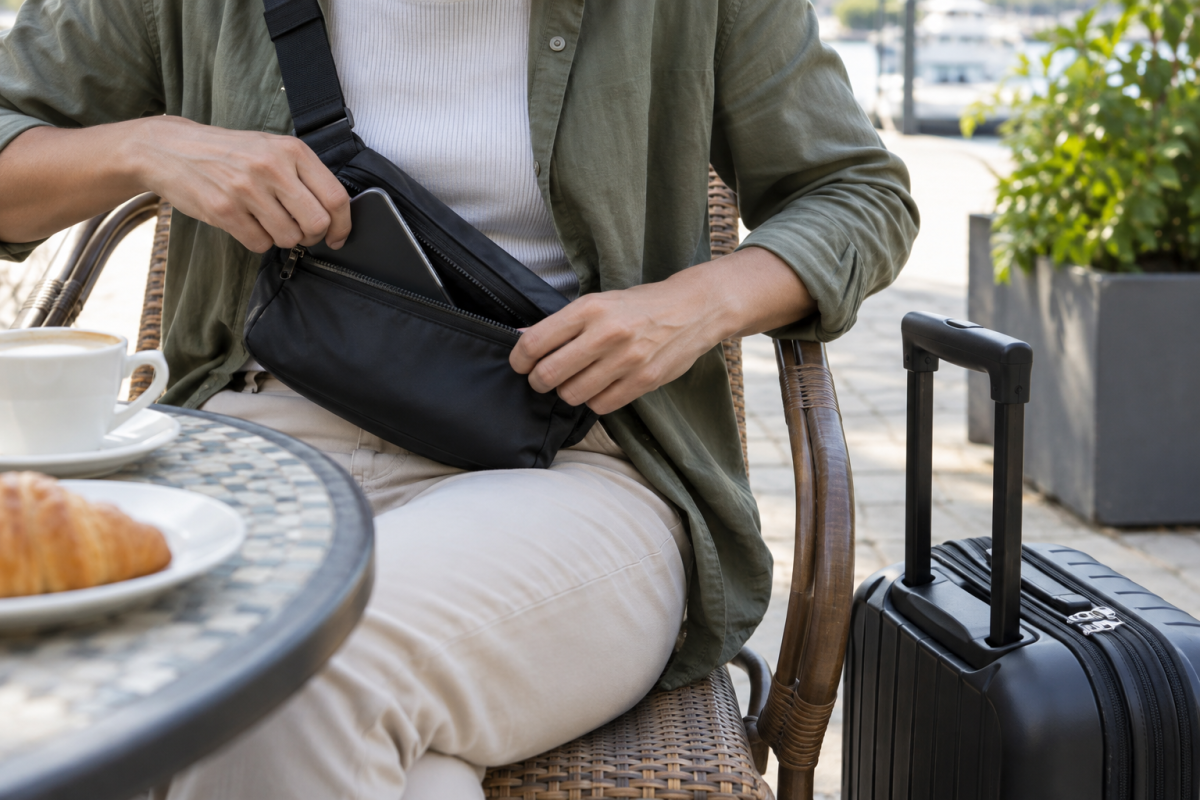
Busy stations, public transport, queues and major attractions are convenient places for pickpockets because people are distracted. Keep bags closed, avoid displaying expensive items and do not hang a phone or handbag over the back of a café chair.
Common distractions include someone bumping into you, asking you to sign something, offering unsolicited help or creating a commotion while an accomplice reaches for your belongings. You do not need to become suspicious of everyone; just pause before letting a stranger occupy all your attention.
10. Use licensed transport
Use official taxi ranks, recognised booking services or transport recommended by your accommodation. Confirm the vehicle and driver details before getting in, and share the journey when the service offers that feature.
Seatbelts and suitable child restraints matter abroad just as much as they do at home. If you are hiring a car, check local driving rules and inspect the vehicle before leaving the depot.
11. Check weather and natural hazards
Look at the forecast, but also consider seasonal risks such as extreme heat, storms, flooding, wildfire or poor air quality. Follow local warnings and change your plans when conditions make an activity unsafe.
The rain in Spain does not always stay mainly on the plain, whatever the song promised. Weather is not background decoration when you are hiking, driving or taking a ferry.
Staying safe when eating, drinking and going out
12. Check reviews—but read them critically
Recent reviews can reveal repeated problems with an attraction, tour, restaurant or area. Look for patterns rather than treating one furious review as established fact. I use several sources, including maps, travel forums and Tripadvisor, before booking something unfamiliar.
This link may earn us a small commission or referral payment without increasing the price you pay.
13. Keep control of your food and drink
Do not leave a drink unattended or accept an open drink from someone you do not trust. Pay attention to how alcohol, heat, altitude, jet lag or unfamiliar measures affect you. Agree in advance how everyone will get back to the accommodation.

14. Meet new people in public
Meeting locals can be one of the best parts of travelling. If you arrange to meet someone through an app, choose a busy public place, tell another person where you are going and keep control of your own transport.
Be particularly cautious where local laws criminalise same-sex relationships or where dating apps have been used to target travellers. Check destination-specific advice and trust the feeling that tells you something is wrong. You are allowed to leave without being polite about it.
15. Know who to contact in an emergency
Save the local emergency-service number, your insurer’s assistance line, your bank’s lost-card number and the contact details for your accommodation. British travellers can find the nearest embassy, high commission or consulate through the UK government’s embassy directory.
If something is stolen, report it locally and obtain a reference or written record where possible. Contact the relevant provider promptly rather than waiting until you return home.
The most important travel safety tip
Preparation is there to give you confidence, not to convince you that disaster is waiting outside the hotel. Research the genuine risks, make a few sensible backups and then enjoy the trip.
For help turning the rest of your ideas into a workable holiday, read my step-by-step guide to planning a travel itinerary.
What are your best travel safety tips?
Comment below and let us know!
Did you enjoy this article?
Share it with your friends and family on Facebook, Twitter and Pinterest.